As a bee seeks nectar
from all kinds of flowers,
seek teachings everywhere.
Like a deer that finds a quiet place to graze,
seek seclusion to digest all you have gathered.
Like a lion, live completely free of all fear.
And, finally, like a Wild one, beyond all limits,
go wherever you please.
—Chogyal Namkhai Norbu
I woke this morning to be reminded of this quotation, before driving (or rather being driven by the kindest of friends) to SFO to begin this journey in the pre-dawn. The timing, like so much in the past days, could not have been more perfect.
The saying doesn’t originate with the great Tibetan Dzogchen teacher Namkhai Norbu Rinpoche. He goes back to the tradition and rephrases an existing insight, or rather, as I read it, a pair of insights: first, that we should see all of life as our teacher and be open to the lessons complicated and constantly shifting causes and conditions have to teach us, no matter where we are—in places sacred or secular, holy or mundane; and second, that we should look to others with whom we share this planet—non human animals, neuro-divergent humans, to name two—as indispensable teachers as well.
I love the rapid recital of the teachings the creatures in these lines have to offer, each according to its nature. The bee ranges, finding nourishment and wisdom where it may, not overstaying in any one place and exhausting the available resources. The deer literally “digests” experience, seeking silence and solitude to metabolize what it draws and has drawn from its surroundings—a practice that takes time and requires a kind of retreat from the world. The lion, in the shortest of monosyllables, is privileged to live free from all fear. How might each of us tap into that place that, Rinpoche, insists, also exists in each of us? And finally the “Wild one,” sometimes called a “Madman,” both transgresses existing boundaries and transcends them through the pure force of his or her or their own preference. I love the way, in Namkhai Norbu’s version, we are ourselves addressed as “the Wild one”: “go wherever you please.” With this permission, the permission to roam, we are given both ultimate freedom and ultimate responsibility: go and do whatever you want; never forget the teachings and grow in them constantly.
Before COVID, I spent a fair amount of time “going off to dusty lands to practice,” as Dogen Zenji would say. Dogen specifically suggests that we not do this—that we instead stay home and see what we can learn about our practice from the midst of our quotidian lives. I ignored him, and in so doing I learned and saw much in the wide, wild world. Yet when COVID hit, I found myself, like so many others, pinned in place, in a reduced and sometimes claustrophobic world that eventually reduced to a few blocks around the house where I live, where I sheltered in place with my beloved young dog, Qinu. My world, and Qinu’s: our house, now also my office. The small practice studio I am so fortunate to have in my tiny backyard, where we started each day, sometimes fearless, sometimes paralyzed by fear. The blocks around our house, the beach we walk to every morning to watch the sun rise, the trails in our beautiful county—although even there, only the handful of trails on which Qinu and I could walk together. The handful of backyards opened by people I love to gather and maintain basic human (and canine) contact. The friends with whom, every few days, we would take a walk. COVID was a radically shrunken and often a spectacularly solitary experience … except in all the ways it wasn’t.
I noticed, as many others have noted, that as my world shrank, it came into ever sharper focus. Walking to the beach every morning, people who had passed each other for many years before slowed, acknowledged each other, eventually risked a greeting, possibly even a name. I started noticing the gardens we walked by on our way to the beach each morning—this plum tree, that jasmine, each unique and particular. Squirrels, neighborhood cats, and perhaps above all, birds: each one in its own-being, came forward to announce themselves, and, in not a few cases, to expound the dharma. I may or may not have been seeking teachings, but everywhere, they appeared.
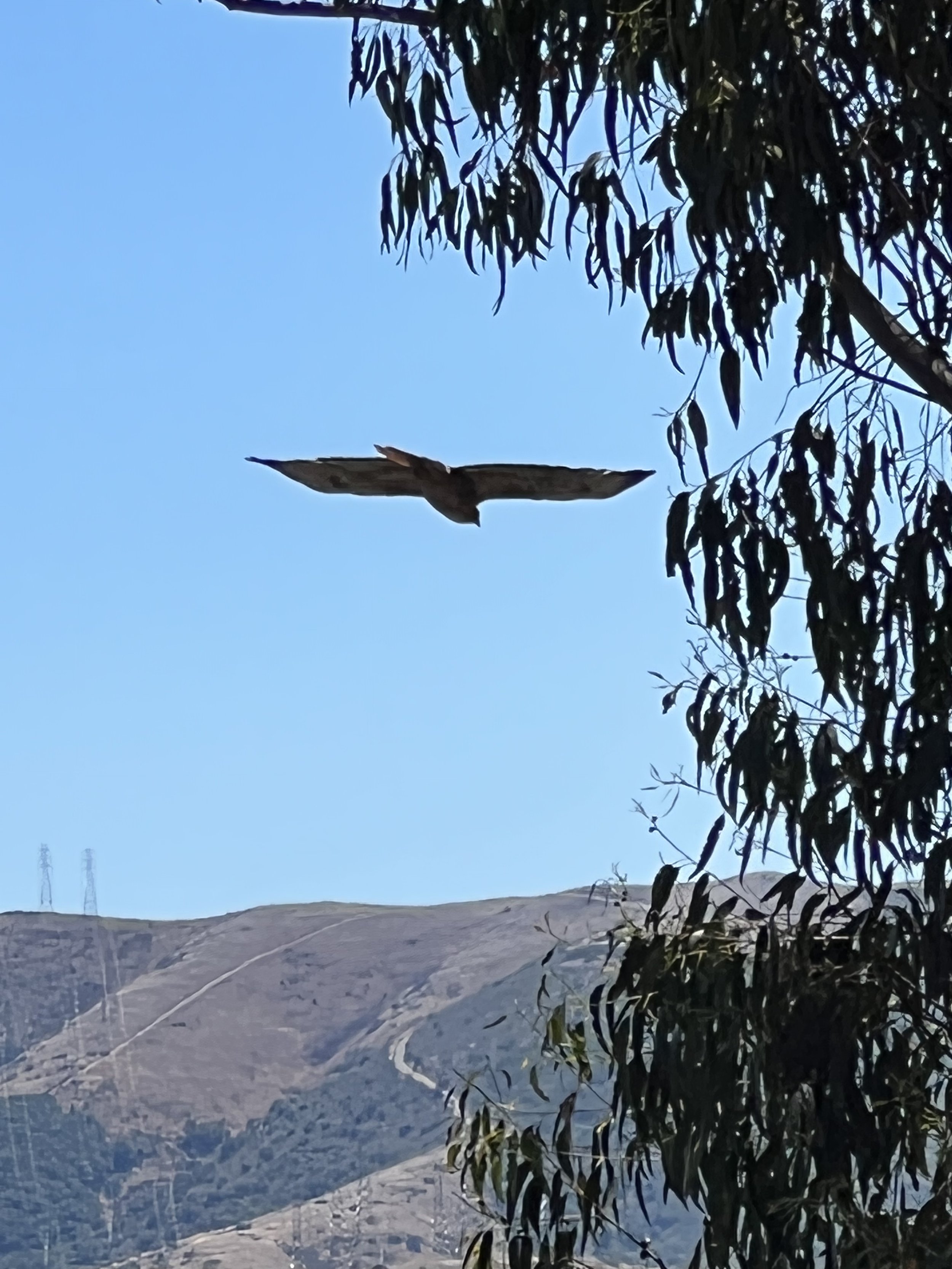
For reasons I’m still not sure I have begun to understand, among all the other teachers who freely offered themselves to us in our little world over the past two and a half years, the raptors were the most present, the most demanding of particular attention. Every day, walking in the morning or the evening, driving near or far, birds of prey (and others) appeared everywhere. Lighthouse Field, the coastal campus, Highway One, West Cliff itself—suddenly there were hawks, falcons, owls, and kestrels everywhere. Pausing to notice them became one of my great joys during this period—we might have a “one hawk morning” or a “three hawk day.” But looking, and especially looking up, and finding these spectacular beings became a solace, a joy, and an encouragement.
I was wondering on the first leg of my journey today: if, Namkhai Norbu Rinpoche-like, we were to put hawks into the litany of the teachers all around us, what might we learn from them? And I remembered the many, many times I saw crows harassing red-tailed hawks, peregrine falcons, little cooper’s hawks, as they flew or ate or just sat on a branch in their morning meditation. I don’t know what the history is here—maybe the hawks steal the crows’ babies or their territory or they’re just too damn pretty. But the crows clearly have it in for them. Yet after months of watching this daily spectacle, I finally noticed something about the hawks and falcons: no matter how many crows come at them, no matter how ferociously they dip and dive or how close they come to smashing into the larger birds, the hawks just sit there, still. Surely if the hawks chose to fight back, they could do the crows some serious damage—but they don’t. At least in 30 months of watching, I never saw one of the larger birds strike back or one of the crows make contact. They would just sit quietly—as though being dive-bombed by a family of crows was just the most ordinary, manageable thing in the world. As though there was no chance the crows would ever hit them. As though stillness was the most powerful lesson in the world.
I’m off to the dusty lands again, but I’m carrying a host of new and homegrown teachings with me—plum teachings, coyote teachings, and above all, raptor teachings. I’m hoping to bring along a fraction of that stillness, when things get difficult or frantic as I’m moving through the wild world. I’ll be bringing deer teachings, lion teachings, bee teachings, raptor teachings—and perhaps above all, Wild one teachings. What freedom, what responsibility, to go wherever I please. May I be worthy.
 Walking and Praying