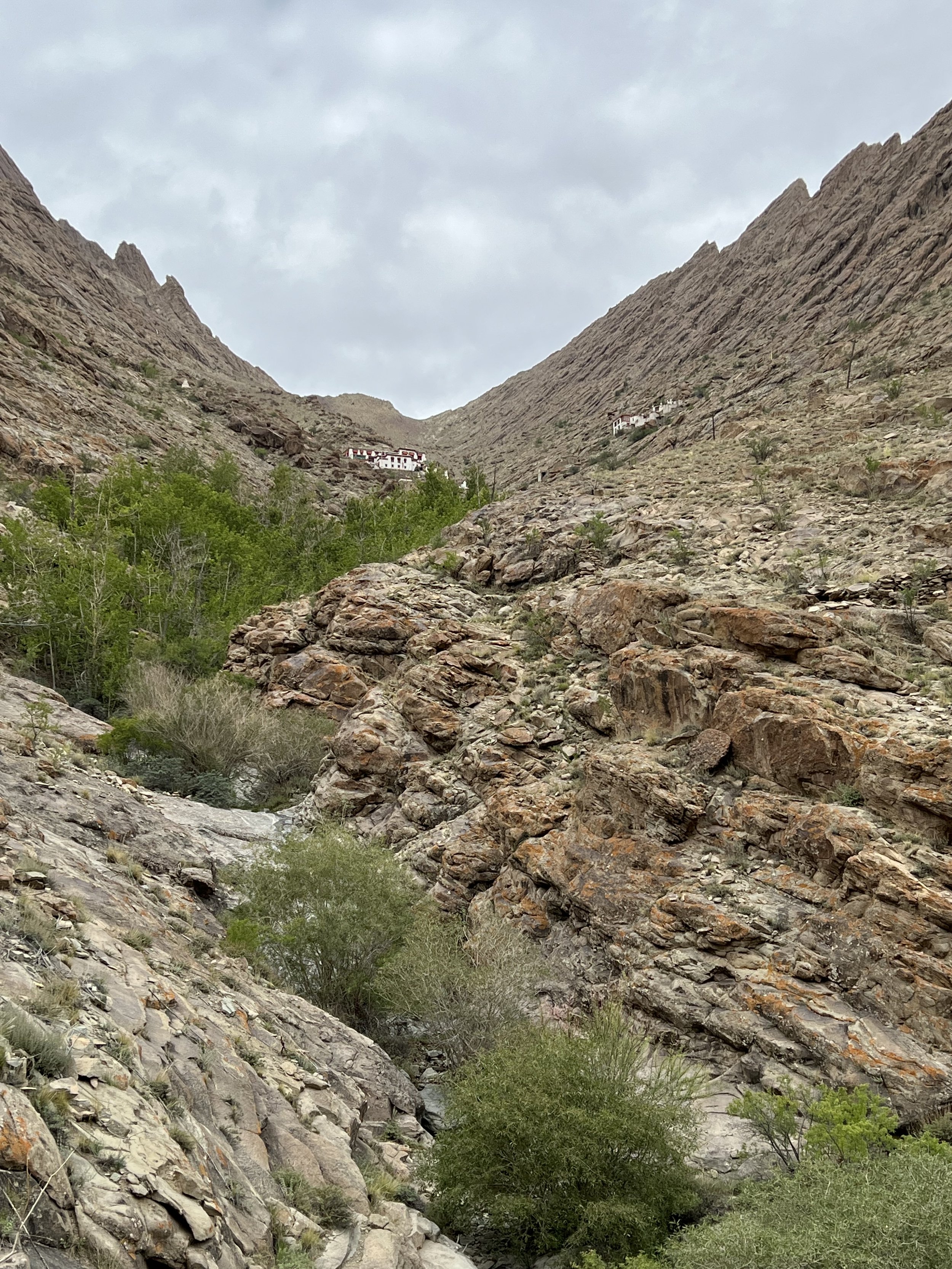
Today began with a walk up to Gotsang, a hermitage about two kilometres above the most resplendent monastery in Ladakh, Hemis. Where Hemis is a bustling maze of buildings, temples, schools, mess halls, and residences, Gotsang is a silent and striking retreat nearly hidden in the rock walls of a nearby valley. At the center of the hermitage is a large cave where the 13th-century meditation master Gyalwa Gotsangpa is said to have meditated for many years until he attained awakening.
To get to Gotsang, you walk away from the Hemis complex, past construction sites, residences, and lots and lots of dogs. We heard children outdoors chanting, and saw impeccably dressed young monks forming perfect lines and reciting the chant in full-voiced unison. As we began our walk along the creek bed away from the monastery, their voices went with us, intermingled with the sound of rebar being cut and the voices of many birds. Soon the sound of the stream took over.
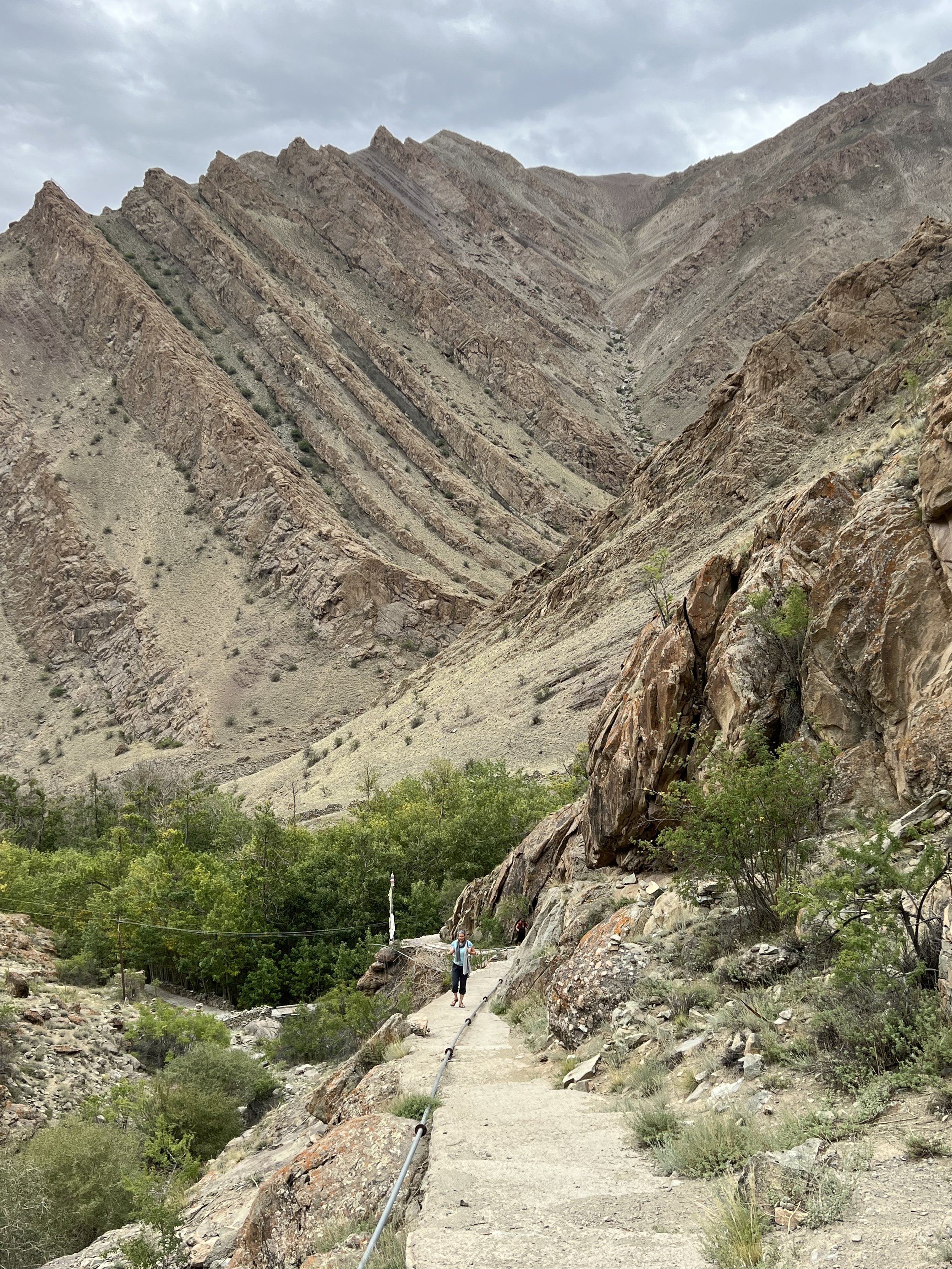
About ten minutes from the main complex, the trail emerges from willows, leaves the stream, and takes a hard right up one of the most striking mountain valleys I have ever seen. The rock is purple, and it emerges from the earth in layer after striated layer at an angle of 45 degrees. Behind you there is a V-shaped wall, ahead of you and to either side others. It feels like nothing so much as being grabbed by a rough hand and pulled into the heart of the mountain.
Nothing could be stranger than the feeling of being just a half hour’s walk from the Vatican of Tibetan Buddhism in Ladakh, a place of ceremony, festival, ritual, study, and rank, and this small retreat center tucked into a perilously steep mountain wall. Just a handful of monks live at Gotsang. They elect to go there for three years (at least) of intensive practice, primarily to learn the yogas of Naropa. These six esoteric practices have been going on in that place unbroken for 800 years. The most well-known of the practices is Tummo, the cultivation of inner heat. Advanced practitioners are said to be able to sit on the ice of the river that runs through the valley in Winter in wet robes and dry them. Some years ago His Holiness the Dalai Lama, concerned that these ancient practices were no longer afforded sufficient respect, allowed a small group of witnesses to observe the Tummo practice. Suffice it to say, credibility was restored.
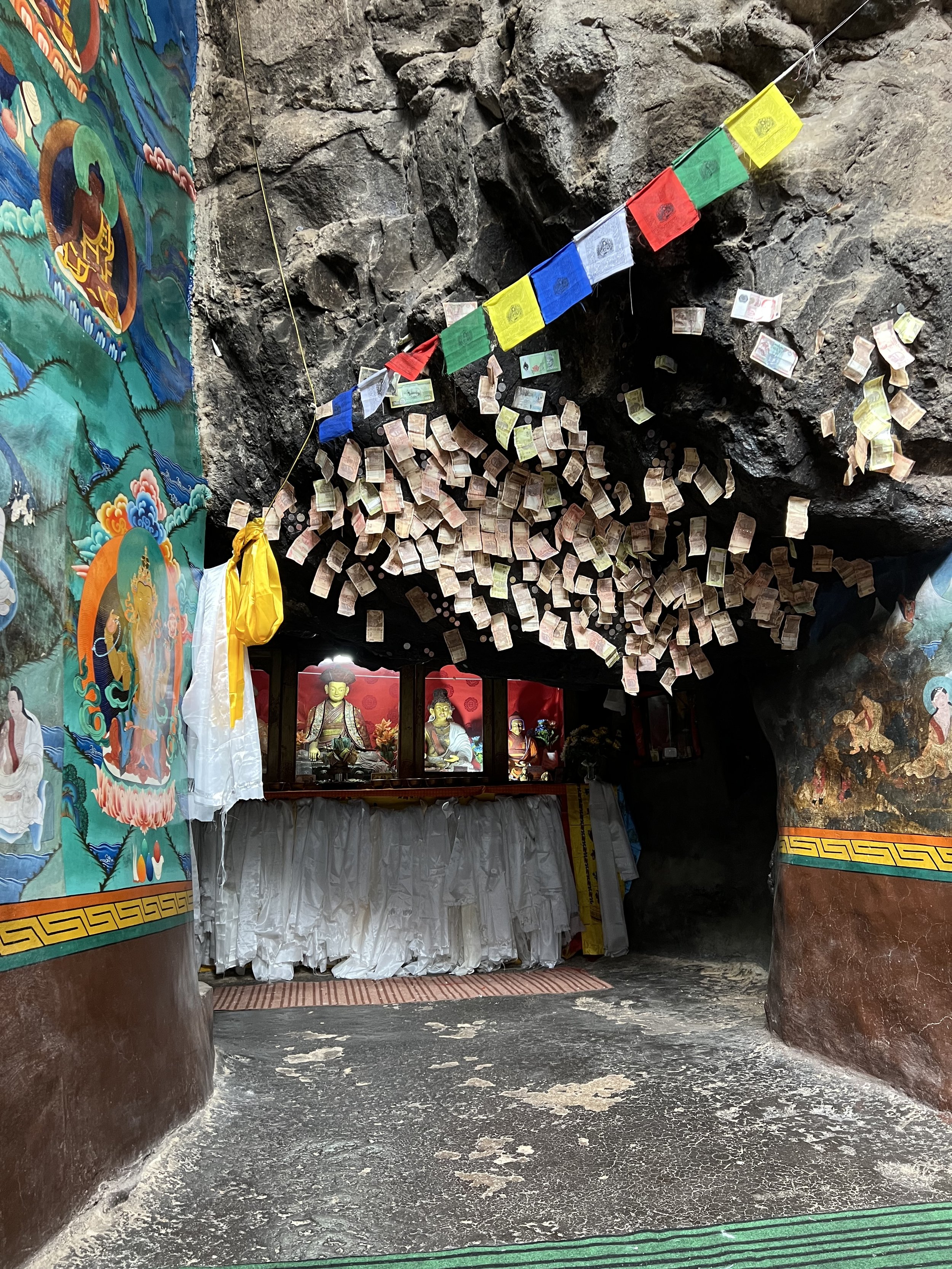
Gotsang’s cave is a surprisingly beautiful space, covered in offerings from those who visit there. The cave is now housed within a building, and the walls of the little temple are covered in bright paintings of sages and practitioners from the past thousand years. Sunlight streams in through windows high in the walls. It’s hard to imagine what this cave would really have been like for a practitioner alone on this mountainside for year after year, foraging for food and creating what heat he could from a small fire, breaking the ice to get water or scraping ice from the walls of the cave itself.
For reasons I don’t fully understand, today felt like the first real day of this pilgrimage. Perhaps it was the effort it took to make it up the mountain, breathing hard and, as I do every year, wondering if it’s too soon to make the journey up the steep path and over 13,000 feet. Perhaps it was the threat of rain throughout the day, the feeling of being exposed in a wild landscape, in danger of a good soaking. Perhaps it was not knowing whether the monks would welcome us, as they did, warmly and with tea, or, as they have in other years, by offering us five minutes in the cave and asking us to leave.
I think maybe it also felt like the start of this pilgrimage because of an accident of history. I couldn’t stop thinking while I was in the cave that while Gotsangpa was meditating in this cave, making his fires and eating his roots, sitting in the cold and wind, just trying to wake up, Dogen Zenji, the founder of the Zen lineage to which I belong, was building temples, writing beautiful and elaborate philosophical essays, and outlining the fundamentals of a monastic life in the Soto Zen tradition in Japan. At the heart of Dogen’s Zen, of course, is “just sitting,” which is at least part of what Gotsangpa was doing up in his cave—though he was doing many other things besides, things the Zen school would not have much to do with.
I also thought a lot about Tassajara, the mountain monastery where I have practiced and which I have called my practice home for 20 years. I had never really noticed before that it, too, is tucked into a sharp V in the middle of a mountain range, almost hidden from passersby. It, too, is at the end of the road. And it, too, is a place where people come to practice alone together and try to wake up in the middle of a landscape that seems to most people ridiculously harsh and singularly uninviting.
Yet what Dogen Zenji calls the mountain training—the training we receive both in and from the mountains—can be many things other than harsh. It can clean the spirit, return us to our creaturely nature, strip away pretense, and wake us up to our capacities. It can connect us to an inner heat that may or may not dry wet cloth on a winter’s night, but which, once found, can be a powerful source of energy, awareness, and generosity of spirit.
As different as Gotsang is from any place I have practiced, or any place I probably ever will, I was grateful to make the first true stop on my pilgrimage in a place that inspires immense respect, awe even, and yet with which, somehow, I feel a deep kinship. I was particularly moved by a very old painting of Milarepa, the Tibetan poet and meditator who is famous for his many years practicing deep in the mountains. He is often shown with a hand cupped around his ear, because he is taking teachings from the animals and plants and rocks around him. He is also known to have preached to these beings with whom he shared the landscape. In this particular image, a dog is curled near his meditation seat, and some animals have come to hear the teachings. He is thoroughly engaged with his environment, yet somehow fully attuned to the dharma. This is the mountain training.


 Walking and Praying
Leave a comment