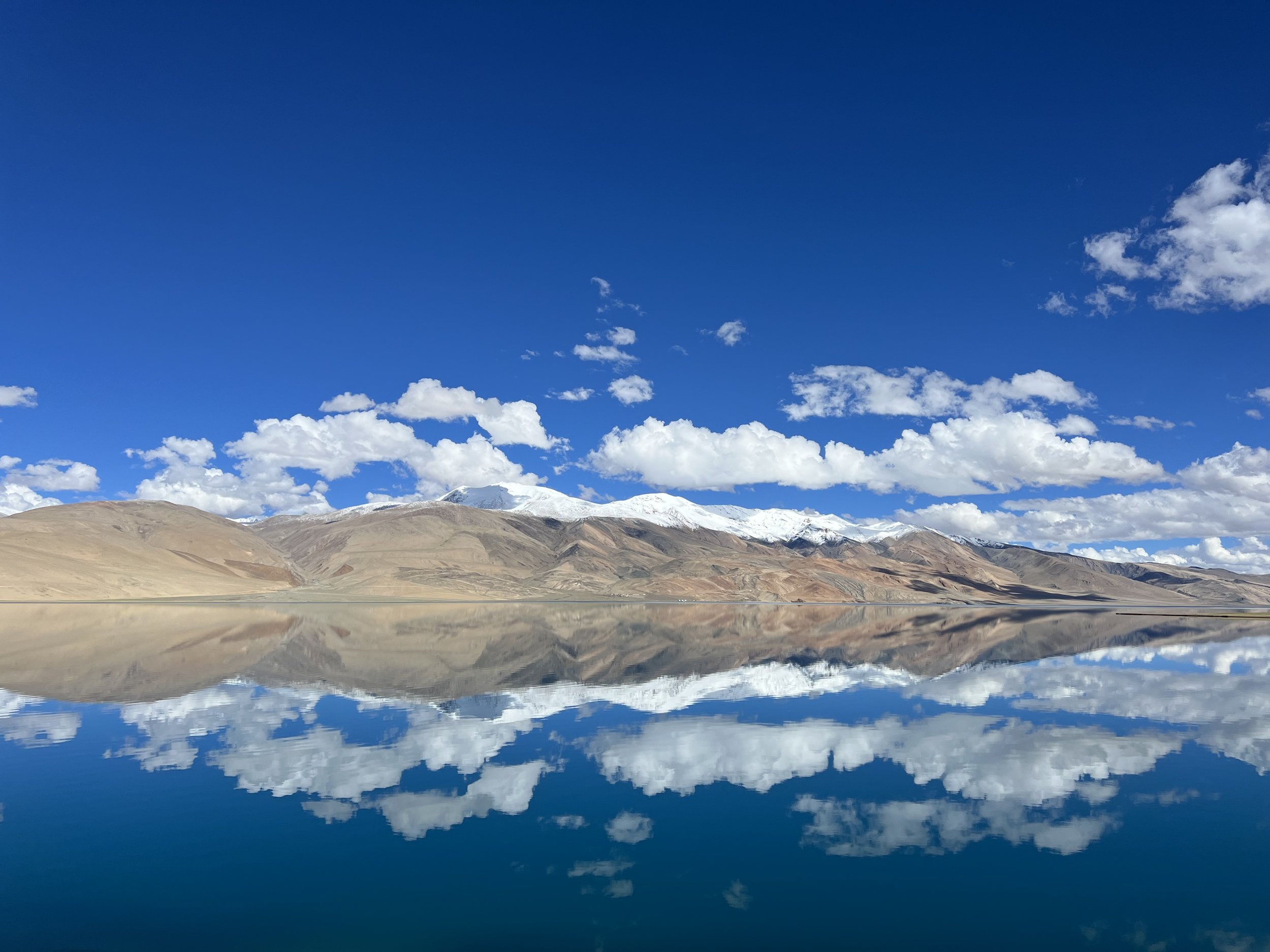
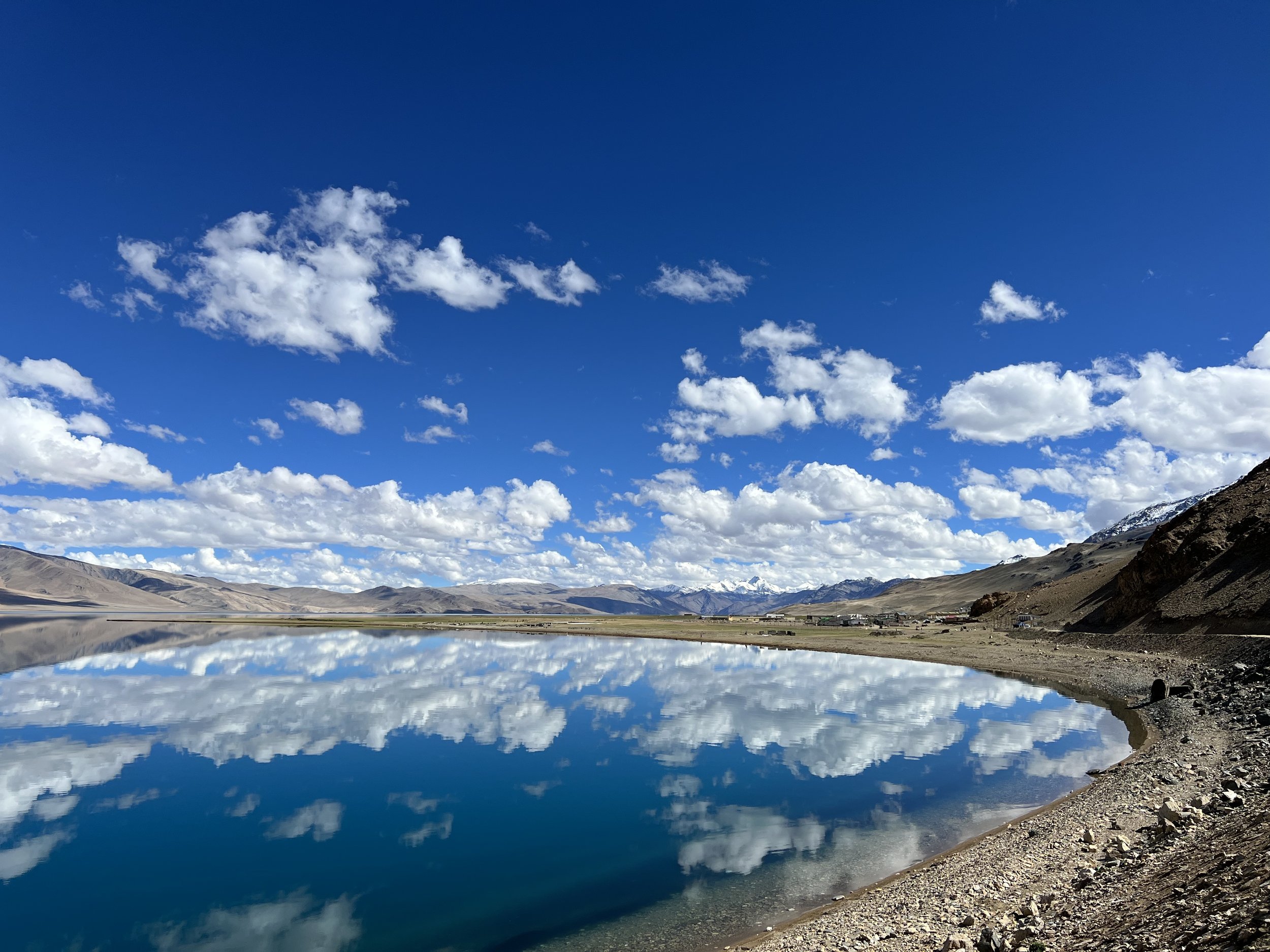
After a six hour drive that included numerous adventures, not the least of which was joining a long line of cars and motorcycles navigating their way through a 4-foot deep rushing side-channel that had burst its banks, we arrived at Tsomoriri, a lake on the Tibetan plateau (Changtang) that constitutes the culmination of my annual journey with guests in Ladakh. As we pulled up to this sacred lake, the driver, Dorje, stopped the car and jumped out, saying, “photo: reflection.”
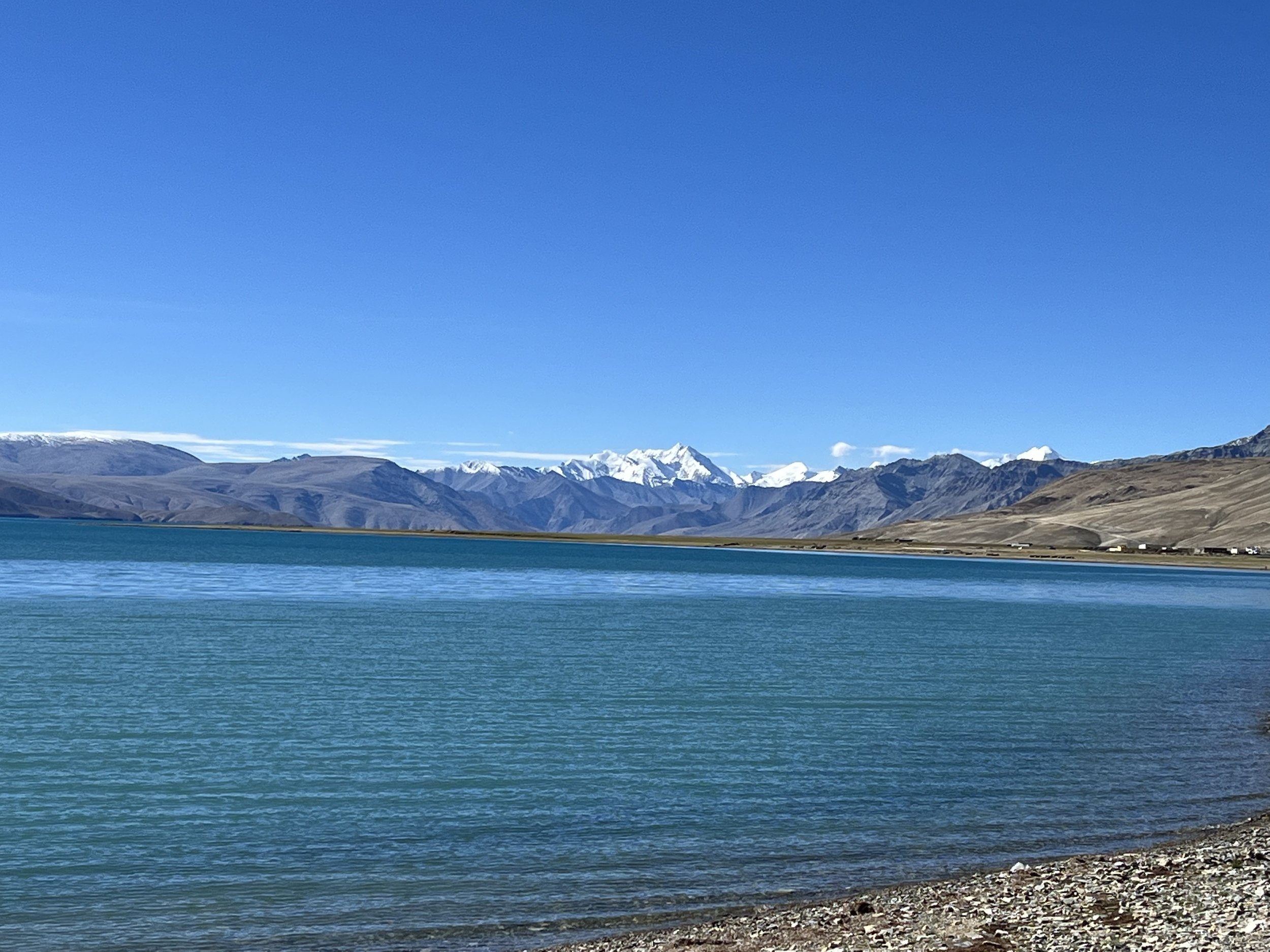
It was about 4pm, and the sun was hitting the crystal clear water of the lake at just the right angle to capture every one of the surrounding peaks, as well as the clouds above, in perfect symmetry. If you stare at this phenomenon long enough, long experience tells me, you’ll begin to wonder which way is up and which is down, which is the sky and which the substance of the lake’s two mile deep waters. The lake becomes a perfect mirror, not just reflecting but becoming completely unified with the mountains and sky above. You almost begin to wonder if there are mountains and clouds in a second world under the waters of the lake, which perfectly mirror the world here above. If the words don’t make sense to you, skip below to see some images of what it is I’m imperfectly attempting to describe: a pure mirror, without distortion, vast as the sky.
In Tibetan Buddhism, five kinds of wisdom are enumerated, which, in the more orthodox strains, are described as arising spontaneously when the mind is purified of common human afflictions of thought and feeling and the primordial or “natural” mind is able to arise, cleansed of its attachments and delusions. In some traditions, including the Bon tradition in which I have studied for some years (as well as in the Zen tradition, as I understand it, though the terms are slightly different), we are all said to have access at different times to these varieties of wisdom, although our access is intermittent and must, in order to be stabilized, be cultivated carefully through a lifetime of practice.
The second kind of wisdom in these traditions is known as “Mirror-like wisdom.” This kind of wisdom might best be described as the capacity of the world and the wise beings around us to reflect our minds back to us without distortion, if we are willing to notice what we are putting forth into the world and what is coming back to us. If we see a beautiful flower and our first impulse is to grasp and pick it, and if we pause long enough to notice this acquisitive, grasping response, the flower has the capacity to teach us something about our own tendencies, without having to scream as it’s cut and without giving us a lecture or slapping our hand away. Mirror-like wisdom is thus deeply relational, requiring not only the non-reactive nature of the world but also our own desire to notice and learn about, learn from, the imperfect nature of our own minds and actions as we navigate our human lives and interact with the beings around us.
A good teacher—and I have been blessed to have many—can also, of course, be the possessor of this mirror-like wisdom, helping us tirelessly to see the nature of our own messy minds, but doing so without judgment or attachment to making us or our minds any different from what we are. Through working with a skilled teacher, we can become more aware of and perhaps even transform our own tendencies, such that we exhibit fewer of the propensities toward ignorance, greed, hatred, and delusion that make of our human lives such a scene of misery and discontent. The extraordinary thing about such a relationship with a teacher, however, is that it requires an enormous amount of non-interference and just witnessing on the part of the teacher; they can’t just tell us to fix our minds and expect that anything will come of it. It’s only through beginning to cultivate awareness of our minds in the presence of a clear mirror that we can begin to transform in a way that is truly lasting—to cause less suffering and also, importantly, to suffer less ourselves.
What makes such a clear mirror? My Bon teacher Tenzin Wangyal Rinpoche insists that the qualities of stillness, silence, and spaciousness are the requisite attributes of any mirror that does not distort. Through their own long practice, our teachers develop these qualities so that they can fulfill their Bodhisattva vow to save other beings from the folly of their own self-imposed delusional tendencies. Just as some humans can develop the capacity to become clear mirrors, he insists, the world itself can and ceaselessly does act in this way: “the world, the whole universe is a mirror for us,” a constant, generative and generous opportunity to learn from and transform the nature of our own minds, should we wish to accept the gift of waking up that is offered to us at every moment of our experience.
When people tell me they would like to journey to Ladakh, one of the first things I say is that Ladakh is a place that has the capacity to show us who we are, if we want to know. Of course, if we are not curious about understanding ourselves and our particular contributions to our own suffering and that of others, then we know a thousand fine schemes and distractions and justifications to avoid whatever truth or understanding there is to be had here. But if we do want to know, if we are hungry to wake up and to suffer less and to cause less suffering, I know of no place with so powerful a capacity to reflect us back to ourselves with a minimum of distortion.
It had not occurred to me, at least until this most recent trip to Tsomoriri, that what I really mean when I say this about Ladakh is that this place is characterized, at least in my understanding and experience, as a quintessential fount of mirror-like wisdom. It makes sense, of course, that Ladakh in general and the Changtang in particular should have this particular wisdom capacity. This is the spot on the planet associated most powerfully with the qualities of stillness, silence, and spaciousness. Other terms used to describe this region, which are also terms used to describe the qualities of natural, undistorted mind, include clear light, boundless space, vast emptiness, and pure luminosity. Standing on the Changtang looking through the turquoise waters to see every stone outlined in its precise particularity below, or looking up at the clouds shifting and reforming over and over again without pause, I cannot help but feel the presence of these qualities of light, space, and awareness all around me. Every small action I take, every noise, even the movements of my own mind, do feel as though they disturb the silence and stillness, but in that disturbance I am able to see and reflect on my impact on the world with a unique clarity that is dissipated or masked elsewhere.
So, for me, the mirror-like wisdom of Ladakh and of the Changtang, while not always entirely comfortable, are the great teachers of this place, and are a large part of why I keep returning. I pray that with each visit I will carry with me fewer delusions, that I will create less harm, and that I will disturb the stillness, silence, and spaciousness of the place as little as possible. Sometimes the manifestation of this aspiration is incredibly mundane—picking up an empty plastic bottle tossed carelessly aside, walking as quietly as possible in the silent pre-dawn, greeting the other visitors and locals—human and non-human—in a way that manifests warmth without needing them to verify or authorize my presence in this faraway place. Other times, the aspiration is much deeper—to try to be for others what this place and my teachers have been for me: a “mirror of emptiness,” as Tenzin Wangyal Rinpoche says, in which we can together see “the ceaseless manifestation of conventional truth” that keeps us from residing in the peace and profound joy of our original nature.
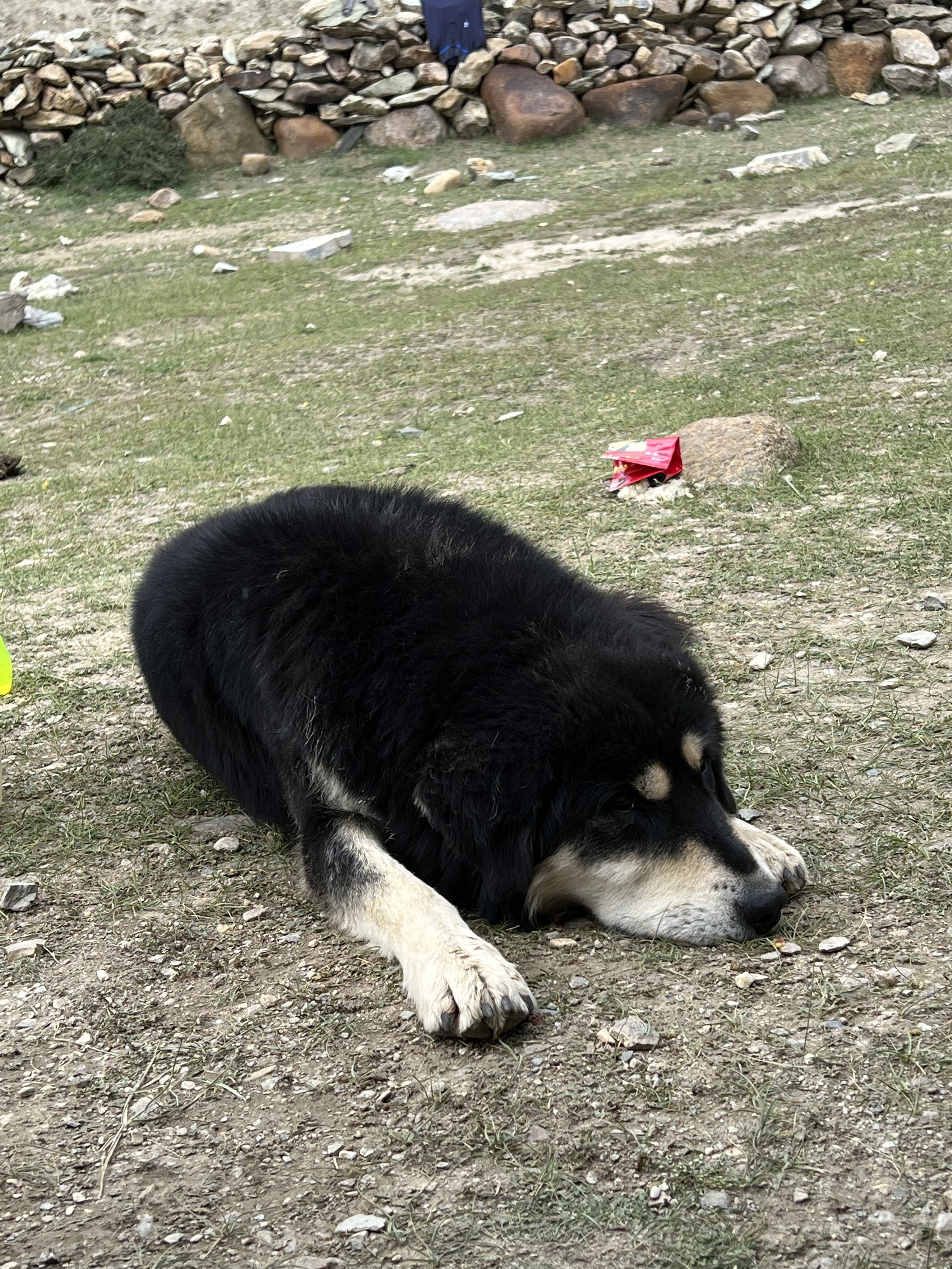
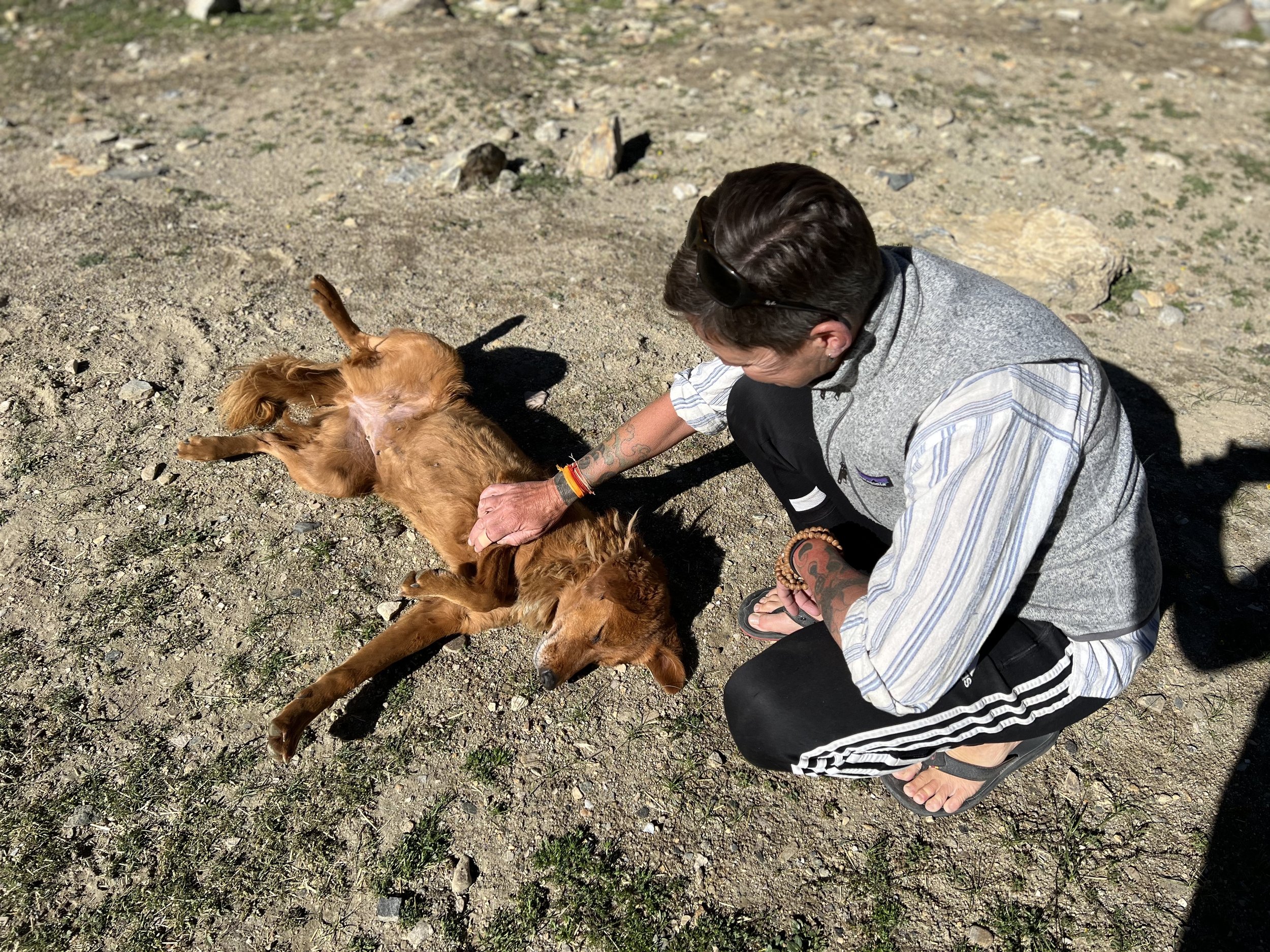
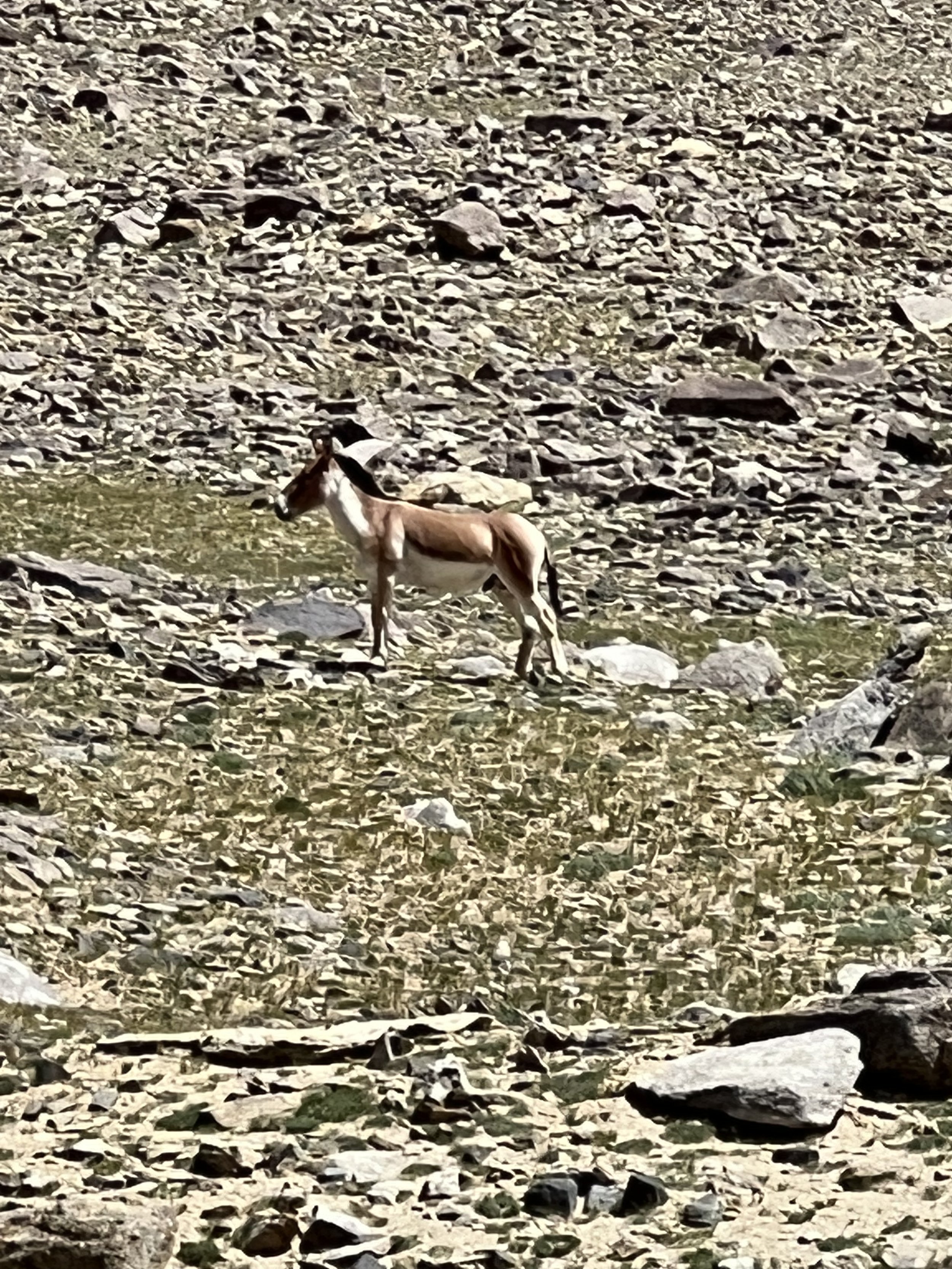
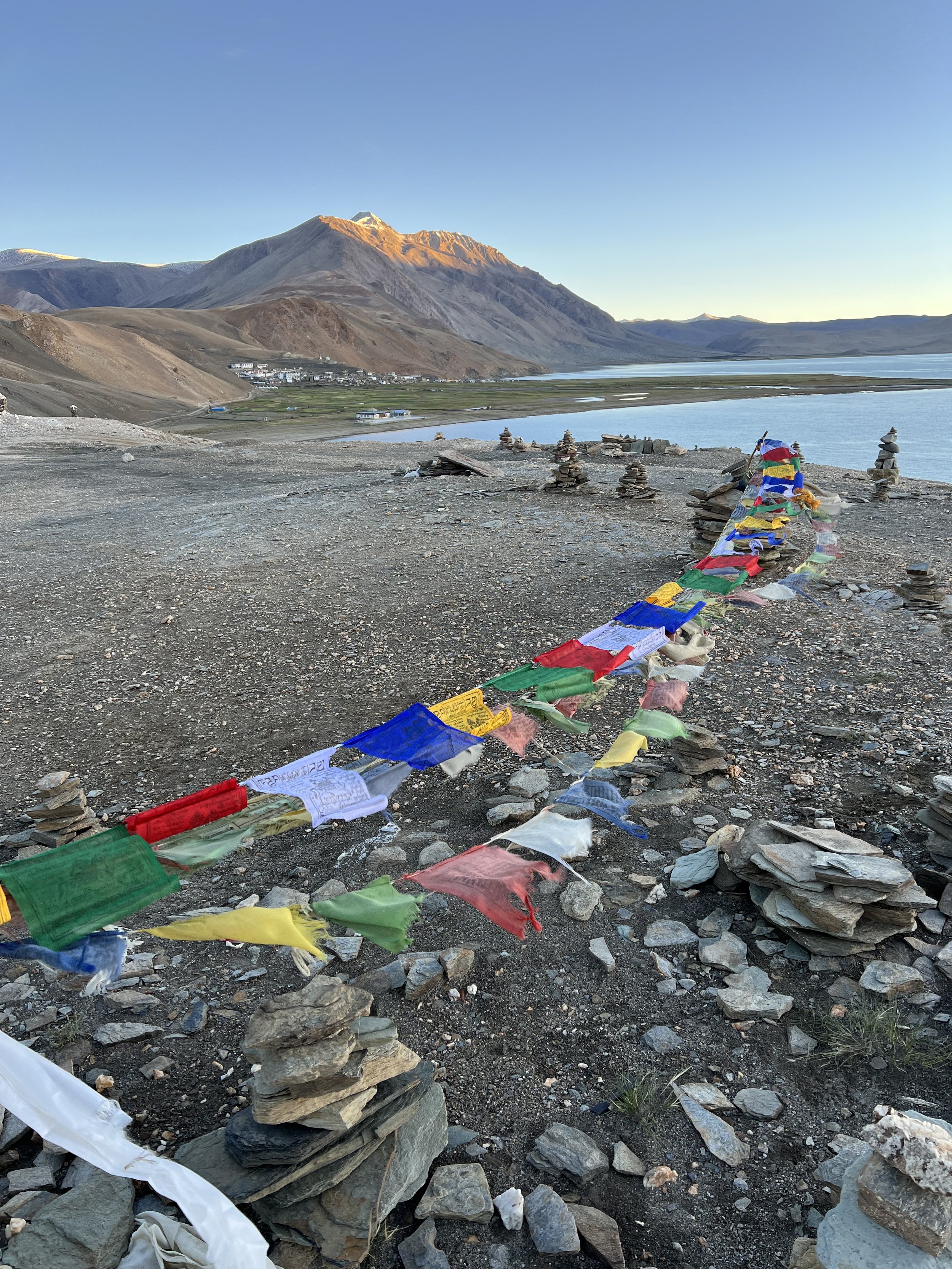
In listening back to some of Tenzin Wangyal Rinpoche’s talks on mirror-like wisdom, one phrase really jumped out at me. He insists that if you are to be a clear mirror for others, you must cultivate “the mirror of spaciousness of your open heart.” Ladakh is a place—a vast and spacious place—that opens my heart continuously and relentlessly. I weep rounding the corner to see Tsomoriri for the first time in three years, having left with no idea how long it would take me to return. I laugh as a young ChangKi, a Tibetan mastiff, plops himself outside the food tent and won’t budge for two days, yet, in his pride and magnificence, never begs or solicits. I fall in love with a small and astonishingly sweet red girl dog, who lands herself in our camp and does nothing but beg and solicit, while also fiercely barking when anyone or anything tries to enter our camp. I weep again when I see, finally, a herd of Kyang, the Tibetan wild asses that are some of the most potent beings to grace the Changtang, many of which have fled South as the pristine lands of the plateau have been developed through military installations and motorable roads. I get up at dawn and trudge to a high place to tie prayer flags in the spirit of vow to what is arising in my life at this time and to where it may take me in the future. And I gasp in awe as I jump out of the car at Dorje’s urging, to see the crystalline waters of this great and ancient mirror-lake in the morning light, as we drive away.
The Zen name I was given in 2005 has two parts. The first, I was taught, is a kind of description of where you were in this life when you came to practice. My first name is Shogen, Auspicious Source. The second name, though, is aspirational: it’s the name that captures what you might become, with dedicated and diligent practice of the way. My second name is Enkyo, Complete Mirror. This most recent journey to the Changtang prompted deep reflection on this name-to-aspire-to, a name I have never really considered carefully until this time of pilgrimage, not least because, if and when I finally arrive in Japan, Enkyo will be the name I give should anyone ask my dharma name. Unlike in the US, it is the second name which a practitioner gives to introduce themselves and to which they must then respond—a seriously humbling thought.
My time on the Changtang allowed me to remember and generate gratitude for all the ways I have been prompted, prodded, and pushed to clean the mirror of my own heart, as another of my teachers, Krishna Das, would say, during the decade I have been coming to Ladakh and the decade of practice that preceded it. And yet my time on the rooftop of the world also allowed me to see clearly and without judgment the work that remains to cultivate a heart sufficiently, continuously, reliably open that it can be a mirror of awareness for others. As is invariably the case, I returned from the Chantang in equal measure amazed, grateful, moved, humbled, and inspired to keep learning and to keep opening my heart into and beyond the wisdom of this place.



 Walking and Praying
Leave a comment