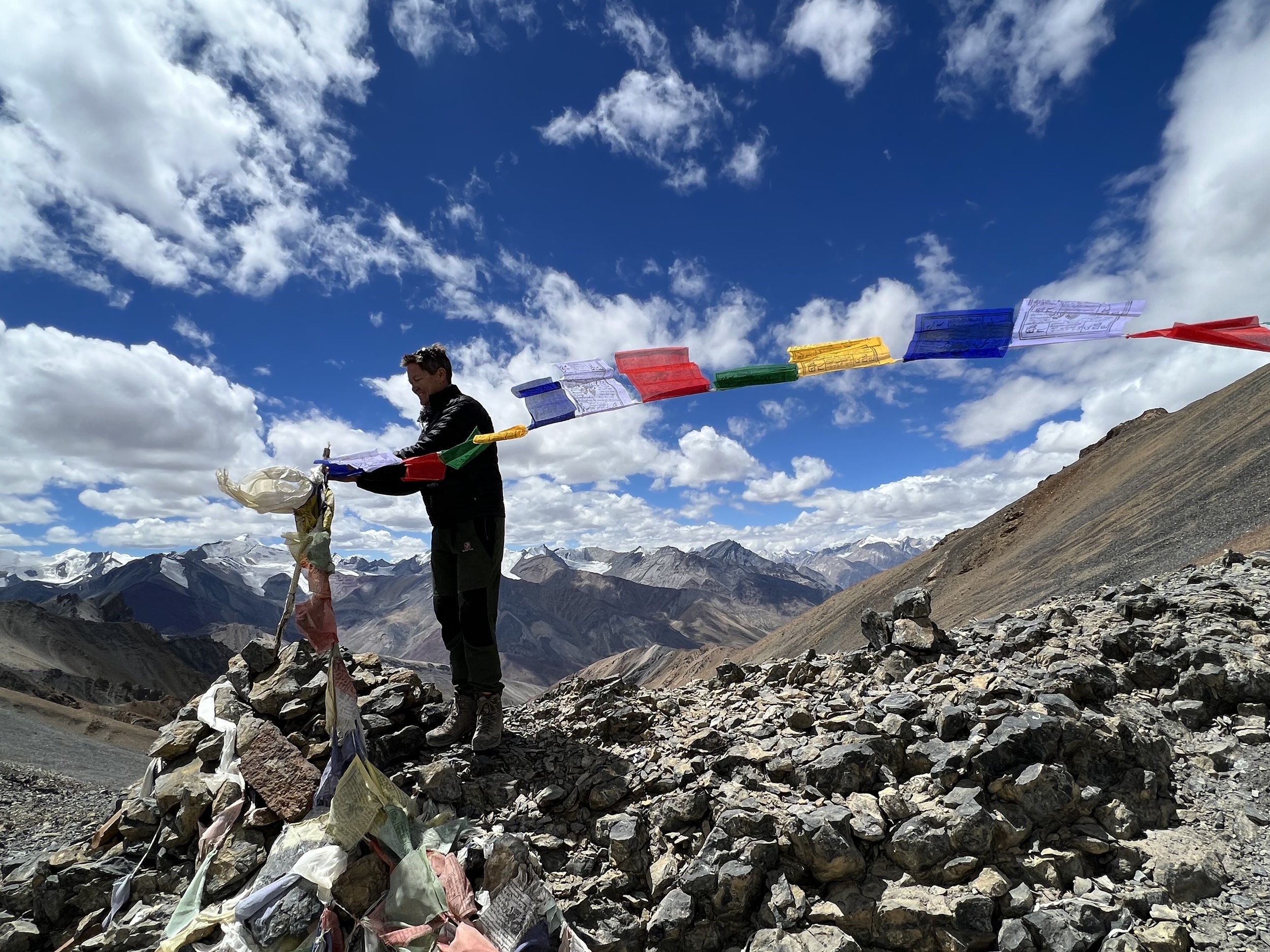
I set out on this four-month journey with some pretty high-level questions, which I recorded in an earlier post. At least in the most recent portion of the journey, however, a more immediate question has been on my mind as i walk and contemplate and rest and pray: what, exactly, is the “mountain training” to which Dogen refers when he writes, yama ni kufu nari, “this is the mountain training”? And more generally, I guess, what is the mountain training to which I have committed so much of my life since I was 20 years old, and from which i apparently believe i still have a great deal to learn?
In part, my preoccupation with this topic has been influenced during this long, 18-day trek, by the fact that I have been reading a new (though sadly posthumous) set of essays by the brilliant and for me hugely influential late writer and naturalist, Barry Lopez. The book bears the luminous title, Embrace Fearlessly the Burning World. I could not recommend a book about these times and about how to live in this world as an ethical being—especially one trying to develop the capacity for Tsewa, open heartedness, in the midst of the mess or messes we find ourselves in—more highly. One quick note regarding content: the book has a few references and one full essay on the topic of the sustained sexual abuse Lopez suffered as a young boy at the hands of a family acquaintance. I believe the essay is one of the most potent descriptions of living on after and ultimately healing late in life from early life sexual trauma; nonetheless, it may prove too distressing for some readers.
I first became acquainted with Lopez’s work when I was in my early 20s and moved to Alaska to try and find a way to live a happier and more thoughtful, upright life than I had previously selected for. In one of the most unlikely choices of my life until that time, I became a student and later an employee at an outdoor school that kept me in the mountains of Alaska for months at a time. While I was certainly no natural at outdoor living, let alone at being in a tightknit community of 20 or so people thrown together and mutually dependent for a month at a time, I knew there was something or some things that I badly needed to learn and i stuck around long enough to at least begin to sense what those things were, even if i only scratched the surface of the learnings in those years.
When I think back on those days, I do not remember a lot of detail, but one thing stands out for me still to this day, and perhaps not coincidentally it is also something I have heard people say about monastic life. One of the things that I found so relieving and i would now even say therapeutic about life in the Alaskan wilderness was the radical presence required to survive and remain even moderately comfortable. To put this another way, the way I put it to myself at the time, what was new and revolutionary for me was the necessity of doing only one thing at a time. If you went down to the kitchen to cook dinner for your tent group, it took every ounce of concentration not to knock the pot off the little stove, or overcook the noodles, or leave the kind of mess a bear would enjoy finding. Keeping your few dry things dry, contriving a way to make your wet things dry again, keeping water out of the tent, not pissing off your tentmates in the process: these were a full time job. Distraction or any attempt to multitask or find a shortcut came at a high cost in terms of discomfort of one kind or another.
One thing I do remember is that I found immense relief from what had been a lifetime of extreme anxiety by being forced to show up for what i would now call the direct experience of living in an uncompromising environment. I had to learn, perhaps for the first time, in Lopez’s terms, to attend. In fact, in one of the essays in the new volume, Lopez sets down this doctrine of attention and attending in the form of a kind of Rule for those who wish to live well in the mountains and also not in the mountains:
“ Perhaps the first rule of everything we endeavor to do is to pay attention. Perhaps the second is to be patient. And perhaps a third is to be attentive to what the body knows.”
Of course, this rule of three is actually just one rule: attend, in all the senses of the word. Part of this attending requires getting out of your busy mind and becoming intimate with the wisdom of your creaturely being—attending, as Lopez says, to what the body knows. Using the senses you’ve been given, trusting something other than your noisy thoughts, attuning and entraining to your environment: the first thing the mountain training of the past 30 years (or more now) has given me and continues to give me is a radical lesson in the power of attending in these and related ways.
There is another, not unrelated part of the mountain training that also became much more present to my awareness after reading Lopez’s book over the past couple of weeks. This awareness actually emerged from what I consider to be the most devastating passage in the entire book and one that I have not stopped saying over and over again to myself since reading it. Lopez writes,
“ to survive what’s headed our way – global climate disruption, a new pandemic, additional authoritarian governments – and to endure, we will have to stretch our imaginations. We will need to trust each other, because today, it’s as if every safe place has melted into the sameness of water. We are searching for the boats we forgot to build.”
While there is much to pause over here, and while I could probably consider at length, in particular, the way in which the mountain training has taught me about the necessity of trusting each other, it is the last sentence that I absolutely cannot get out of my head. One of the things about the mountain training is that it requires you to remember what it is you need to do to guarantee a minimum of safety for you and those with whom you travel. You do not forget to build the boats. While any seasoned outdoorsperson knows that there is no way to eliminate risk, part of the commitment that you make, at least if you want to travel well and responsibly, alone or with others, is to predict the risks and to prepare for them scrupulously. There is a kind of outrage for a person like Lopez, who spent so much of his life in the outdoors, traveling well and responsibly, to imagine something so asinine as simply to have ignored the melting of the safe spaces and to have “forgotten” to build the boats necessary to navigate these new and rising waters.
As I think about these two elements of the mountain training, newly brought into focus by reacquainting myself with Lopez’s brilliance and profound wisdom, I notice that one of them has everything to do with the present and the other has everything to do with the future. It might seem impossible to radically attend in the present while also preparing for barely imaginable futures, and yet that is what the mountains demand and that is part of the training they offer.
I knew when I embarked on this journey that part of what I was trying to do was to re-center myself in the present after the juggernaut of the pandemic. But I also know that part of what I am trying to do is to figure out how to orient myself to the kinds of emerging conditions Lopez so concisely summarizes as “what’s headed our way.” How can the mountain training, most broadly construed, help us to show up, to attend, to refuse to ignore the rising waters, to expand our imaginations, to find ways to trust and even love each other, and maybe, just maybe, get to work on those boats we have not yet begun to build?
 Walking and Praying
Leave a comment