On September 1, 2018, I began a trek with my dear friend, Laurence, into the heart of Zanskar. Zanskar is the Southwest region of Ladakh, known for its jagged peaks, abundant rivers and streams, monasteries, villages, and staggering beauty. We began the trek at what was then the end of the motorable road, a single lane dirt track over passes and (literally) through waterfalls and streams.
Our first day had an air of surreality to it. We walked for a few hours and descended into the small village of Lingshed, with a plan to camp near the monastery, or Gompa. As we arrived on the grounds, a monk came hustling out of the Gompa saying, “it’s time for lunch.” Now, I’ve had plenty of hospitality from monks all over Ladakh, but I’ve never been invited to lunch. As it turned out, the entire monastery was preparing for a giant puja, with a fire ceremony to burn offerings of all of the things that grow in the land around the gompa: barley, sugar cane, apricots, and more.
While the story of that puja would be worthy of another entry here, one thing in particular remained with me about that day. The monk who had received us told us that His Holiness the Dalai Lama would visit Lingshed in the Summer of 2021, and he wanted me to promise to return for the event. He asked me three times, until I promised that yes, I would make my best effort to return for the visit of His Holiness. No Dalai Lama or anyone even remotely of his stature had ever visited this remote mountain monastery. It was clear that the monk wanted to make sure he had an appropriate welcoming committee. I even went so far as to write the promise down in the notes in my phone.
When I arrived in Ladakh this year, I knew that His Holiness was in Leh, where he spends his Summers and has a residence. It’s cooler and drier here than in Dharamsala, and so it’s good for his health. Yet he also comes here, many would say, because Ladakh now is about as close to what Tibet was before the Chinese invasion as you can find on the planet. While Ladakh does not have dozens of Gompas of the magnificence of those that once flourished in Tibet, there are many, many Gompas, still full of monks practicing and studying and teaching. There has to be some sense that Ladakh in 2022 feels just a little bit like Tibet in 1959.
The day after I arrived, I asked my main contact in Ladakh, Namgyal, if there was any chance of seeing His Holiness while we are here. “Well,” he said, “he’s going to be in Lingshed on August 10. You remember it? It will be a long drive but you could go.” As it happened, the time between August 9 and 11 was the one portion of the trip that was not scheduled with complex logistics—ponies, a guide, and so on—in a way that could not be reversed. “Of course we must go,” I said, with a decent dose of chills. I could not believe that I would somehow manage to fulfill this promise I had barely remembered making, just adjusted for COVID. Namgyal made arrangements for a small camp to be ready for us for the night before the teachings, and we were all set.
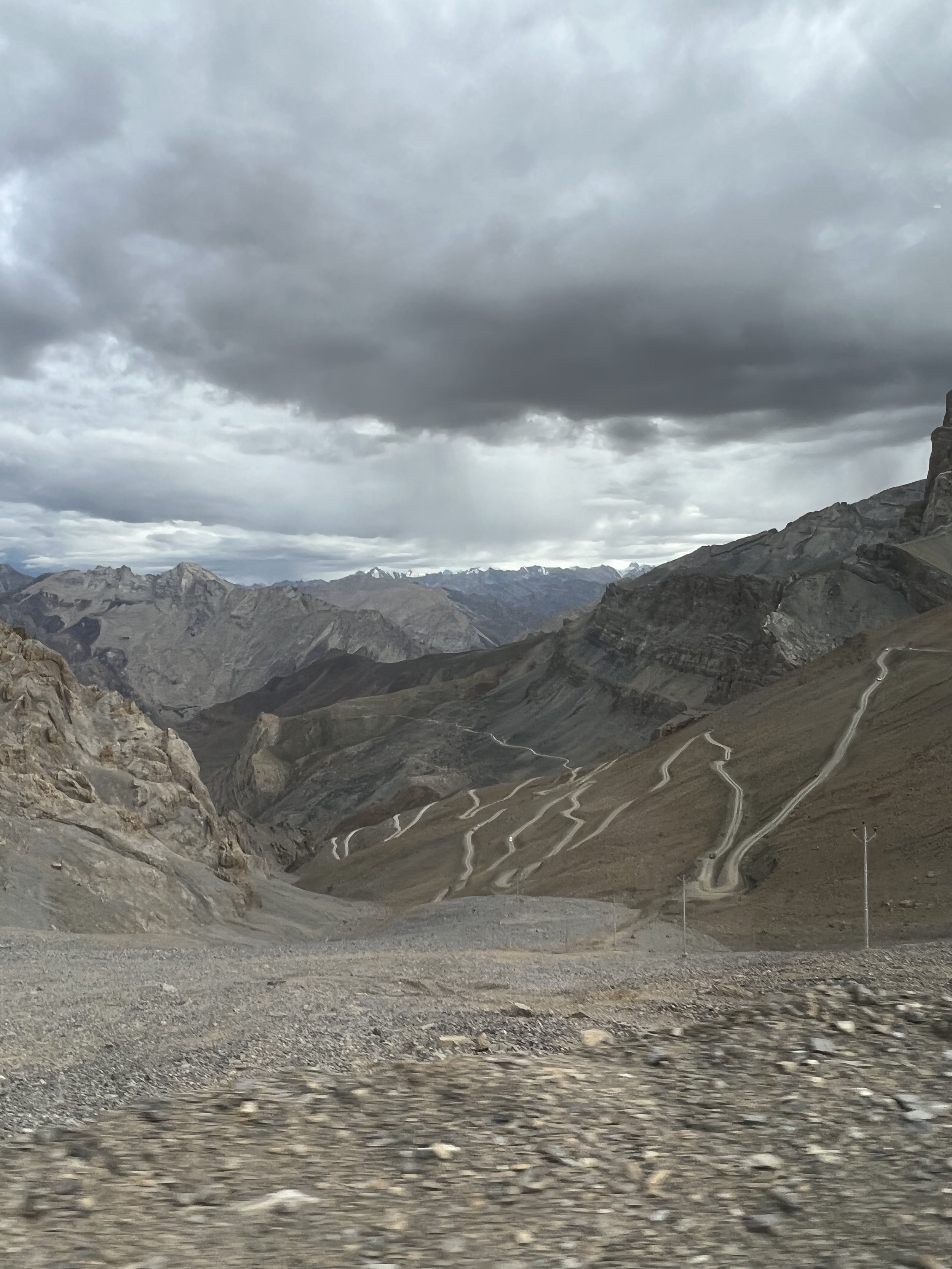
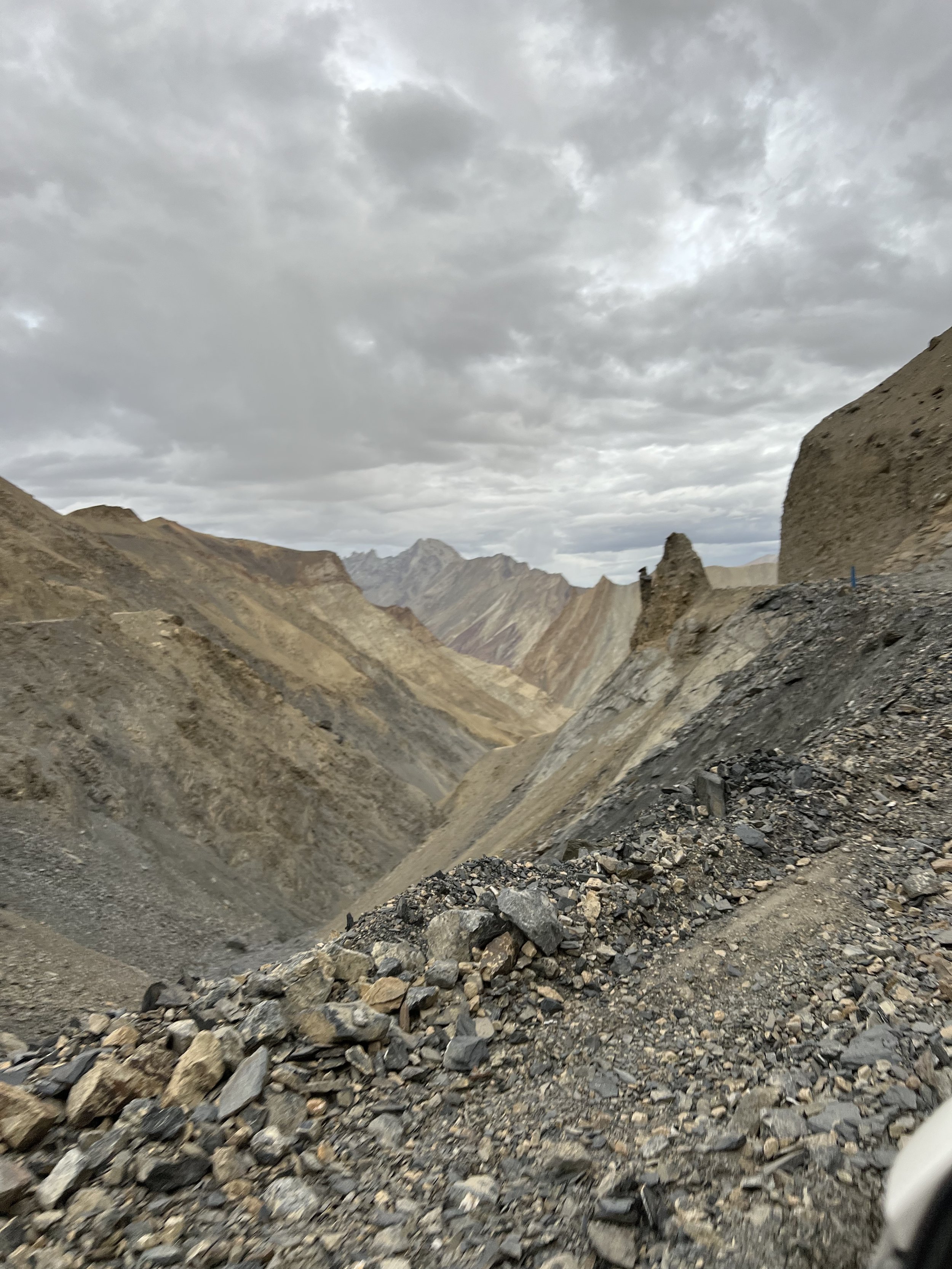
The drive to Lingshed is like something out of a dream. You spend over 5 hours on that dirt road, which defies gravity, logic, common sense, and any existing sense I might have had of the possibilities of beauty. The road cuts through a gorge with granite walls hundreds of feet high and then opens out into a giant plain with rolling hills and sharp peaks. The road then climbs over one, two, three passes all in the 16000 foot range, plummeting back down to 10,000 feet, only to rise again. Of course, with people from the surrounding area headed to the teachings, there were a lot of us on the road, a lot of dust in the air, a lot of questionable passing, a lot of bumping around. I did as I do here—slammed in my headphones and opened the window wide for fresh air (except when we were too close to a car ahead), singing to myself in my head and dancing around to music that means something to me and carries the presence of the people I love. The mood on the road, like the mood in my head, was festive and joyful—all of us were making this unimaginable journey into the heart of the mountains to see a living Bodhisattva, the current incarnation of Avalokitesvara, the Bodhisattva of compassion, to be exact.
We finally arrived in the tiny town of Lingshed around 8 pm, just as it was getting dark. There were cars and camps everywhere, and the Gompa was lit up like nothing I’d ever seen. As difficult as it was to make our way through the single winding and rutted road through the village, there was such palpable excitement, so many smiles, so many shouts of the universal greeting in Ladakh, “Julley!,” that I didn’t even mind how tired and dusty and hungry I was. Things got a little more tense when we failed to find our camp, took a turn down the wrong, steep, tiny dirt path, barely made it back up to the “main road” (overstatement), and tried again to drive through town discerning which camp might be ours. Just as I was starting to hatch a plan to beg dinner off a camp full of Ladakhis, we somehow miraculously heard someone yell the name of Namgyal’s company, Yama—and camp was found. We ate hot food and may have had a small toast of whiskey to celebrate the epic journey.
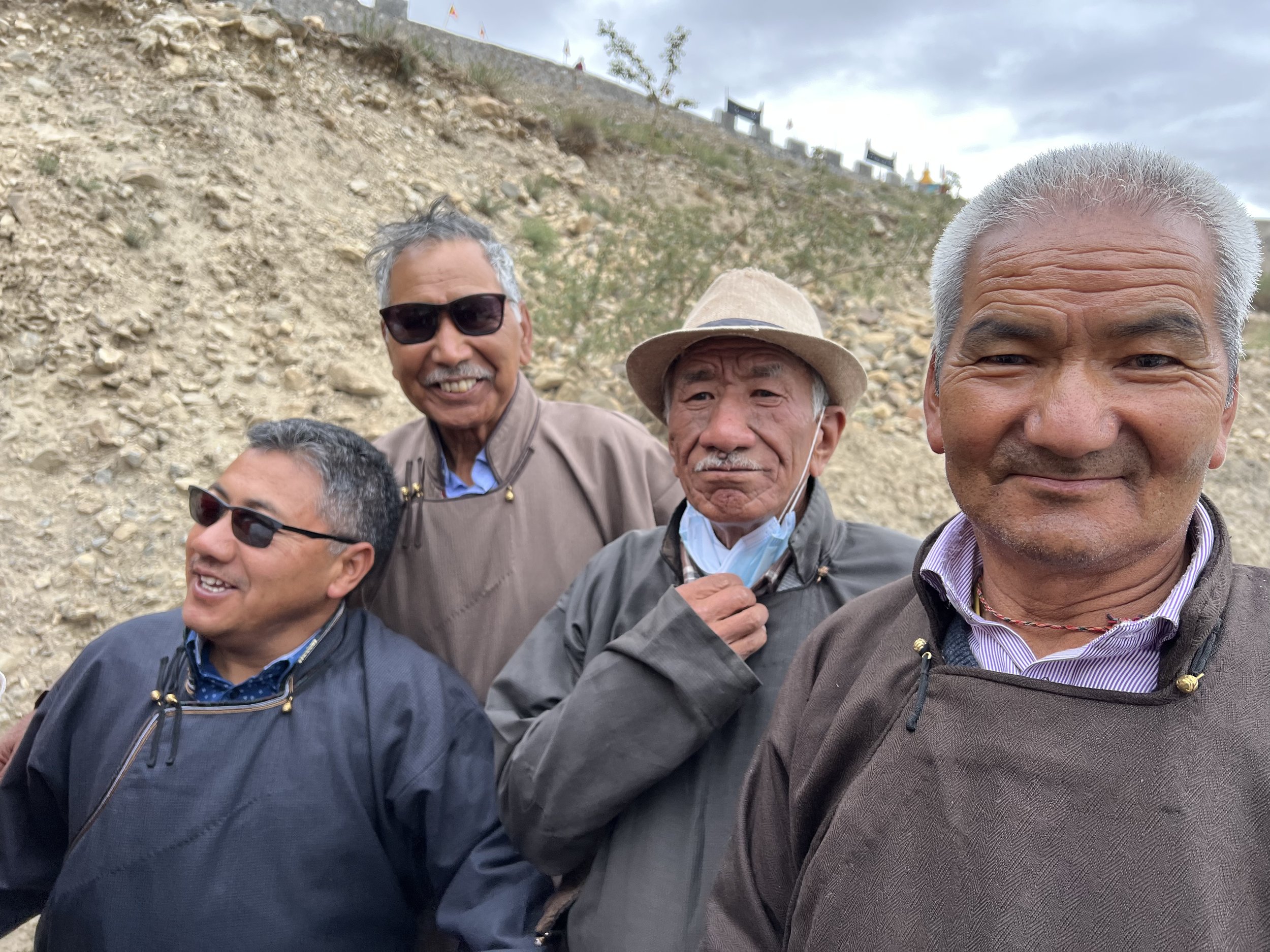
I woke early and noticed that everyone from the surrounding camps was already heading to the large open space in front of the monastery where the teaching would take place, right next to the helipad where His Holiness would land, somewhere around 9 am, we had been told. It was not quite 6. I woke my traveling companions, inhaled some cups of coffee, and started walking toward the Gompa, about a half hour away. Almost immediately a jeep truck pulled up with four smiling Ladakhi men standing in the back, clearly having a blast. They insisted we climb in, and so we did. One of the rules of pilgrimage is to accept all generosity. It is a profound practice of saying yes, even when you think you don’t want help or a ride.
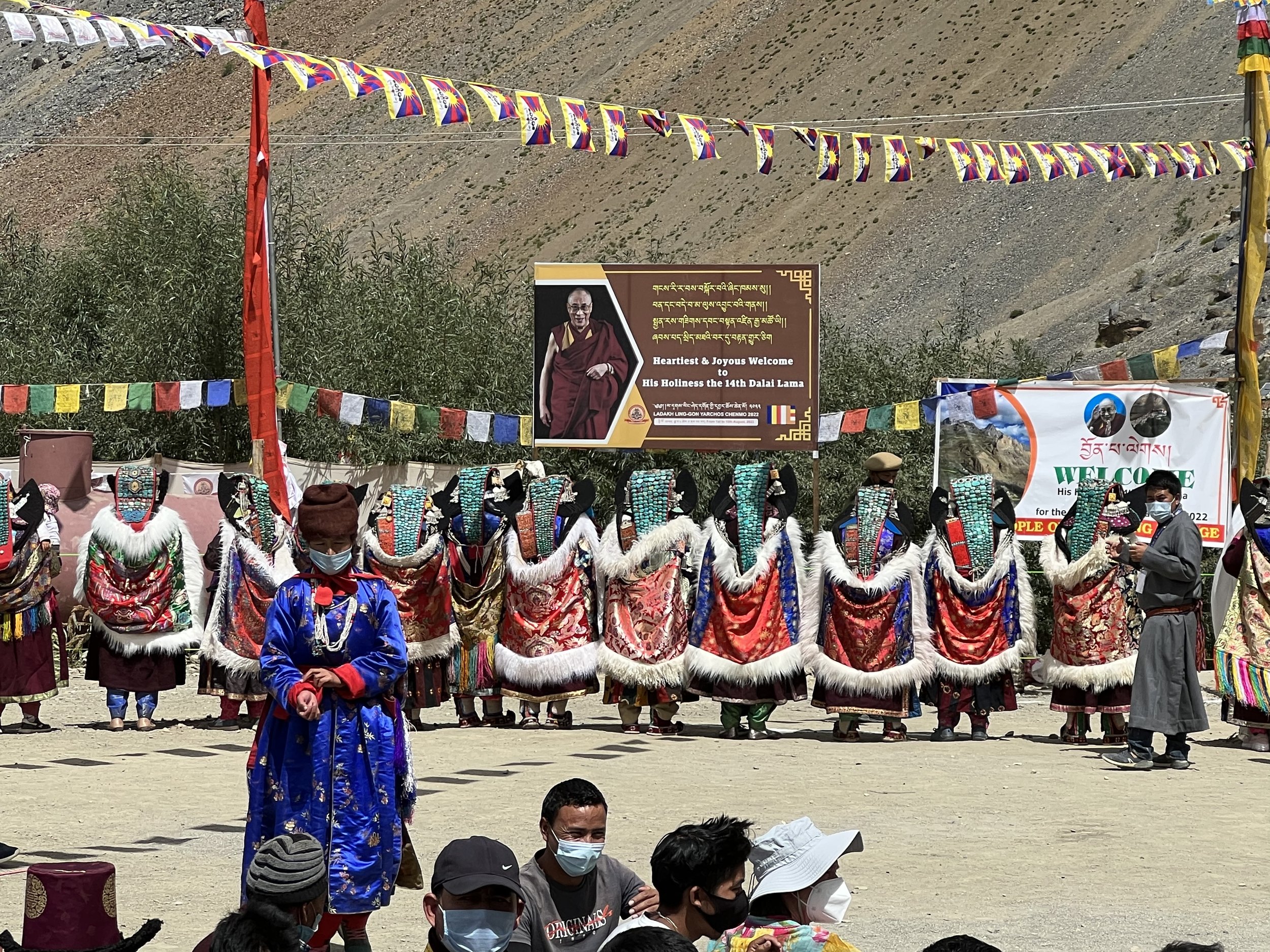
As we bounced along, I asked the men what village they are from, and they said, “Temisgam.” I said, “Temisgam! That is one of my favorite places in all Ladakh—my outfitter, Namgyal, is from there, and we’ll be there tomorrow night.” They laughed hard and asked me where I’d be staying. They laughed harder when I named a hotel one of them, whom I admit did look familiar, owned. Within moments it became clear that another of them, in a beautiful dark blue Chuba, the unisex garment worn by most Ladakhi adults for special occasions, was Namgyal’s brother. I won’t lie: I just started crying because this is how it all seems to work here: dates align, promises are kept, you’re lost and then you’re found again, the people who care for you are everywhere.
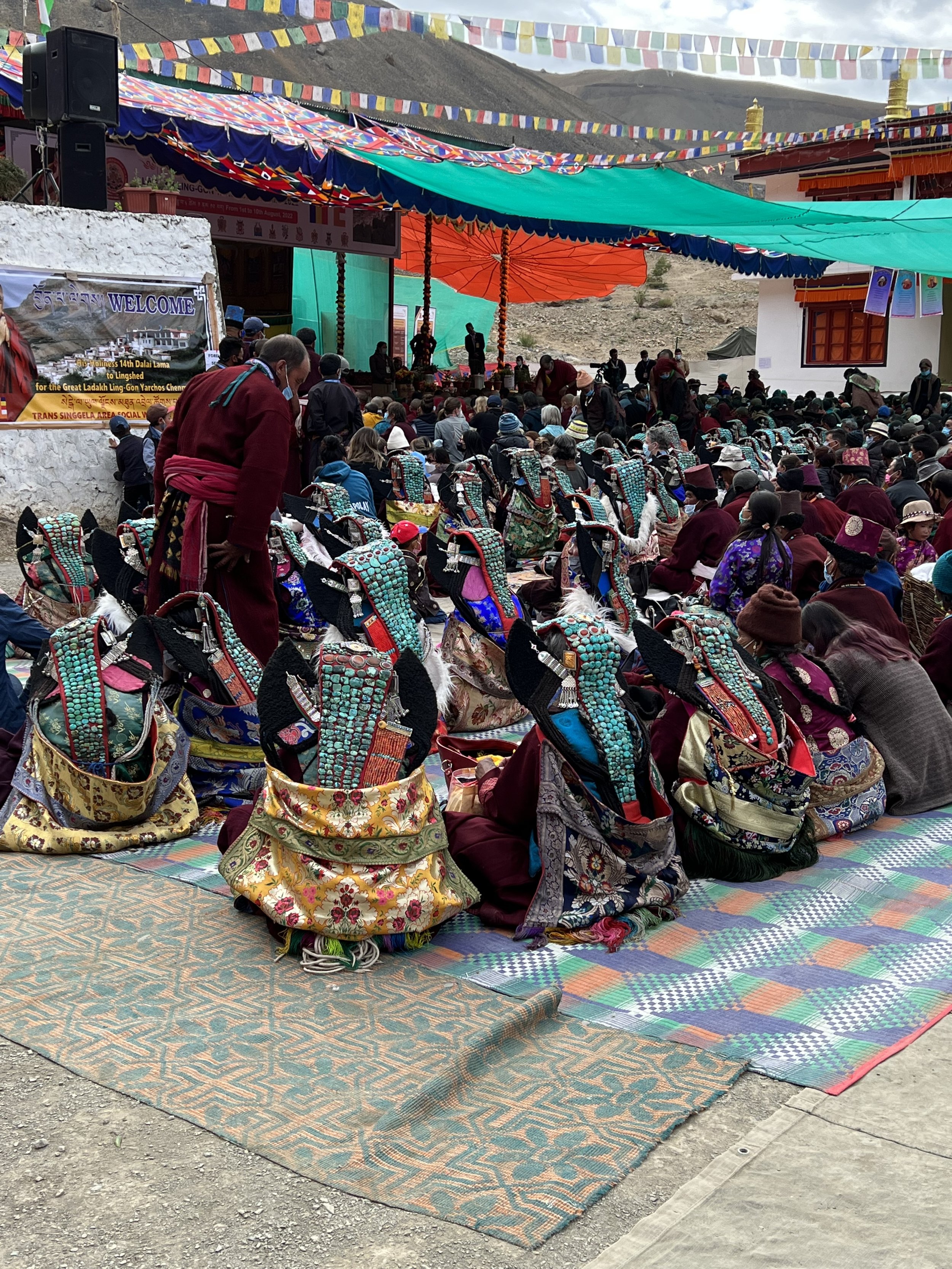
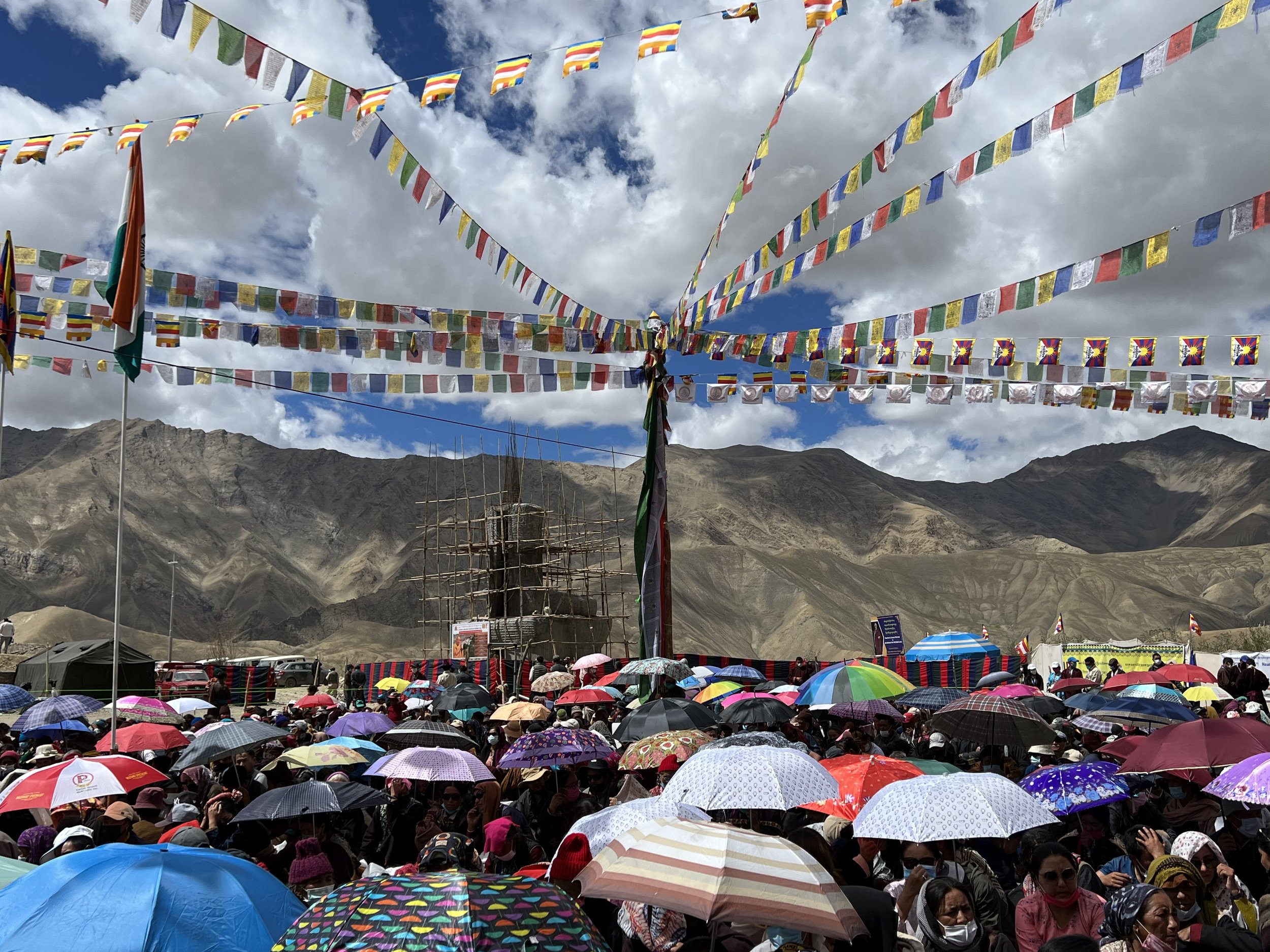
We arrived at the teaching grounds a little after 6:15 and settled in for the three hour wait. They had set aside a section for foreigners, as they do at the giant teachings in the main town of Leh. Here, though, there was only space for about 500 people, most of whom were monks. There were more foreigners than they had expected (they had apparently expected about a dozen, given the incredible remoteness of the site), so we ended up sitting squished in among the married Ladakhi women, every one of whom wore a beautiful turquoise encrusted headdress passed down to her on her wedding day. Over the next hours, we were served tea, Ladakhi bread for breakfast, rice with nuts and apricots, and more tea. Generous helpers crawled through the packed lines of people making sure we were sustained for the long wait.
And it was a long wait. Helicopters kept arriving and dignitaries kept getting off, but still no sign of His Holiness. The clouds dispersed and a baking Ladakhi sun pounded down on the grounds, especially on those of us just outside the makeshift covering. With the approach of every chopper the crowd buzzed into attention and then quieted again, as it became clear the bird was just dispensing more dignitaries. There was continuous chanting, both from the monks in front and, for much of the time, the people all around us. It was a beautiful and also somewhat hypnotic atmosphere. I won’t lie—by 10:30, after 4 1/2 hours sitting crunched in on small carpets surrounded be people in head to toe wool garments, discomfort was happening. We all started wondering what we were doing there, if we would ever get water again, whether maybe it was just time to get up and leave.
I’ve been to teachings with His Holiness on three or four other occasions in Ladakh, and discomfort is part of the experience. The teachings are crowded, claustrophobic, and hot. Monks and villagers with tea and barley flour pass back and forth through the rows, Ladakhi children decide these white people might make an excellent jungle gym, and there is a kind of stoned boredom that sets in. You’d like to think you would meditate deeply on the nature of your mind or emptiness or the meaning of Holiness, and some (mostly white) people even try to look like that’s what they’re doing, but the truth is, waiting for the teachings activates a kind of basic human suffering of which it is good to be reminded.
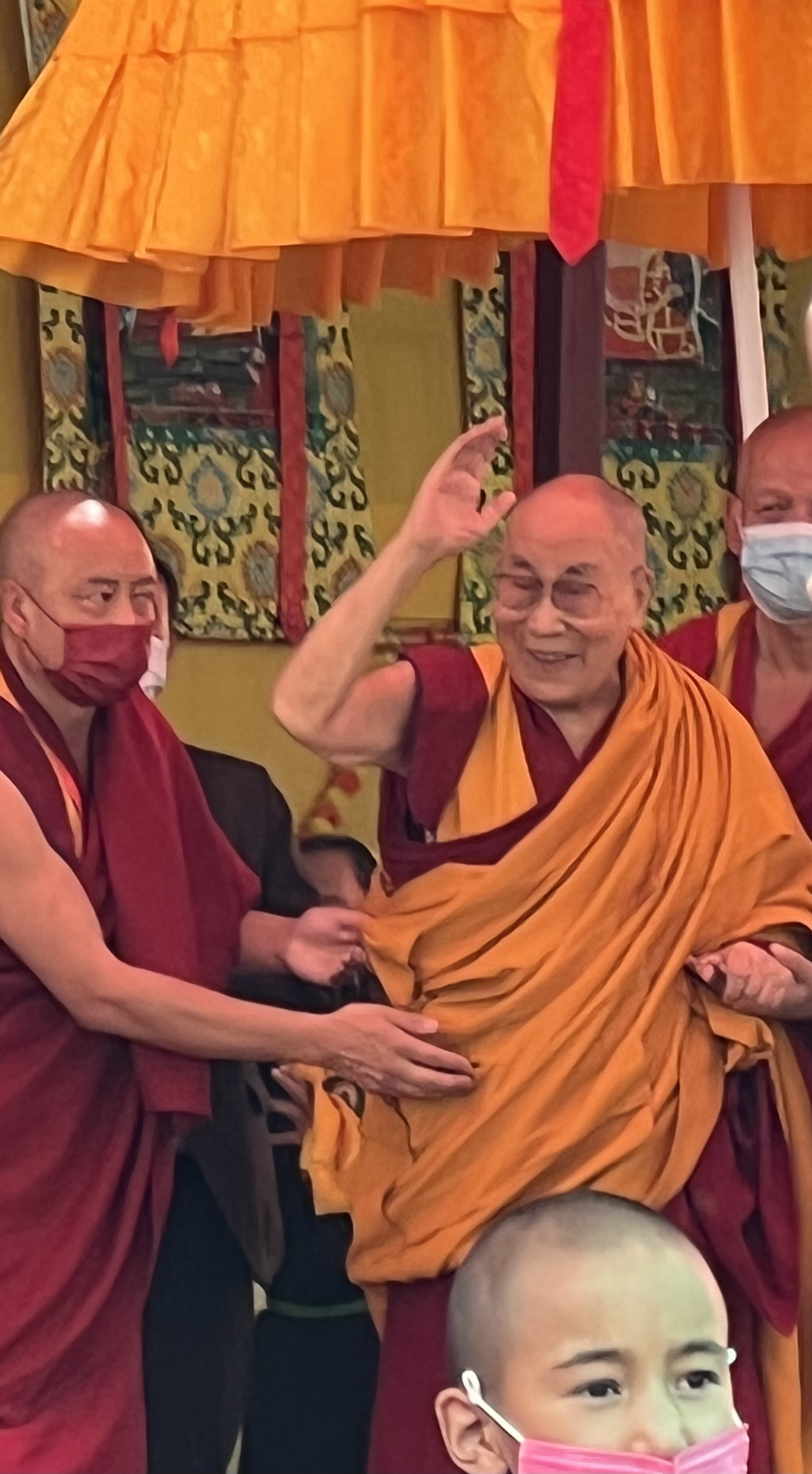
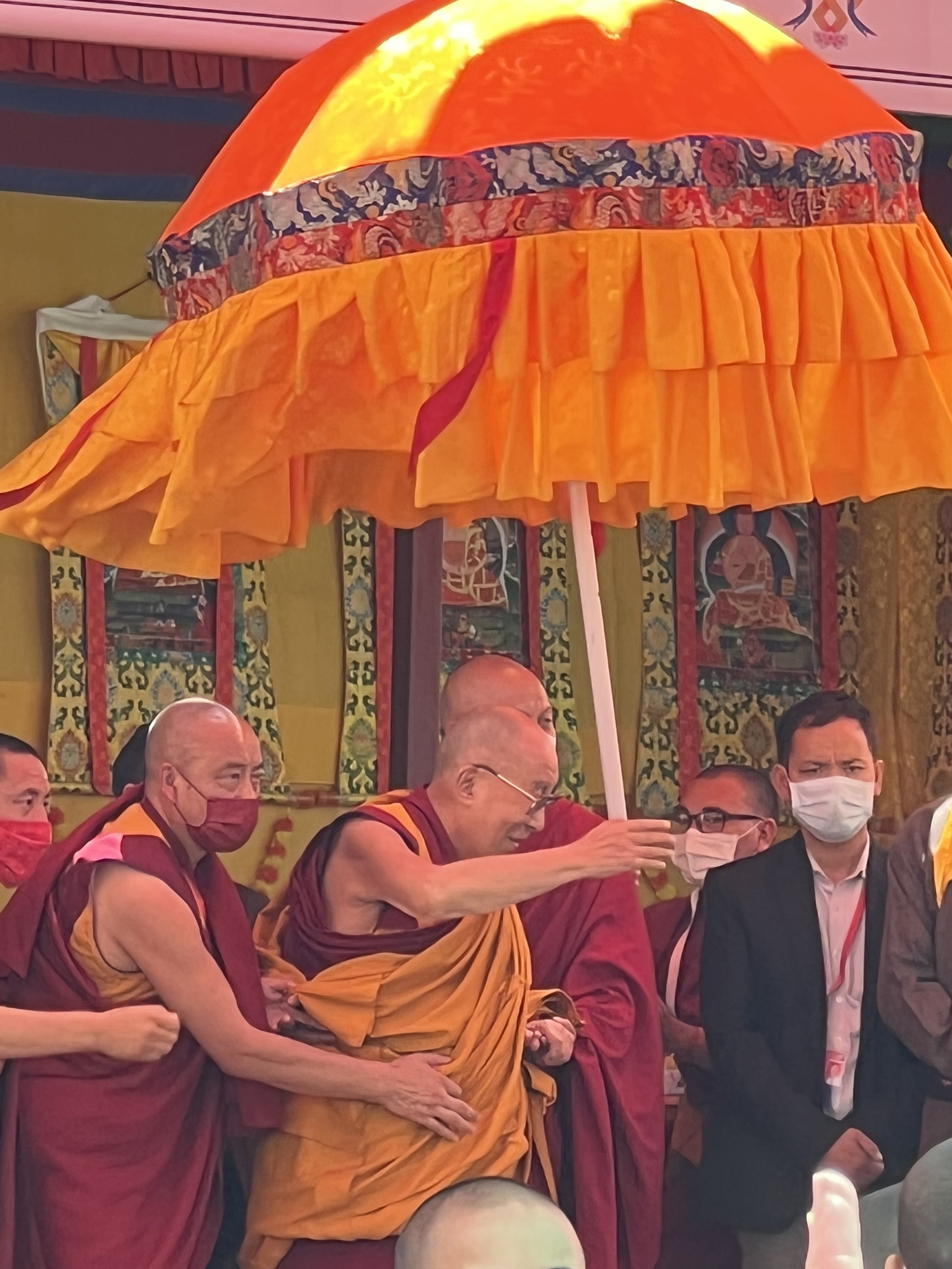
And then, seemingly waking all of us from a collective slumber, he kind of suddenly just arrived—in our case, at 11 am sharp, as though someone had just slightly misread the itinerary. I’m really not sure I can find words to describe either his presence or the effect of his presence on the Ladakhi people. His love emanates from every part of his Being and is reflected back to him by the veneration of the population here. There is no analogue that I know of in the US for the sincere and profound appreciation and love in which they hold they hold their living Saint. And yet he is ever the unassuming deity, the “simple monk,” as he always calls himself, smiling, waving, clearly delighted at the reception and perhaps, too, at the novelty of being in such a remote place in front of such a comparatively tiny crowd of devotees. He doesn’t come to places like Lingshed very often, though I suspect he wouldn’t mind a little more of his time spent in this way.
As often happens to me at the teachings, I took in very little of what was said. There were speeches of appreciation from the leaders of the village and Gompa of Lingshed. There was chanting. His Holiness began to speak on the Eight Verses for the Training the Mind, but soon broke off for lengthy asides about the importance of Ladakh’s tradition of being a home to multiple faiths and his concerns about the absence of Love and Compassion in the Indian national school curriculum. The English translator, whose voice I knew well from the giant speakers set up in the “foreigner section” of the teaching grounds in Leh, was seated quietly on the ground three people away from me, so close I could hear him without using a radio. His Holiness asked for a clock, went back to what he was saying, and digressed again. After a little over an hour, he went silent, paused, and, without ceremony, ended the teaching by repeating the exact words I had heard in that exact spot almost four years before: “It’s time for lunch.”
As with all of my encounters with this ordinary man who is also, according to the people of this place, a great Bodhisattva who walks among us, it will take me some time to metabolize the experience. Once, many years ago, on the teaching grounds in Leh the first time I was ever in his presence, he grabbed both of my hands in his, and I didn’t stop vibrating for three days. Until that time, I didn’t “believe” in the Dalai Lama as anything other than a powerful religious leader with an uncanny knack for connecting with people of all faiths. After that, I knew he was that, but that he was much else besides.
I hesitate to say this, but Ladakh, at least for me, is a place of significant and unceasing “coincidence,” or what I will call here, for want of a better term, magic. You make a promise you can’t possibly expect to keep, and circumstances align to push you into the exact place and time where you can do it justice. You get lost and you get found again, by someone you practically know, even though you don’t know them. Help arrives when you need it, and you give help when it’s needed. A living God shows up in a small mountain village and reminds you to be kind and eat lunch. Words are repeated in the same spot at the same time, in a manner that seems almost incantatory. You suspend your disbelief, because neither your belief not your disbelief is of much use here. Neither, certainly, is required for magic to happen. You allow yourself to be carried along by the tide of circumstance, and in that tide, you find grace, joy, illumination, surrender, and profound peace.
May His Holiness’s life be long and free from further suffering, and may we all continue to benefit and learn from his teachings and from his great example.
A note on timing: beginning tomorrow, and for the next five weeks, I’ll be doing a series of treks that will take me away from connectivity for periods of time. The longest of these treks will be around 16 days. I’ll return here as I can when I get back into some form of communication range. I’m grateful to you for reading and for giving me a chance to digest and reflect on the extraordinary events unfolding on this pilgrimage. I’ve been in Ladakh less than a week. I can only imagine what the next weeks and months will bring.
.






 Walking and Praying
Leave a reply to Jody Greene Cancel reply