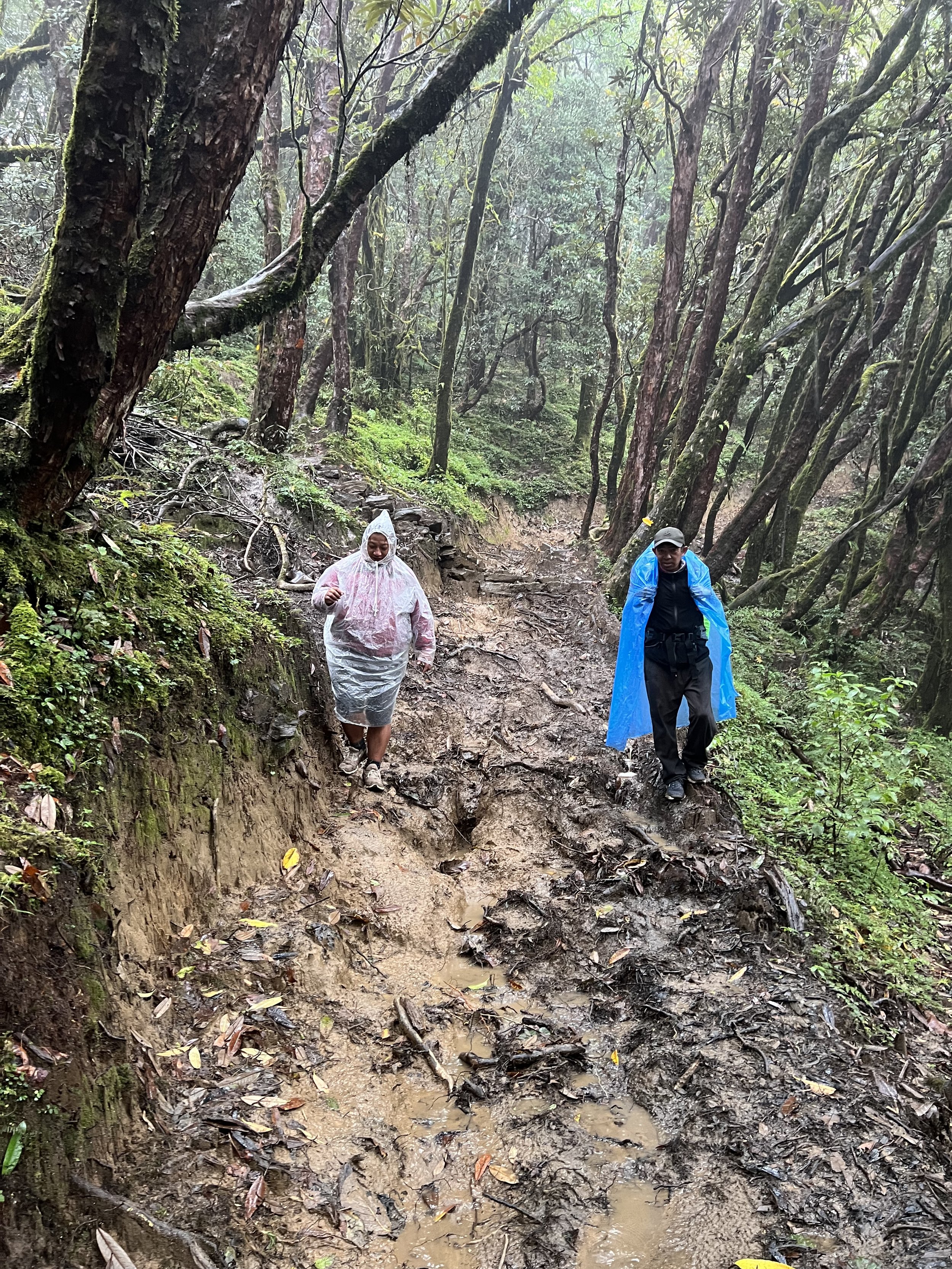
I’m sitting here with seven Nepalese men in their 20s and 30s drinking tin cups of raksi, or arak, at high camp. It’s 1:30 in the afternoon. We hiked in fog, then light rain, then a driving rain and whiteout, for a total of about five and a half hours earlier today. That included an hour for lunch. In some ways, this is a very short day. In others, when you’re wet through and it might as well be Norway as Nepal, it’s enough.
We’re gathered in plastic garden chairs around the large metal stove, and most of our pants are steaming. Same with our shoes and boots. As many other layers as possible hang from a small line over the stove, which, mercifully, was somehow already lit and raging when we rolled in. We are the first guests at this teahouse at Mardi high camp in nearly three months of monsoon. The cooks and helpers from all the other, better appointed little teahouses at high camp seem to have gathered here before whatever trekkers may possibly arrive arrive. This is clearly the high camp locals clubhouse. We feel lucky to get the prime spots near the stove, not to mention the raksi, and every kind of warm welcome.
Now all the cooks have dispersed and i’m sitting with two young men, boys really, Masters students from Kathmandu, but before that from the same village in the far East of Nepal, who are on holiday and who arrived a couple of hours after us, soaked and dripping. They are now drinking raksi as well, though this is unusual for them and seems ill advised. We are well over 10000 feet. They are feeling liberated I think—one keeps saying he has never been away from home or school before and ordering more raksi. His grandmother calls, then his mother, father, sister, one by one, to make sure he’s ok. I think about all the ways we are supported.
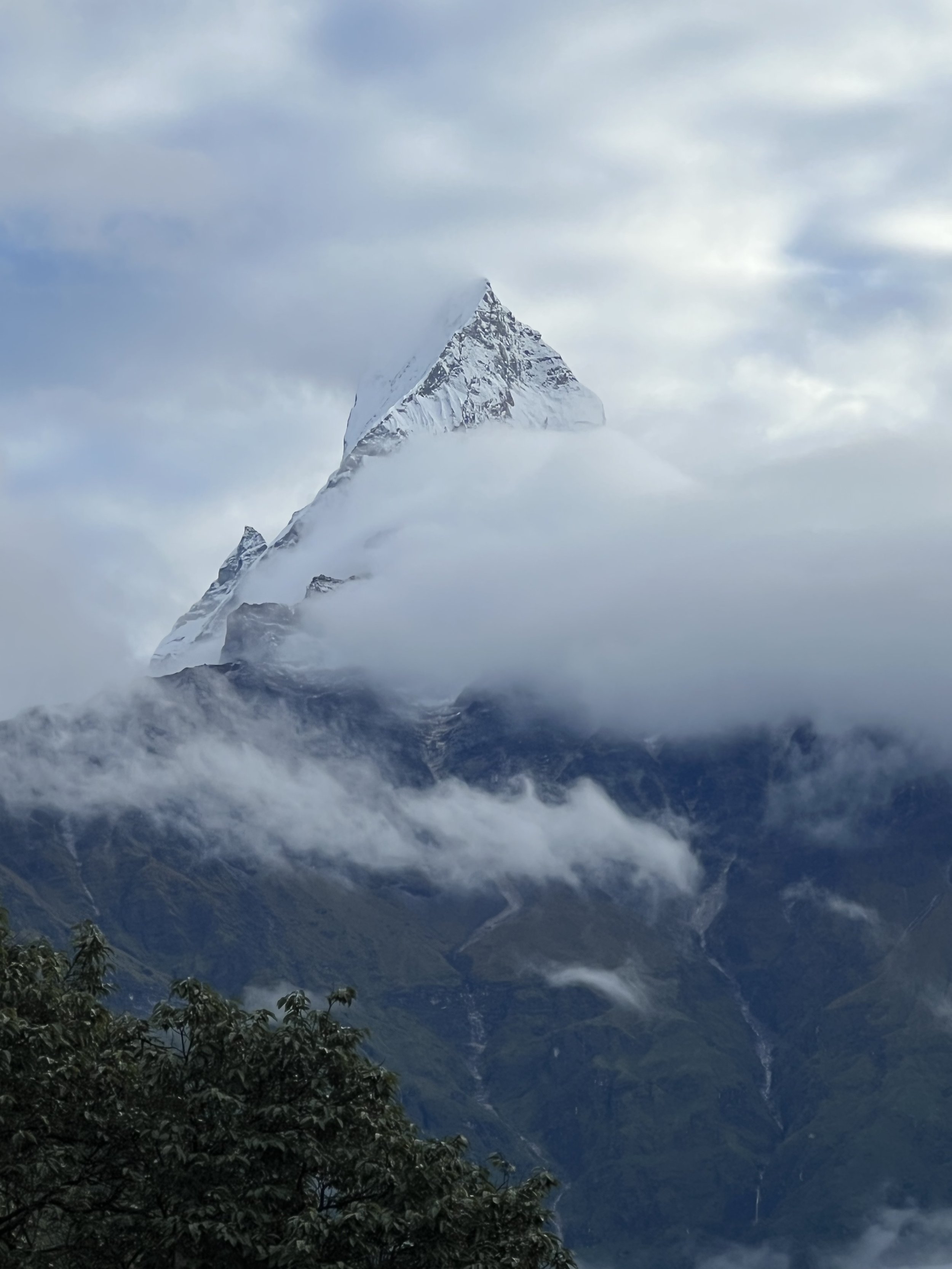
Tomorrow, if it ever clears, we will rise at 4 am and climb two thousand feet on stone steps to the viewpoint for this part of the mountain range, with headlamps to light our way. The students have no headlamps, only their phones, so I invite them to join our little climbing group. We are especially trying for a clear view of Machhupuchhre, Shiva’s holy mountain, which, by what felt like grace, I actually glimpsed very early, almost by accident, from our low camp this morning. If the clouds persist, everyone will sleep in.
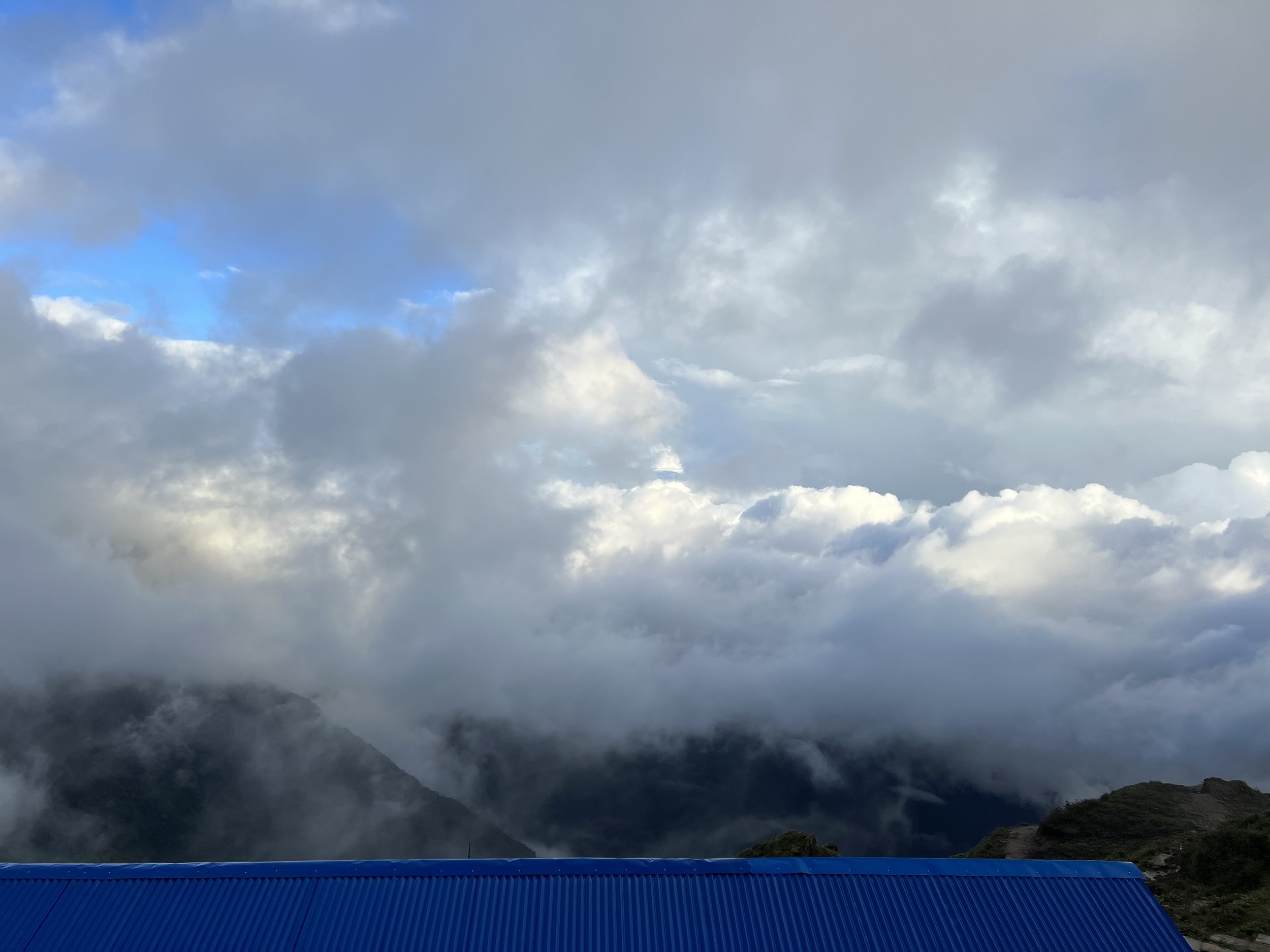
For nearly five hours, I sit by the woodstove, mostly in silence, present but also kind of invisible, with a continually rotating group of men and boys speaking Nepali to each other. Once in a while someone goes out to get more wood and we take turns blowing the coals into life. Occasionally, the clouds break up and blue sky peeks through. Then it socks in again in minutes. It is one of the strangest days i can ever remember, but also one of the sweetest and most relaxing, now that we’re all dry. Maybe it will clear tomorrow. There is hope.
Then there’s a final hour before dinner spent talking alone by the fire with Pradeep, the young man who seems to be in charge of the teahouse, which has a little solar power in the dining room, no shower or wifi, but a killer view when the weather Gods cooperate. The guide, Ram, has gone off to play some kind of game with friends up here and has been gone for hours. Pradeep’s English is better than anyone else’s on this cold mountain, and he is curious, asks questions. Later in the evening, to Ram’s shock, Pradeep sees me eating rice and dal with my hand and asks me, “Didi, you want more food?” Didi is older sister, a universal form of address by these mountain dudes for most Nepali women they meet. I have crossed some boundary and I feel happy. Also, there are vanishingly few women on this mountain and I am glad to feel, even in abstraction, their kinship. Sometimes a dude, I think, sometimes a Didi. It’s all good.
*****
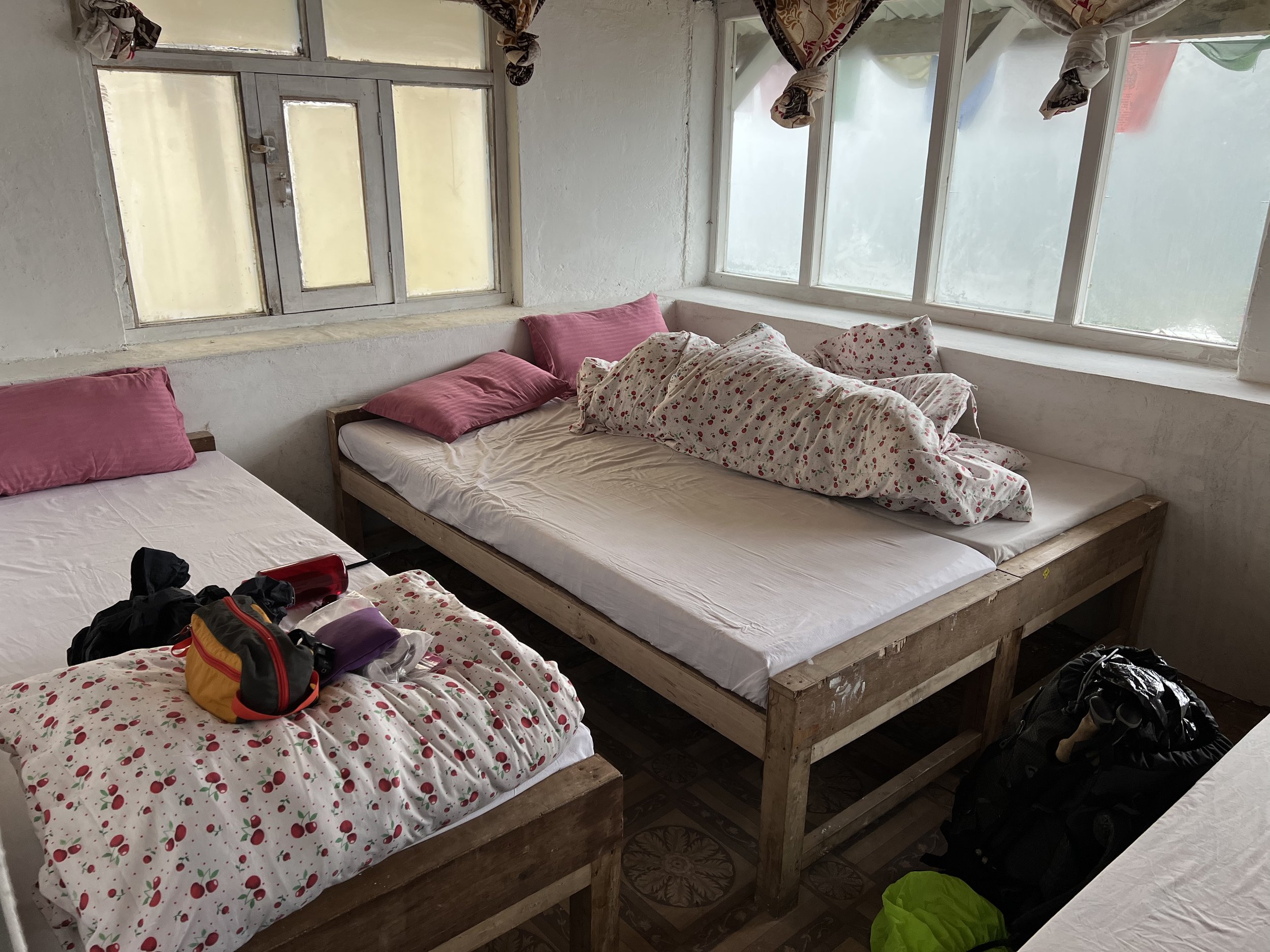
It’s in the 30s in my spartan room. it’s all ill-fitted windows on every side so you can see the mountains, if there really are any. I would have no way of knowing, given the day long white-out. There are four pallet beds in here, not so different from tassajara. There is no space between them and nothing else in the room, including a light. The rain is a deluge and i am grateful to be under cover—my thin sleeping bag and two heavy duvets. I’m warm and dry and oddly happy. If I’m restless in the night, I could almost roll from one bed to another without incident.
Tomorrow the alarms will go off at 4. If it sounds like heavy rain, as it sure does now, I will turn over and go back to sleep. If not, maybe we’ll go out and check the sky—me, the guide, the porter, and the two boys from Kathmandu. Pradeep says he might come along for the hell of it. Maybe we will make a little pilgrimage, the six of us, if the skies look at all clear.
For now there is lightning, and low rumbles of thunder, and sheets and sheets of rain on the tin roof. We’ll see what the night brings, what Shiva has in mind. I know the story is that Machhupuchhre has never been climbed, that climbing it is banned at least in part because of the number of folks who tried it in the last century and never came back. I like that it’s unclimbed if not unclimbable. I think of the Kyang I love so much on the Tibetan plateau, the wild horse-mules who have never been tamed. Great respect for the untameable ones, the uncompromised, the ones who will not be made one jot less wild. We’re only going to the little viewpoint at the foot of Machhupuchhre, of course, but I’m listening and paying attention.
*****
It’s 4 am, our agreed upon wakeup time. It poured with rain all night, finally stopping briefly an hour ago. We are all standing outside looking into thick fog, laughing. There will be no “viewpoint” hike in the dark this morning. We head back to our warm sleeping bags for an hour or two with mist on our faces and hopes that our entire descent is not a mudslide—in any sense.
Stopping me in the hall in the dark, Ram apologizes for our trek and I laugh openly, but gently. “It’s not your fault,” I say, as I did last night, when he also apologized. I’m the one who chose to trek in this season and anyway, I tell him, you don’t control the weather. I’m actually enjoying this strange ride—rain and leeches and jungle and all. And anyway, the only viewpoint that matters here is Shiva’s, and he has made his views clear this morning. I’m grateful, actually, to be momentarily in the presence of such total and uncompromising clarity.




 Walking and Praying
Leave a reply to Aimee Cancel reply