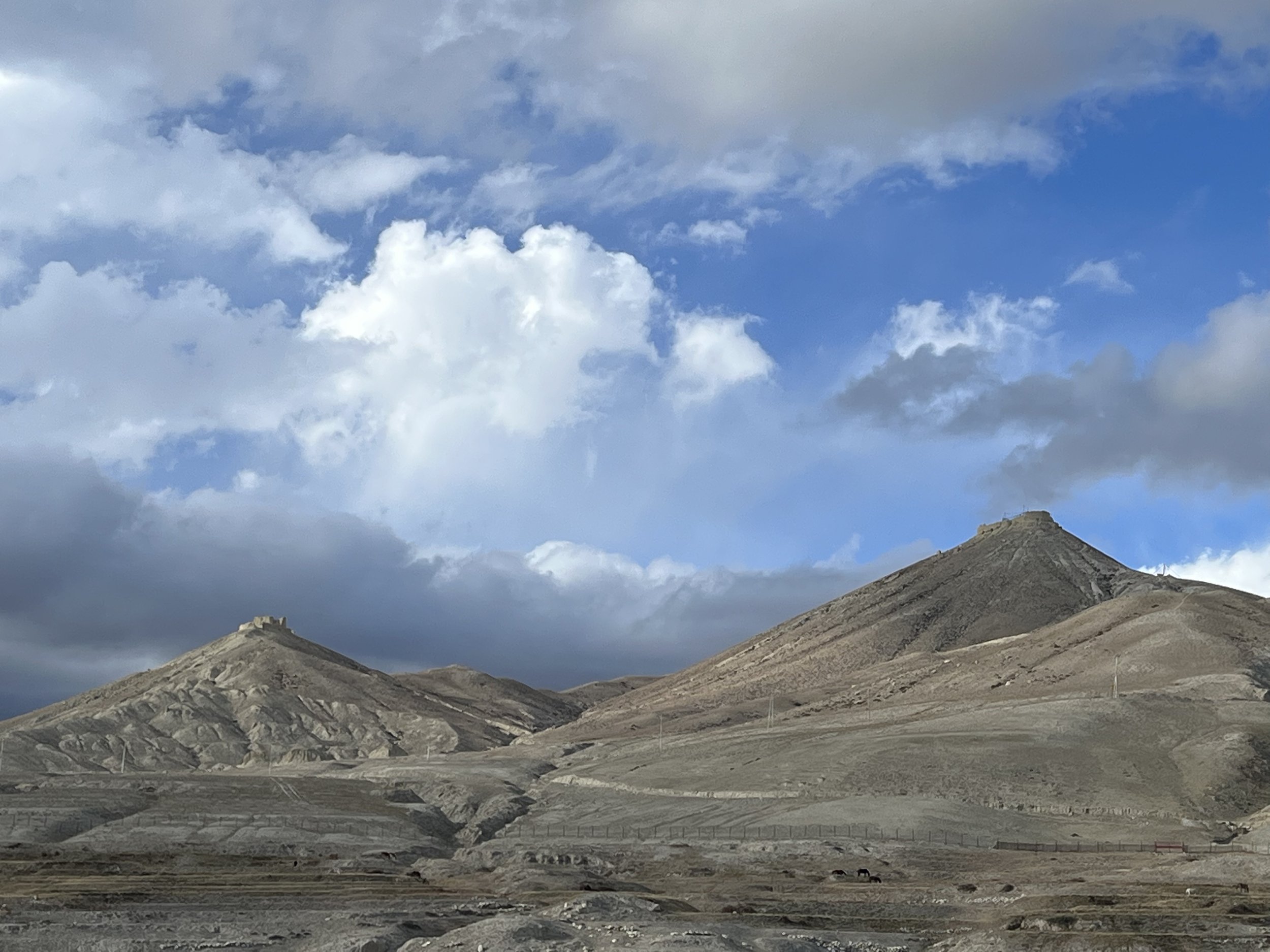
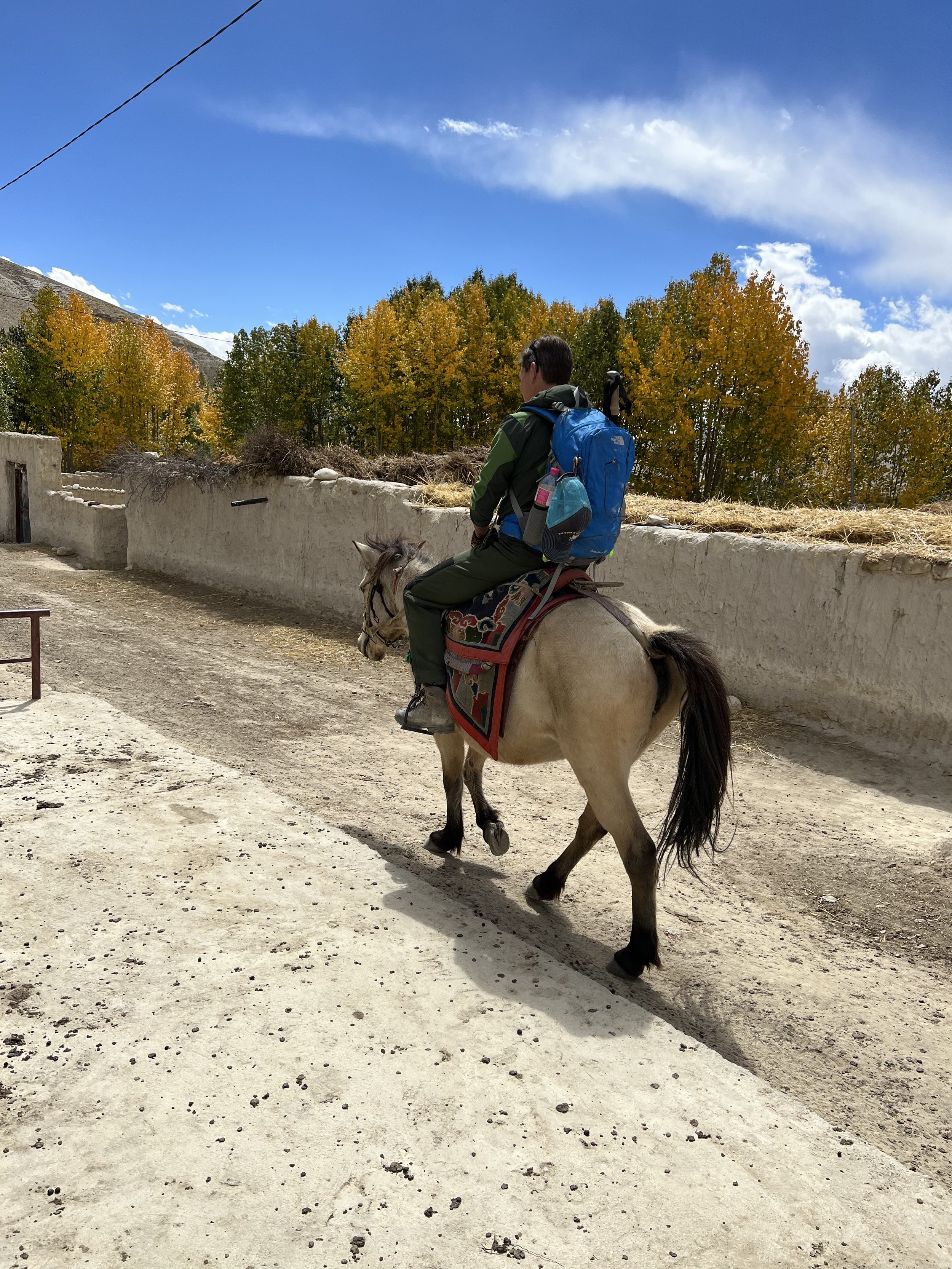
I’m reaching the midpoint of this four-month journey as Autumn colors wash across Upper Mustang and a cold wind rips across the high desert. The dry mountains are dusted with snow. Time has passed, a season has turned, and I can feel change in the air.
Still, it’s hard—nearly impossible—to gauge what has changed or turned for or in me during this time. Much like a three-month practice period at Tassajara, a two-month walk in the Buddhist holy places of India and Nepal is completely consuming, often wordless, in some ways repetitive and even monotonous, and thoroughly mysterious. Perhaps I’ll know at the other end what has been transformed. Perhaps others will see or feel that transformation better than I can. Maybe this has all just been a marvelous saunter on the roof of the world. And if that, well, would that be anything less than perfect?
In considering as I walked today (which was actually a day or two ago—we finally hit Wifi-free territory) what my most potent learnings to date have a been, a spare handful filtered in. Nothing earth-shattering, but not nothing either. I offer them here by way of fragments, open to revision and expansion as the next days and weeks unfold:
1.Be like water. This is a four-month journey in places both inhabited and uninhabited, with more and less infrastructure. We’re (kinda) emerging from a global pandemic. The tourist (and thus pilgrim) trade has been disrupted and in many places is limping back into being. Even here there is a worker shortage. Climate change is a reality. I set out with a clear plan about where I would be when, and I have had to (or been able to) change it repeatedly, in small ways and large. None of these changes has been “a problem.” Japan’s opening was delayed, transforming the entire journey in wonderful though initially disruptive ways I’ve said more than enough about elsewhere. We lost a day of a short trek in Ladakh (and lopped off a 16000 foot pass) because of a small landslide the horses could not cross. We left early for the later 18-day trek because of difficult road conditions and a route that had to be changed at the last minute due to the lack of water in some planned campsites. We redesigned the whole Ladakh itinerary to see the Dalai Lama teach in a small village. We are right now scrapping the planned route for the second half of the Mustang trek (and coming back at least a day early) due to an unseasonal four-day blizzard that is slated to hit Upper Mustang in three days, to the astonishment of both guides and locals. Flowing around and responding fluidly to both obstacles and opportunities is a perennial learning, but I’m finding that the opportunity to practice this daily is making it easier to relax and respond spaciously. Loosening rather tightening in the face of change is turning out to be the key.
2. There’s an art to being guided. If this journey were a sitcom, this would be the repeated gag. In fact, it’s a kind of tragicomic Goldilocks remake. The first guide, in Ladakh, always so fast, and me running to keep up with him (in truth, this has been a thing for years, but only when I was solo with him for 18 days did he feel he could assume “Locals pace,” frequently leaving me in the dust). Then the second guide, in Nepal, so slow I sometimes worry what would happen if something went wrong, weather- or otherwise. I’ve worked to find a sweet spot between gently requesting less talk between guide and porter and more … walking, and reminding myself that we have no place specific to be. Still, when a 5-hour day turns to 8, it’s hard not to get antsy. I’m hoping the third guide, in Japan, and I find the temperature of the porridge of our travel together lto be just right. If not, there will be … more opportunity for practice.
3. Ask for help especially but not only when you need it. Many of my richest interactions here, with people living along the trekking routes, with the many guides who share our itineraries in Nepal, with teahouse owners, with monks who have the keys to the Gompa, have started with a question. Sometimes I really don’t know where I am and I need help navigating, sometimes I really don’t know whose image is painted on the wall of a temple or cast in bronze on the altar, but sometimes I ask a question just to see what answer I get. Mostly I’m used to figuring things out on my own or looking them up, but asking another human opens the possibility of a connection that would otherwise have remained pure potentiality.
4. Eat and pray like a local. For the past month, I’ve eaten the same thing for breakfast, lunch, and dinner every day. It’s what my guides and porters eat. It’s what the families we stay with eat. The logic? People just don’t tend to feed dangerous food to their family and friends. Perhaps more weirdly—at least for the other white people in the teahouses—i eat with my hand and not with utensils. The logic? I have control over the cleanliness of my hands. I’m not all that worried about the utensils, but eating as I do affords me an extra level of protection. I don’t want to jinx anything so I’ll just say, so far, all good. In Nepal, unlike in Ladakh, there is no expectation that you remove your shoes before entering a gompa, at least in Mustang, and I have seen only a handful of guides or Westerners prostrate when they enter a temple. Still, that’s how I have been taught to behave in a Gompa and so I keep to those ways. I can say that countless interactions both with locals and with other trekkers have been opened by the simple fact that I eat and pray more or less as the people who live here do. It seems worthy of endless comment, and is ripe ground for connection.
5. Don’t abscond with precious things. I can’t imagine this really bears saying to anyone bothering to read along here, but I had an experience a few days ago that left me something close to enraged and grief-stricken. In the town of Tsarang, there is a beautiful gompa that I visited alone late one afternoon. Most of the monks in Upper Mustang are away from their monasteries right now, doing puja in the villages to mark the end of the harvest. They’ll be away for a month, which means, among other things, no morning prayers to attend for visitors. The gompas have been left in the care of late adolescent and early adult monks, all of whom, to date, speak astonishingly good English and really know the history and iconography of their temples. I found one such monk in Tsarang, who eagerly showed me around the temple and offered an impressive tour of the wall paintings and statuary. Near the end of our time, he gestured at a 12 foot long pile of sacred texts stacked against one wall of the gompa. Most were of the same, standard size, neatly arranged in closely nestled stacks of four or five with the narrow end facing the wall. On the near end were a pair or larger sutras, acting almost like a bookend, one quite a bit larger than the other. The young monk flipped back the cloth covering of the giant library, opened the largest of the texts, and pointed to an exposed leaf. “Do you know what this is?” I could have hazarded a guess, based on the glint coming off the tightly-packed script, but I let him tell me. “Golden sutras.” That is to say, all of these many texts were written in ink made of or containing gold. “107 golden books,” he said, gesturing down the wall. My face immediately betrayed confusion: 107? 108 is the most sacred number throughout the Buddhist world; nobody would make a library of 107 golden books. No way. “Yes,” he said, clearly noting my perplexed expression. “One is in a museum … in America. The biggest one.” I couldn’t tell if he meant me to take this personally, but I did. And then this young monk turned, tapped the largest of the remaining texts, the one he had opened, looked directly at me, and said, “This one, he misses his father.” What to say about the mix of emotions I felt in that moment? Tears stung me eyes, anger gripped my stomach, and shame burned my already red face. I had some crazy idea that I would find out where the last golden sutra was, make a plea to the museum curators, make a case that they should at least visit this place and then decide whether this great patriarch should be repatriated and reunited with his textual family. If you’re going to run off with a golden sutra, I raged internally, at least take the whole damn set. Of course, what use does a museum have for 108 golden sutras? But what use does a gompa have for 107? I’m not sure that this experience even qualifies as a learning, but at the same time, I feel confident that it’s an experience that I will never forget. May I be shaped by it as I travel through these sacred lands, and may I never, ever be tempted to remove a precious and sacred object from its home.
So those are a few of the musings I’ve been walking with over the past couple of months. I have no doubt there are others too close for me to be able to see or consciously feel them.
Above all, I feel infinitely blessed to have been able to enter this dharma gate, fully supported by beings near and far, grateful for a healthy body and a ridiculous amount of energy (what has at times been a liability in my life is a real asset here), and bowing in reverence to the teachers, known and unknown, without whom I would never have entered and remained on this path.

 Walking and Praying
Leave a reply to Judy P Cancel reply