Some weeks—or maybe it was lifetimes—ago, I wrote a bit about Barry Lopez, the mountain training, and the combination of presence and planning required to move safely in wild places. One essential feature i forgot to mention was the fine art (and survival skill) of knowing when to quit.
For the entire time we have been in Mustang, I’ve been tracking an intense looking five day winter storm headed this way about two months ahead of schedule. Snow, rain, mixed conditions right around freezing point, with thunder and lightning on top. Initially we held it lightly, but as the days went on and the forecast did not shift, we repeatedly decided to respond by changing our itinerary. In two days, we descended to cover the ground we took four days to cover on the way up. We had still planned to stay another day or two to seal our pilgrimage with a visit to the great holy place of Muktinath, and had worked out various contingencies with vehicles to make that feasible. But on the morning of October 5th, we woke up to heavy rainfall and the news that there was already a significant slide on the road between Mustang and Pokhara, just outside the town of Beni. To make a long story short, and as the mountaineers say, we bailed.
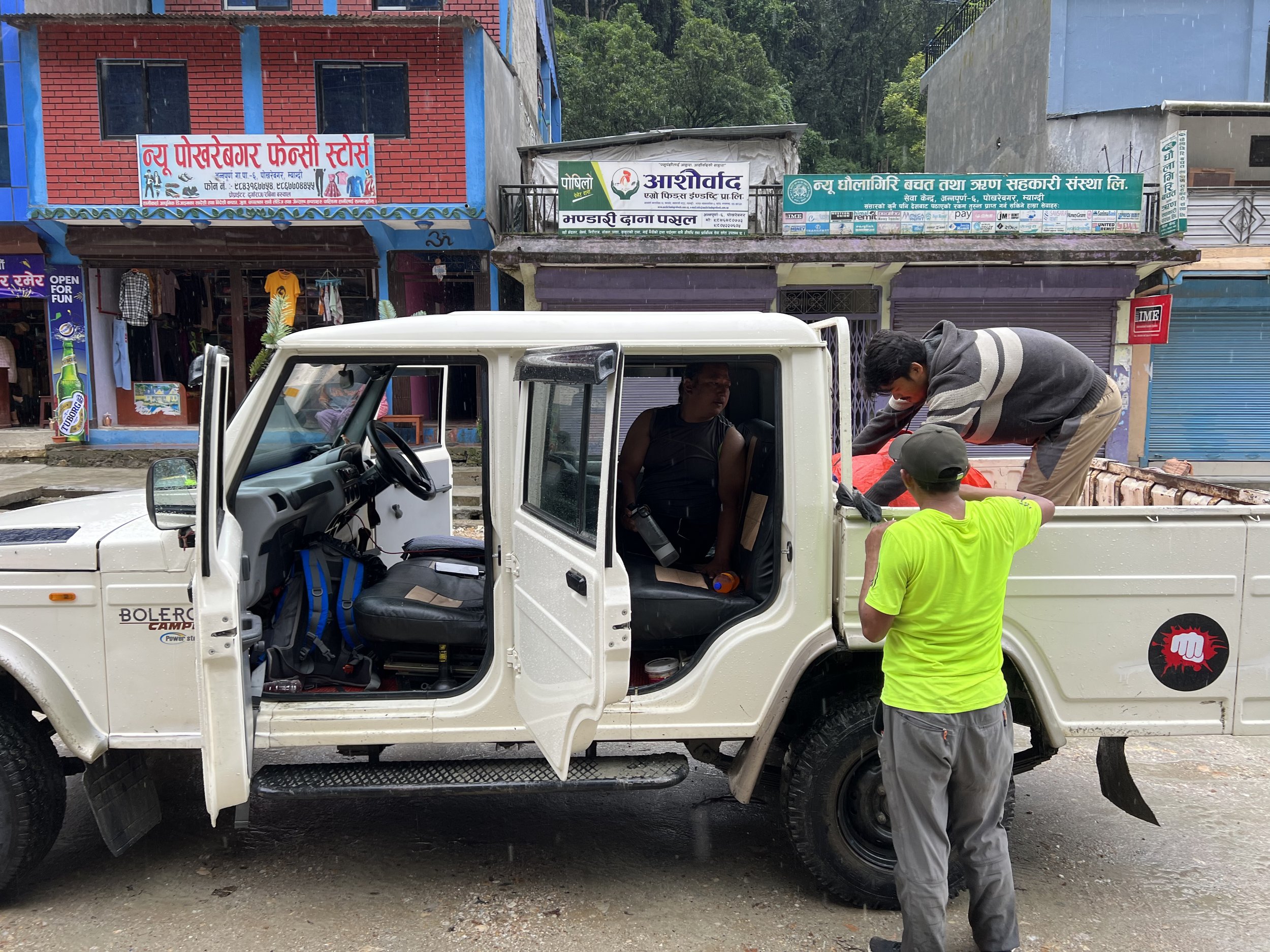
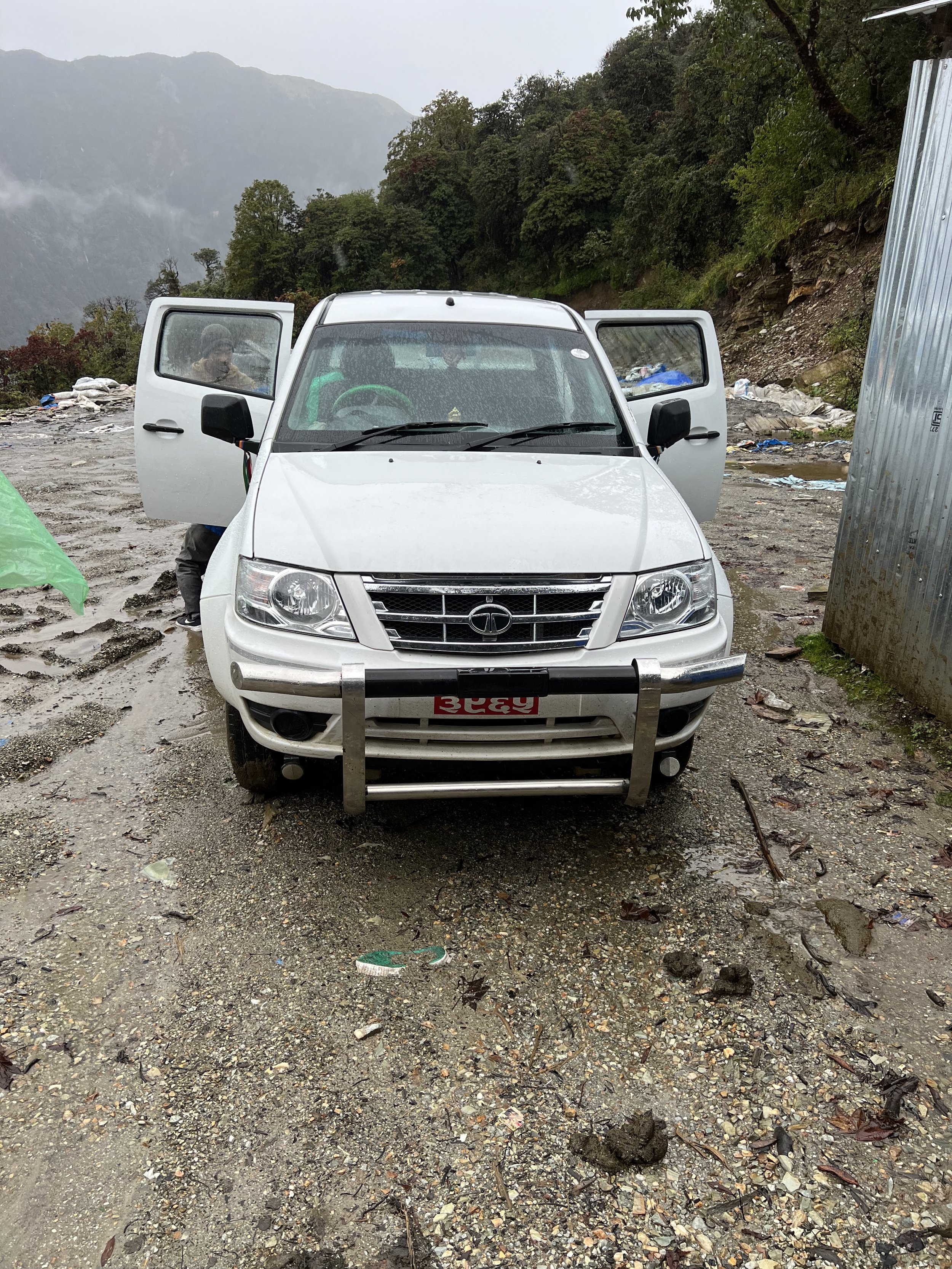
By the time he arrived at my room with coffee at 6:15, Ram had arranged for one jeep to take us as far as the slide, and another to pick us up on the other side to go towards Pokhara, at least as far as we could get. My sweet, slow guide, it turns out, is a master of logistics.
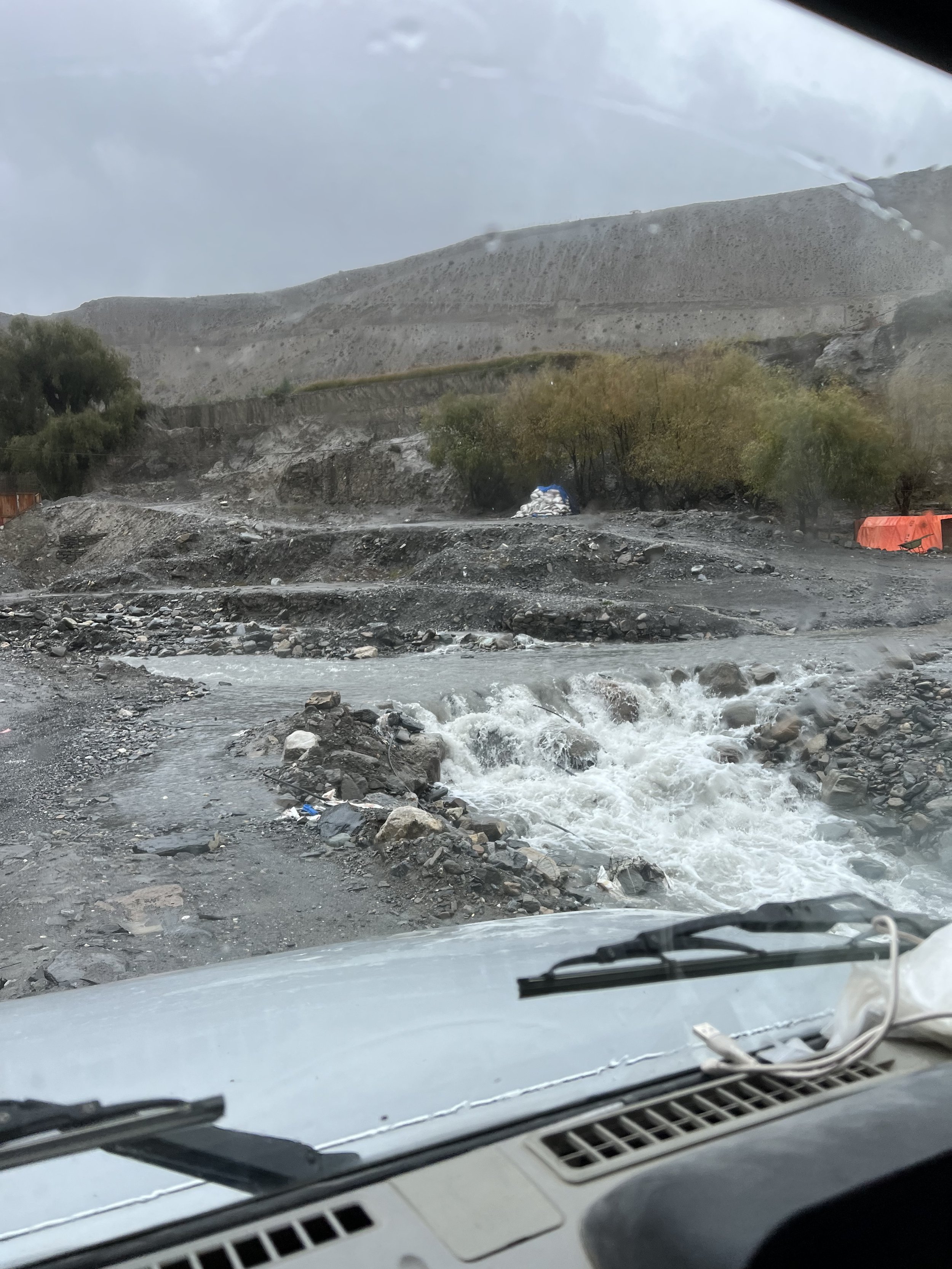
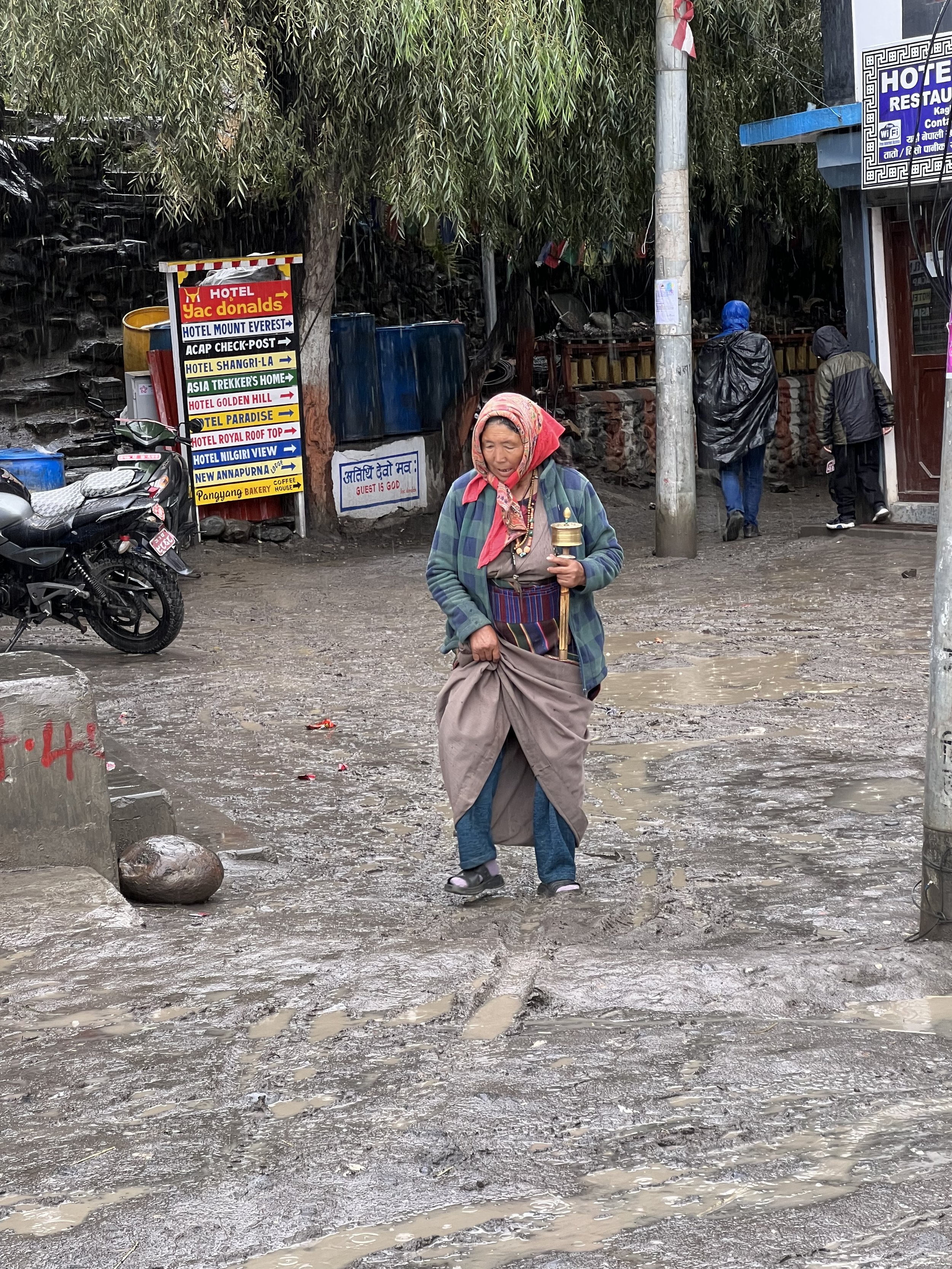
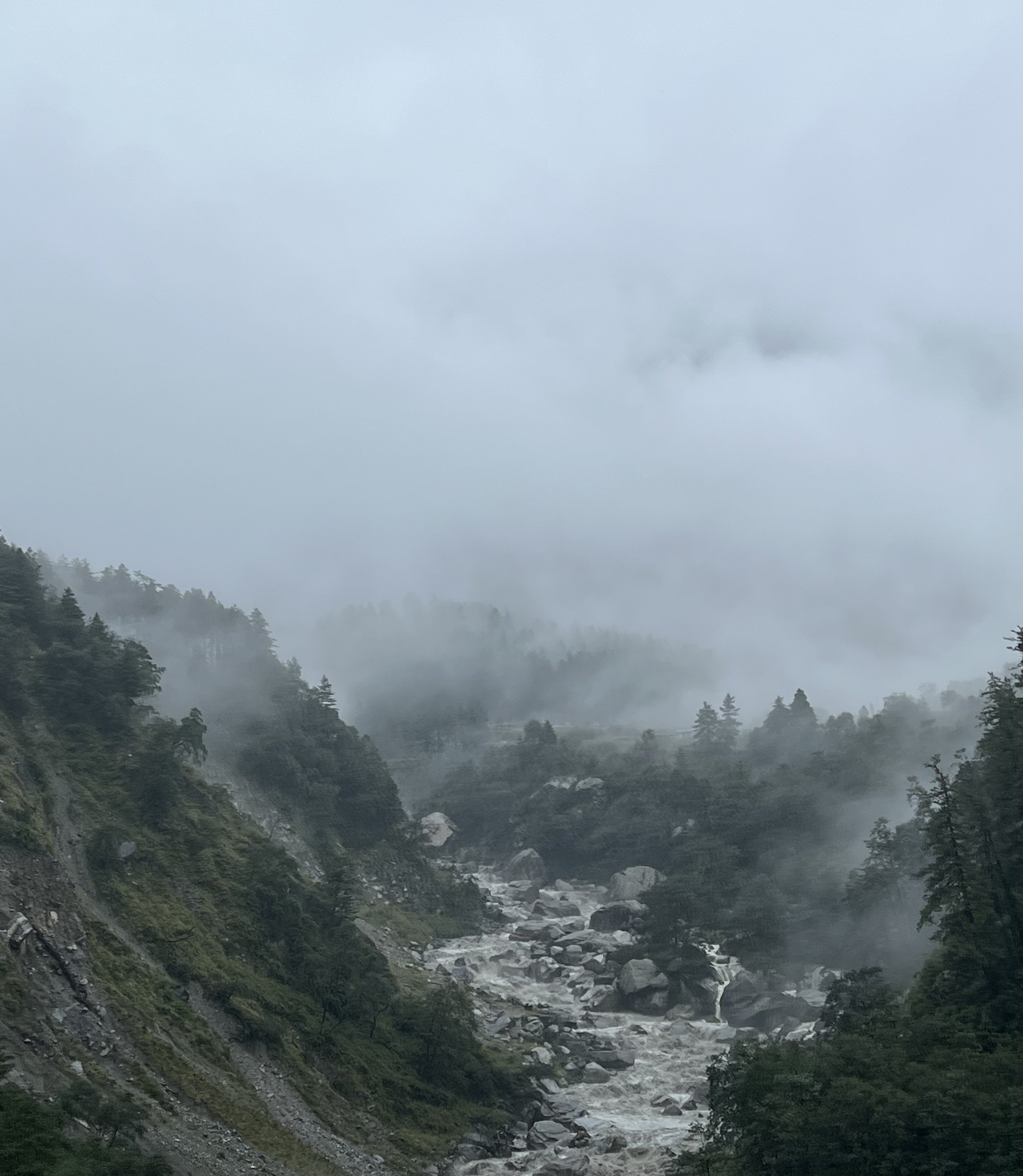
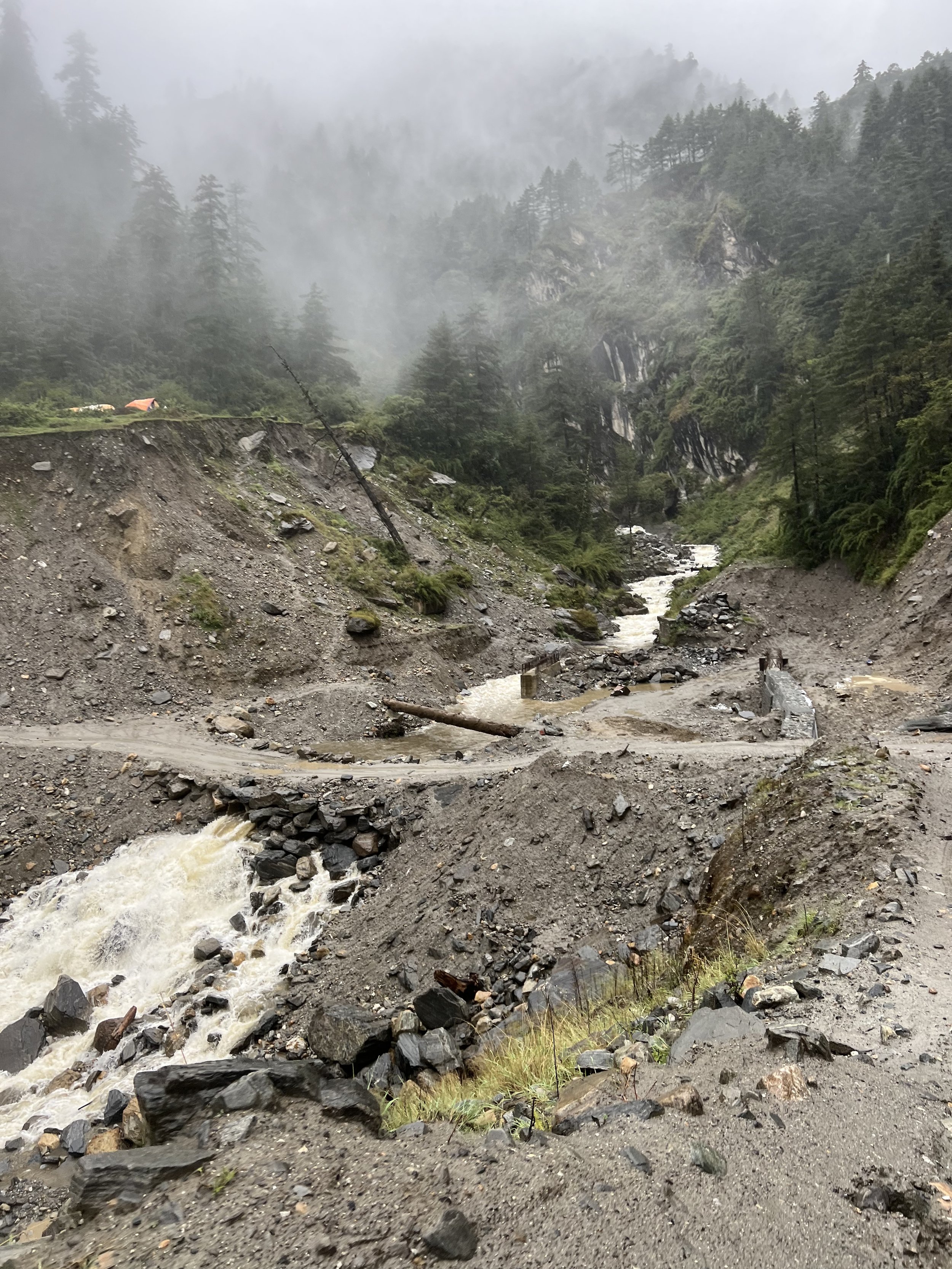
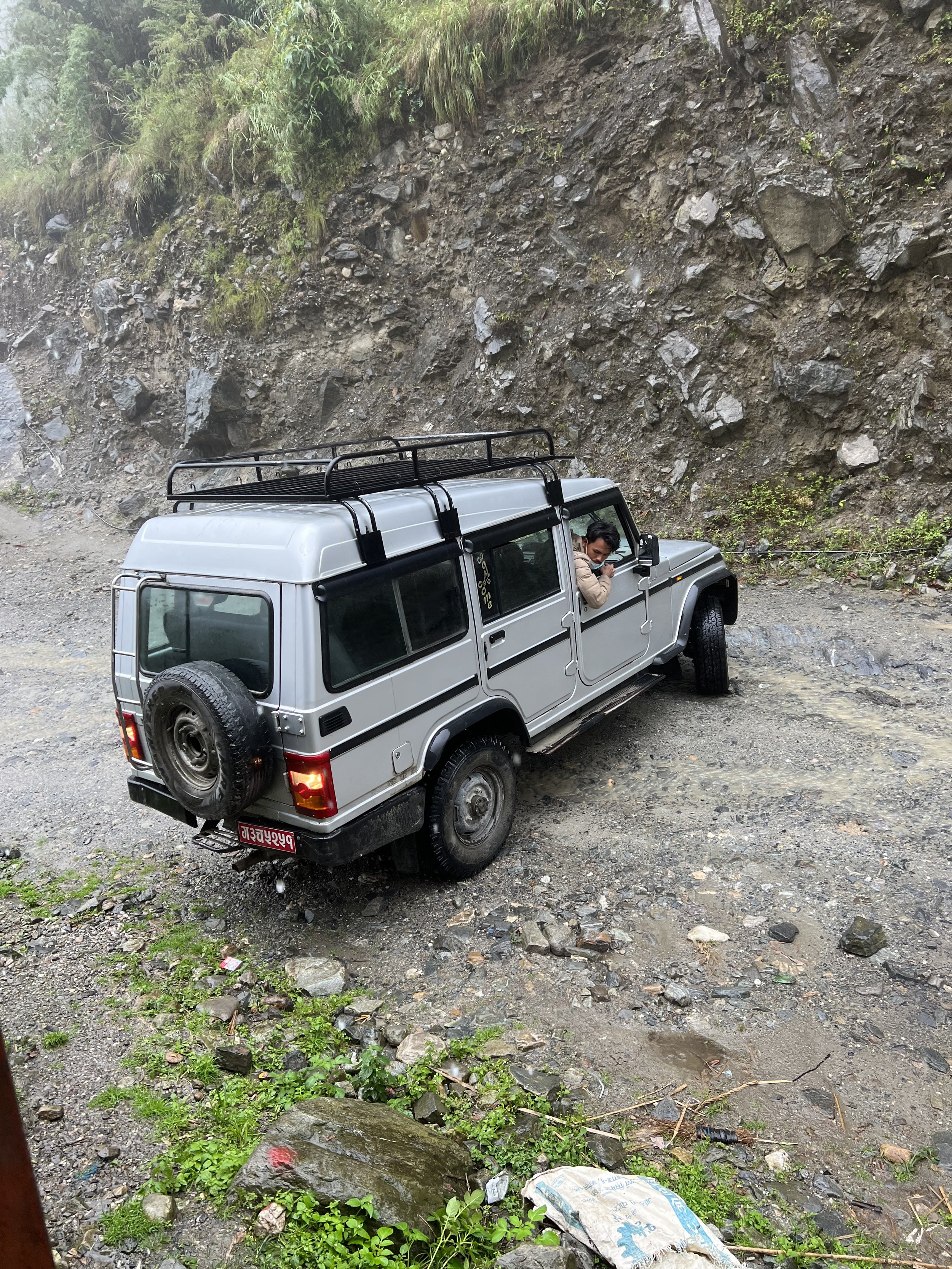
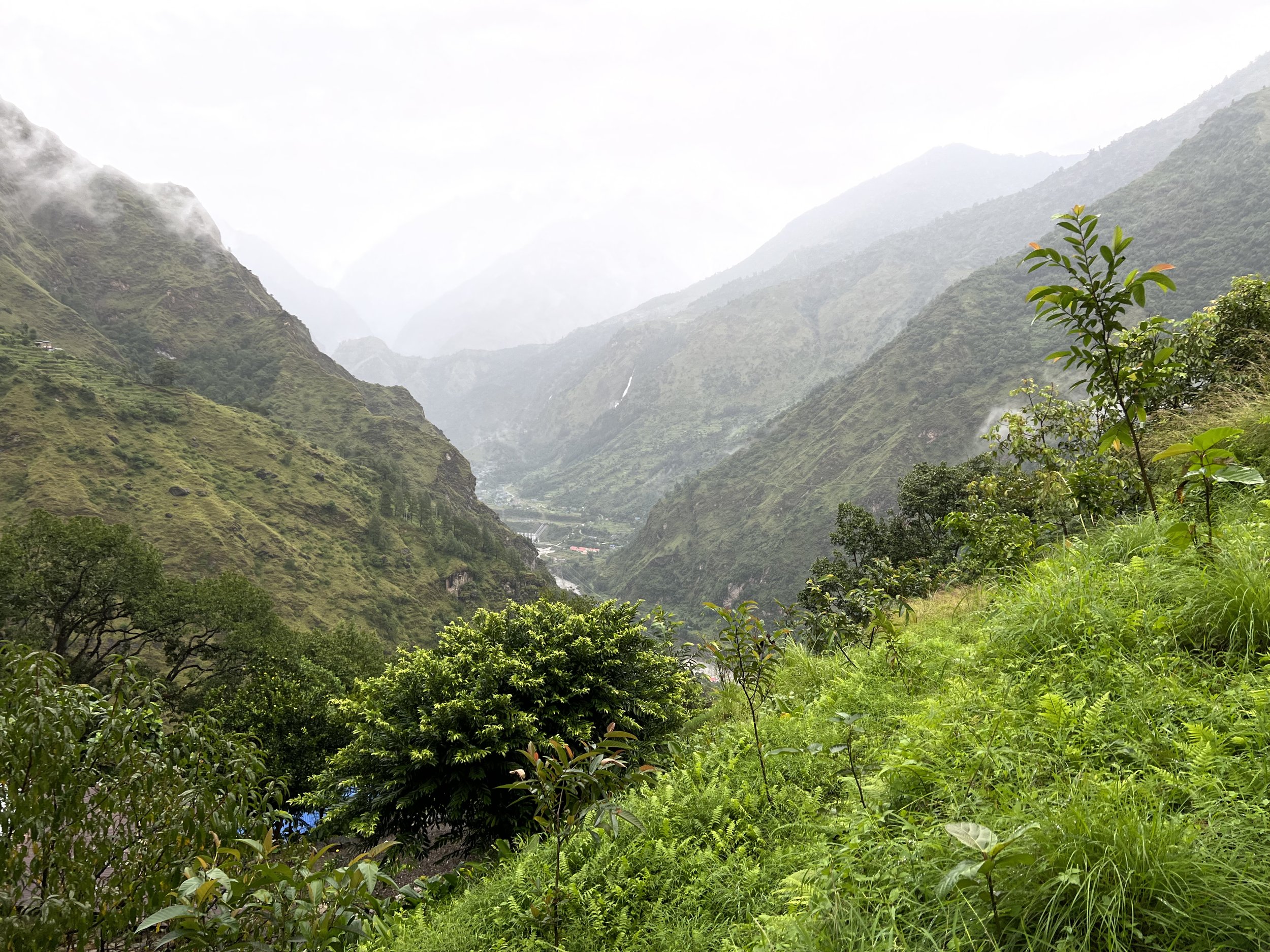
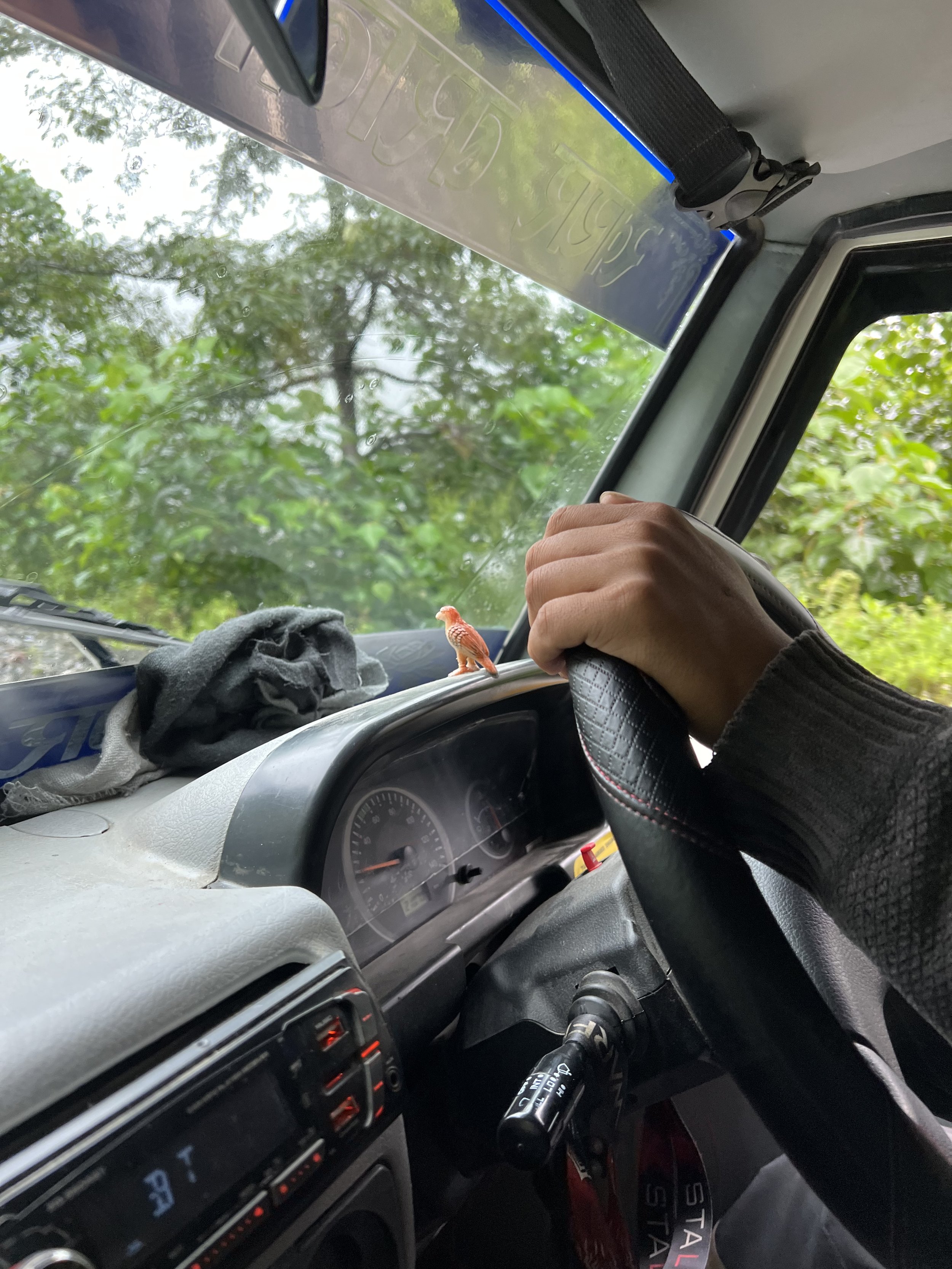
The dry desert we walked through for seven days was now a stormy heath. The mountain guardians hid themselves from view. The road was a river of mud and water. We climbed in a jeep and started the drive toward Beni, thinking our delightful Mustang adventure and pilgrimage were coming to a close.
And then, in an instant, everything changed. We had to bail … on bailing.
I’m not quite ready to give a full account of the next few days. Who knows, maybe I never will be. The good news is we made it out of Mustang and back to Pokhara, largely on foot—a feat I had had no idea was possible. I don’t know that I would say, then, that there is anything that qualifies as bad news. But I will be forever changed by the experience, the experience of very nearly not making it home.
We knew things were going in a bad direction when we came upon a long line of parked cars a couple of hours south of Jomsom. Our driver pulled over and put his head on the steering wheel. Not an auspicious sign. A long debate ensued between guide and driver. It was clear they were weighing the benefits of driving back to Jomsom, or dropping us beside the road so we could start to walk. It took me a while to realize that they weren’t just talking about hiring another jeep. The road was starting to give out after only a few hours, and our options were closing fast.
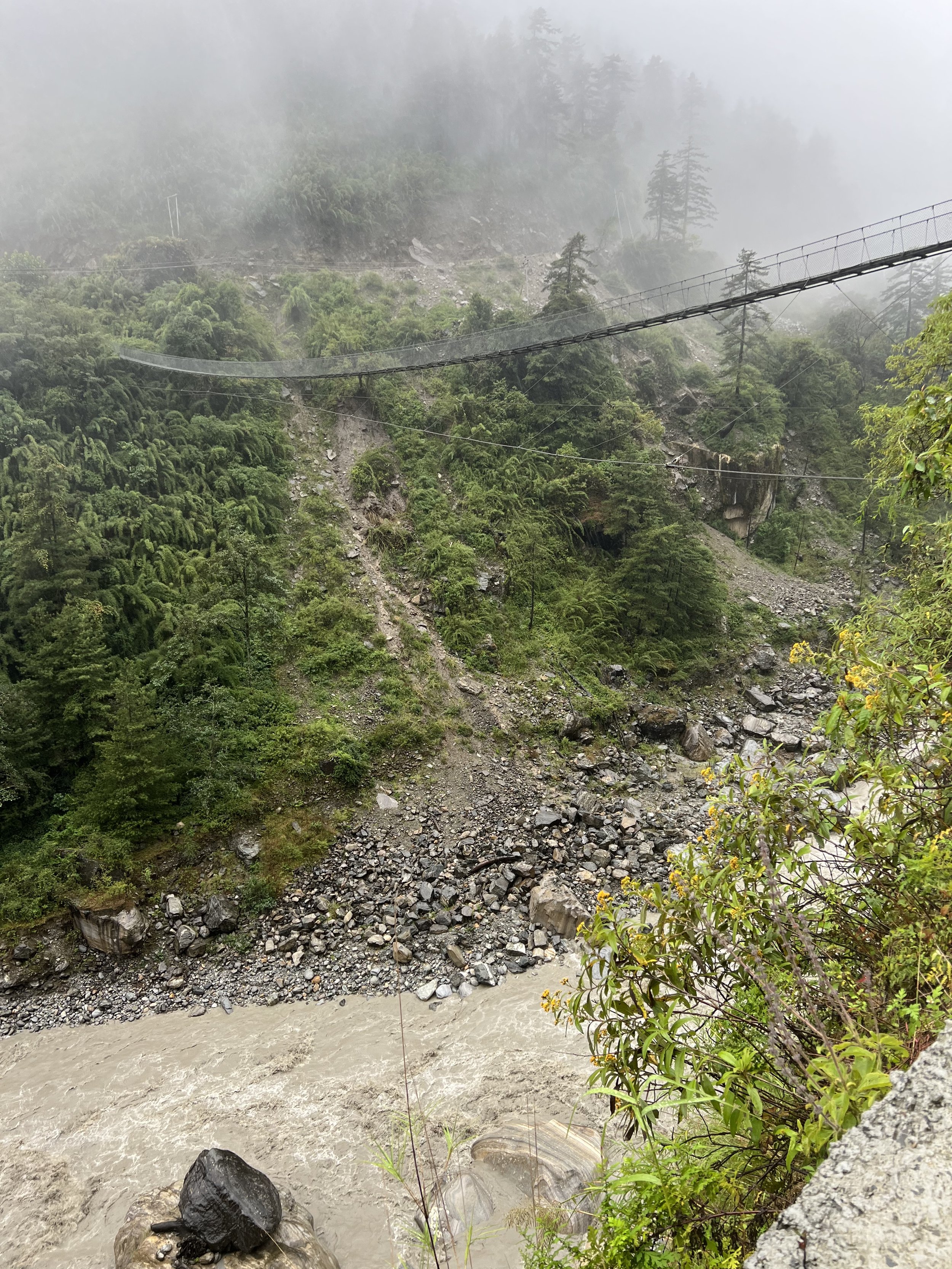
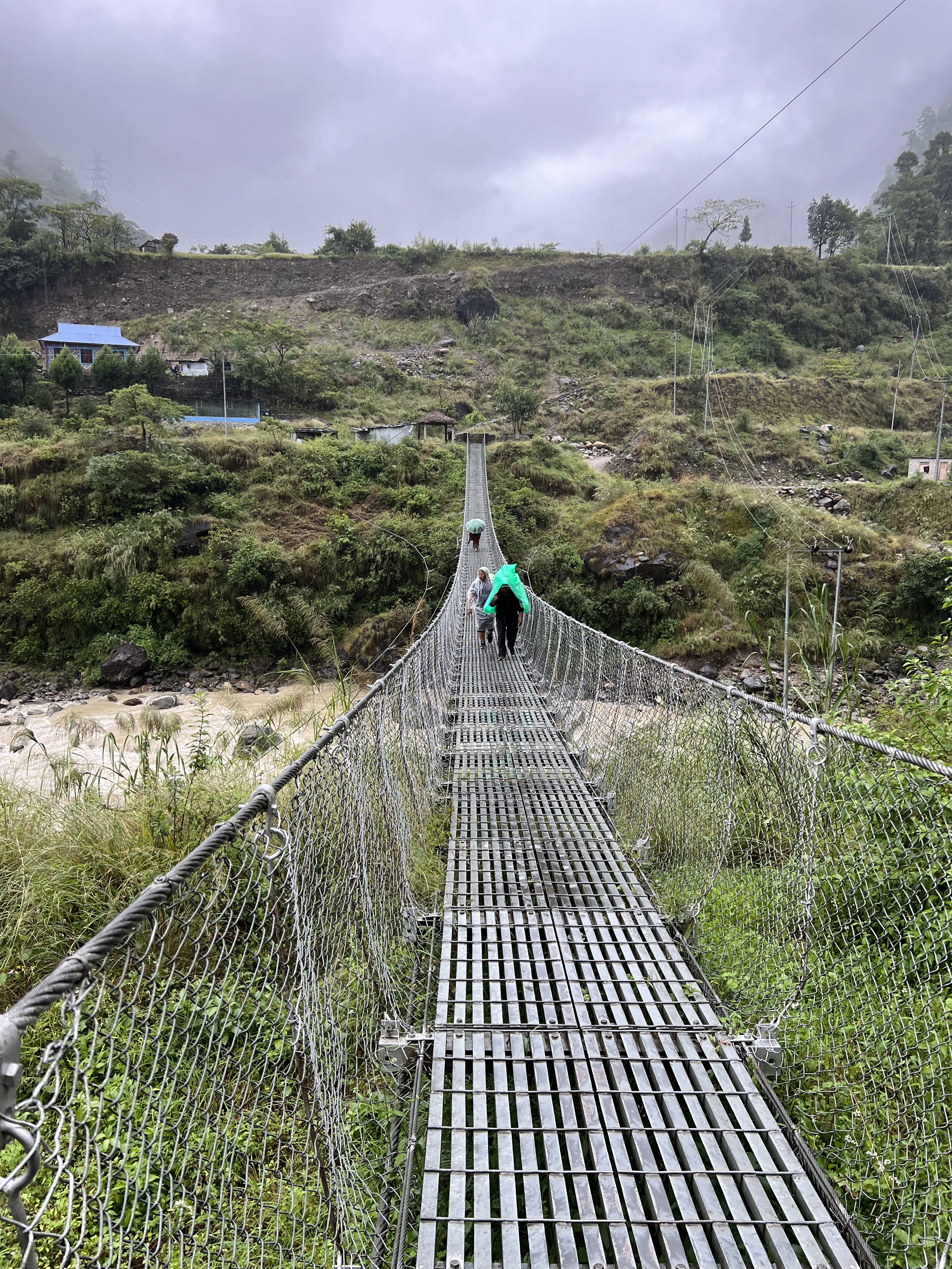
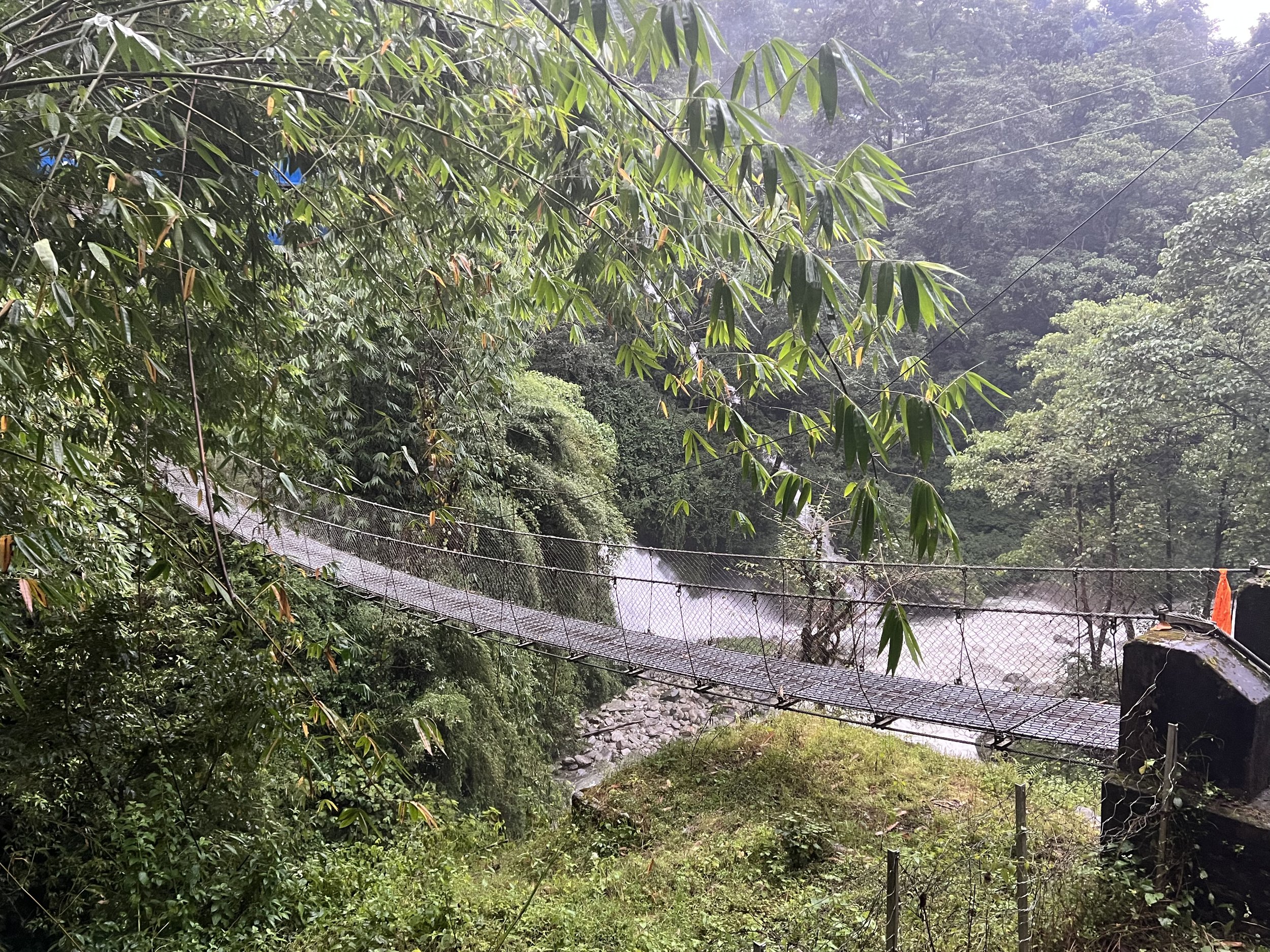
At that time, the most feasible option looked like walking south for eight hours, taking a jeep to the original slide, and picking up our waiting car on the other side. This seems hilariously naive to me now, though at the time it seemed daunting enough. It was pouring with rain, and we (I eventually understood) would have to cross one of those terrifying cable bridges over the Kali Gandaki gorge to walk on an old trekking trail on the other side. Weirdly, the day before, I had randomly decided to test my terror of these bridges by agreeing to take a route that required us to cross two medium-high and -long ones. I’m not sure even now what possessed me to engage in this practice session, but if I had not done so, I would be writing now from Jomsom, still waiting for a way out, because there is no way I would have agreed to cross the bridge over the gorge to start walking back from Mustang.
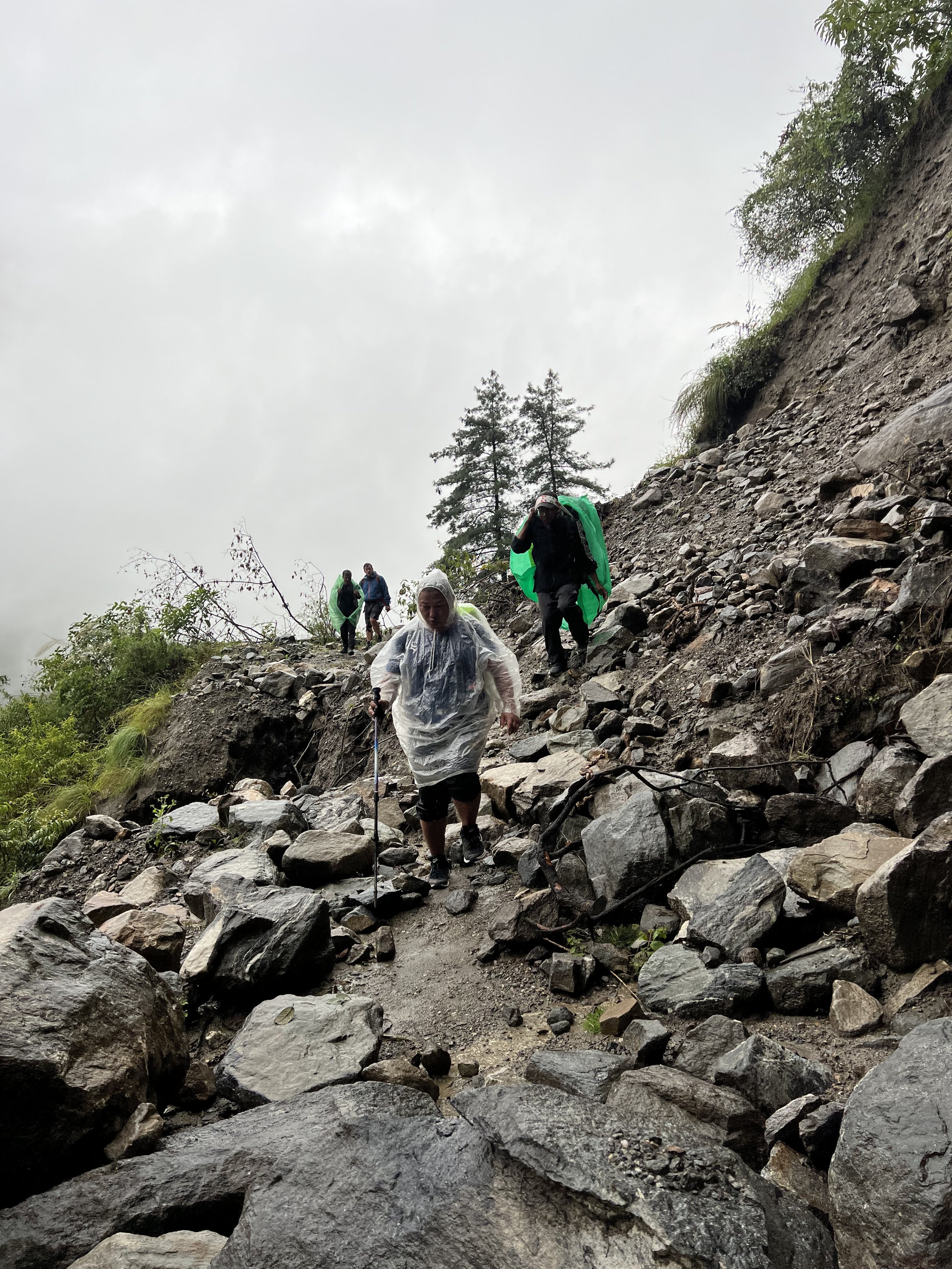
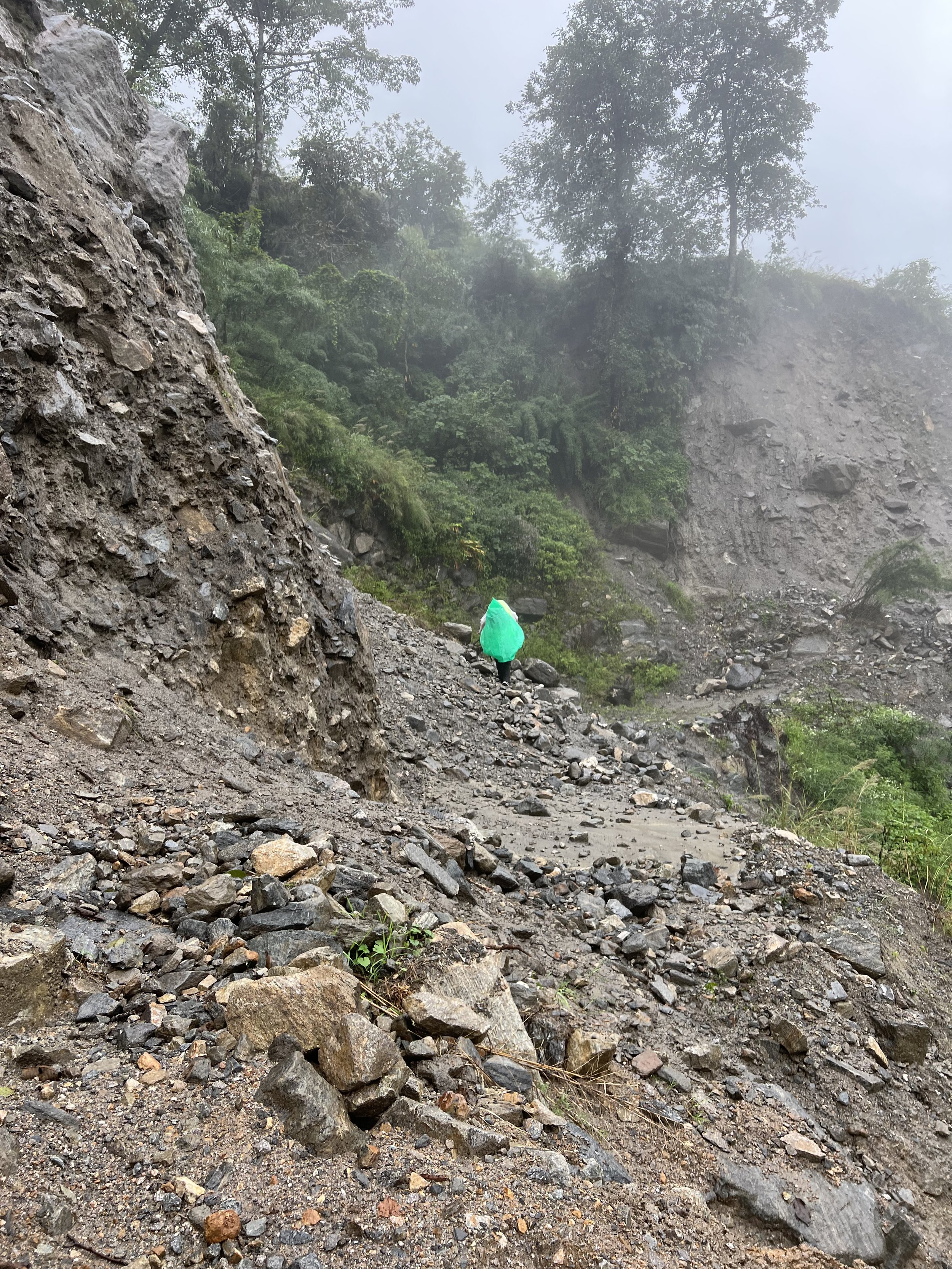
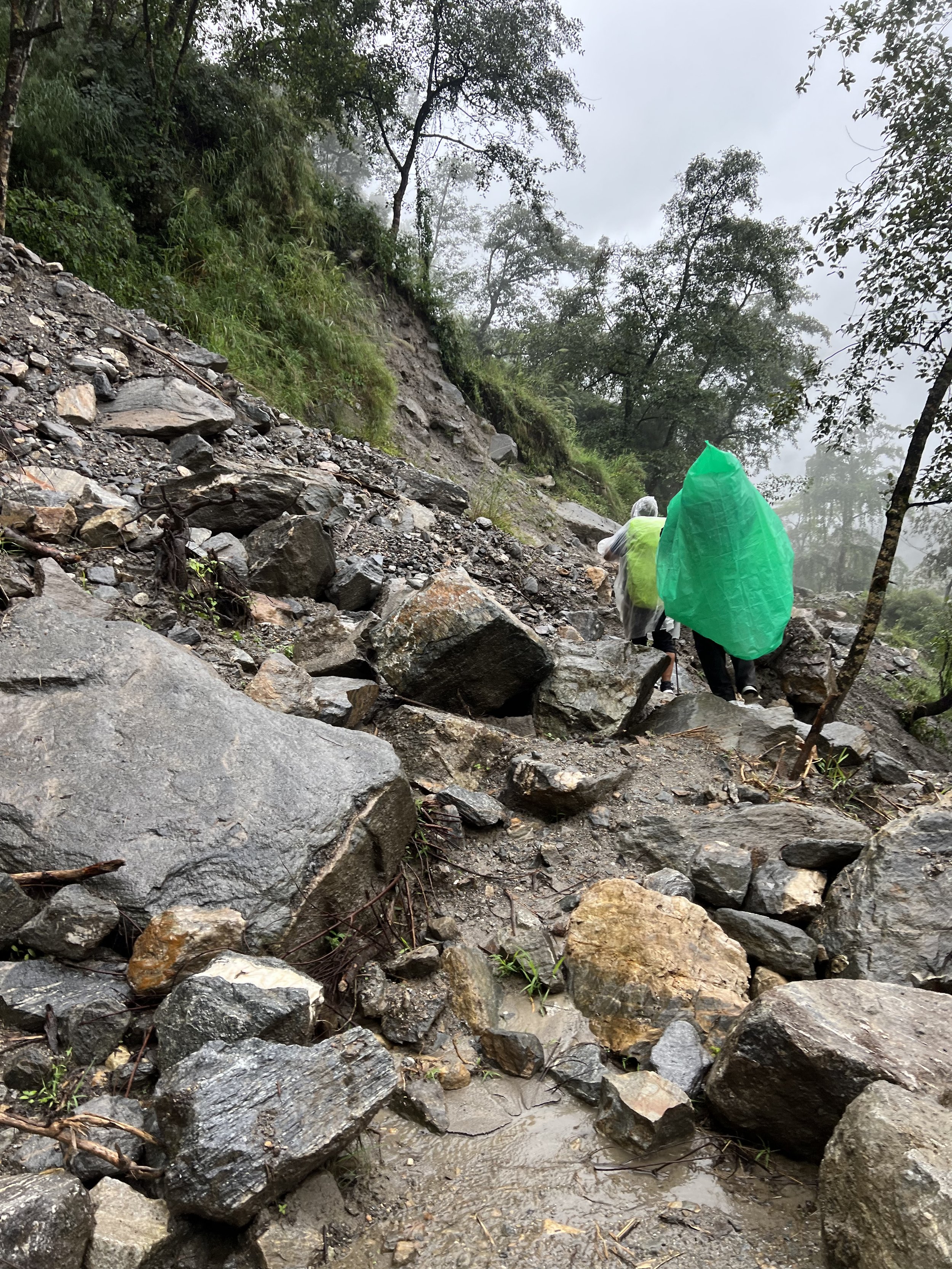
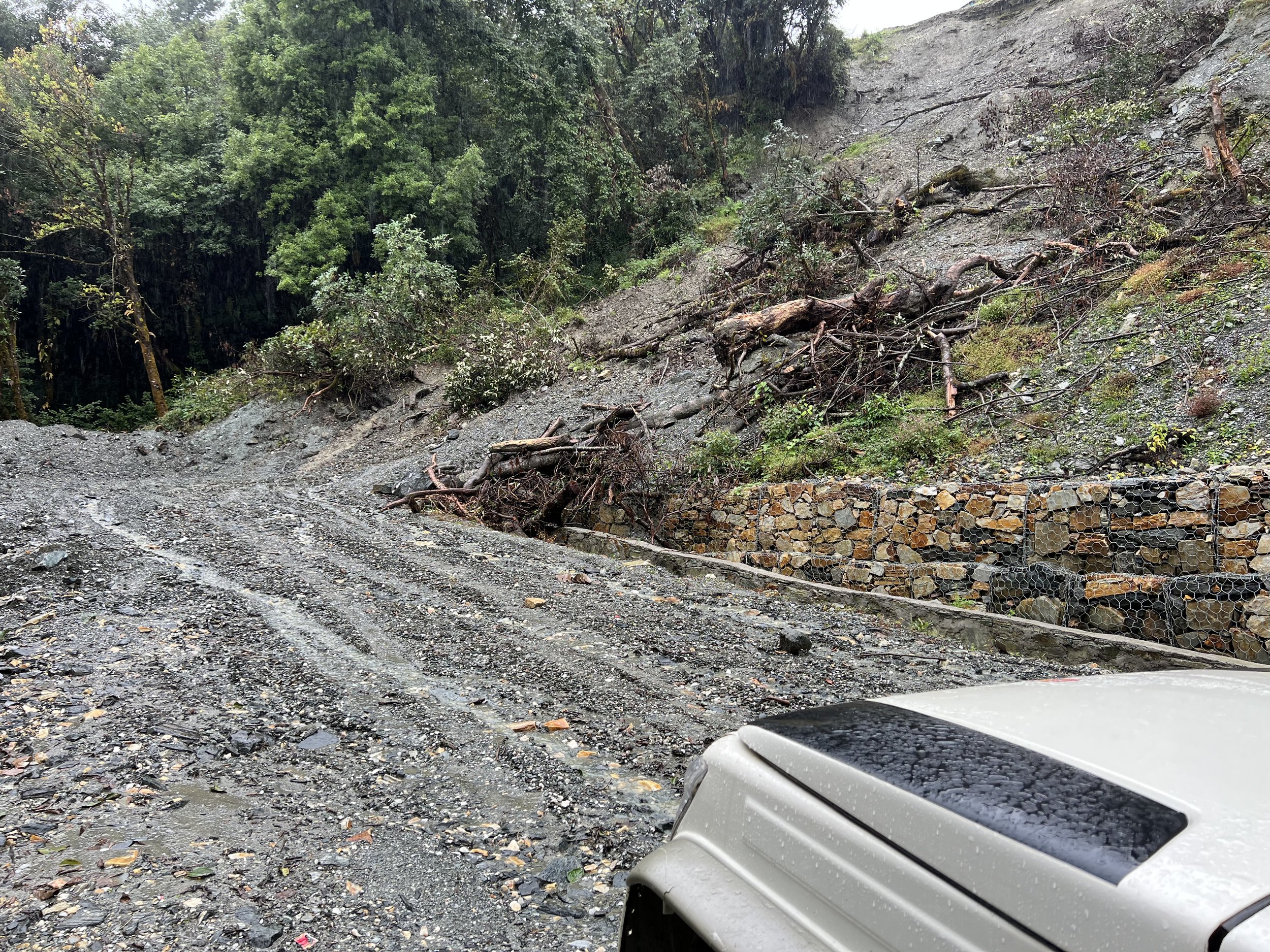
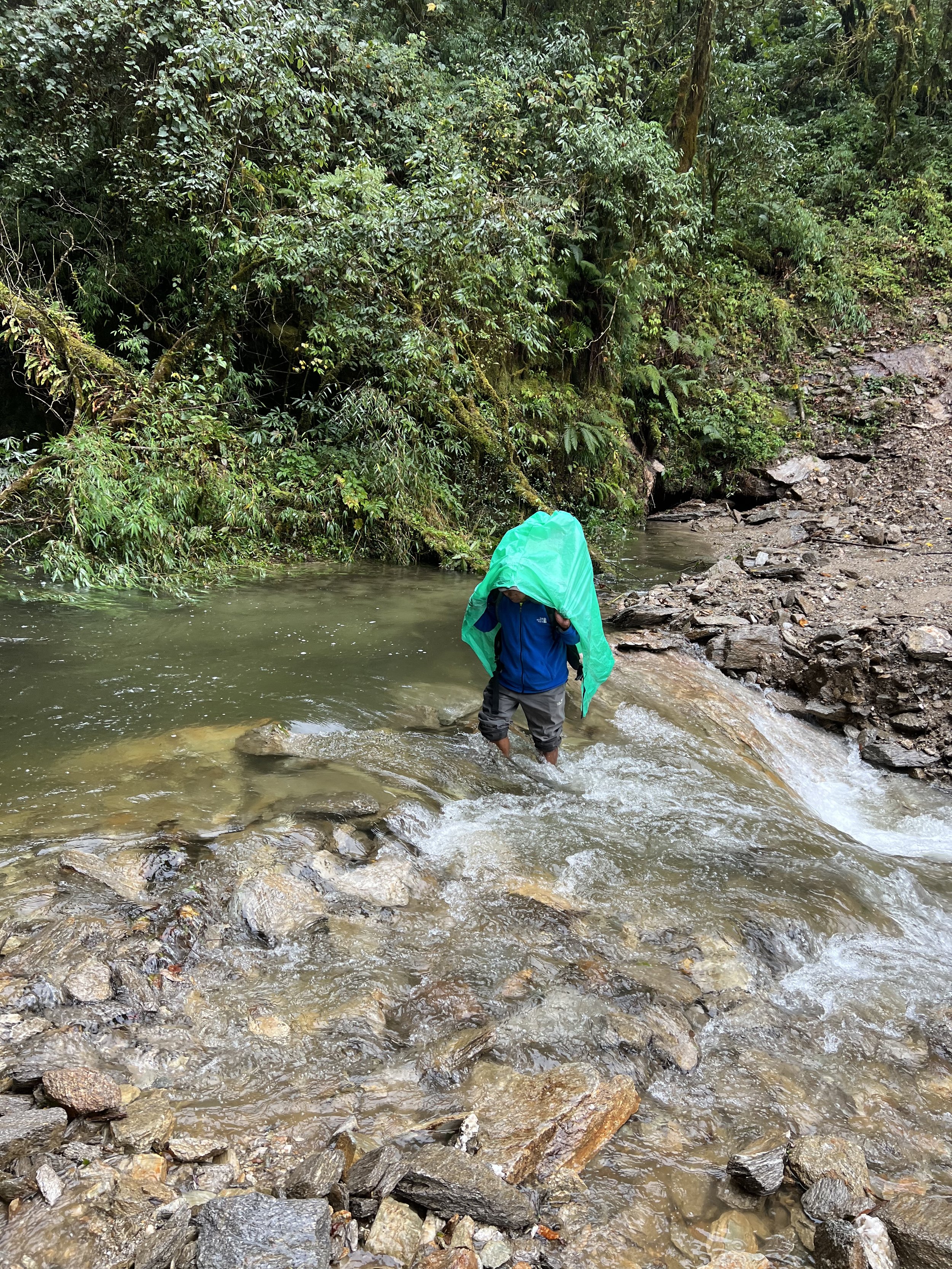
The afternoon’s walk was wet and leech-covered (yes, I finally got my first and only bite), but the trail was good enough for the first three hours. We joined another small group of one trekker, a guide, and a porter. Spirits were high, and we chatted with mountain bikers and teashop owners along the way. But then the slides started. The trail was starting to come down in the section ahead of us. Going back seemed pointless and we knew the trail was in more open land ahead—not prone to slides—so we crossed three recent slides of mud and boulders—dangerous as hell, but what to do? Looking back, I now understand that this was probably the most dangerous part of our walk. At the time all I understood was that we needed to go, go, go to get across the moving field of mud and boulders.
When we got to the place we had planned to cross back and grab a jeep, or walk (again on a cable suspension bridge—there would be eight more of these ahead for us) we looked down to see entire sections of the gorge above the road falling down on the other side of the river. Giant boulders were lying on the road where they had come down from above. Motorcyclists were still trying to head South, and I don’t know if they made it or not. We saw at least one motorcycle floating down the Kali Gandaki, and prayed the driver was alive. Ram took only a minute to announce that there would be no jeep and we would not be walking on the road for as long as possible. An hour or two more on the trekking trail and we’d be in the large-ish town of Tatopani. There would be a “regular” bridge over the Kali Gandaki and we could walk fast down a section of road, and take a jeep from Tatopani to the original slide. To my surprise, the guides’ phones worked all through this event, and they were in constant contact with drivers, their families, and the guides still stuck in Jomsom with clients (many of whom I had come to know over the previous ten days), who had made the decision not to walk.
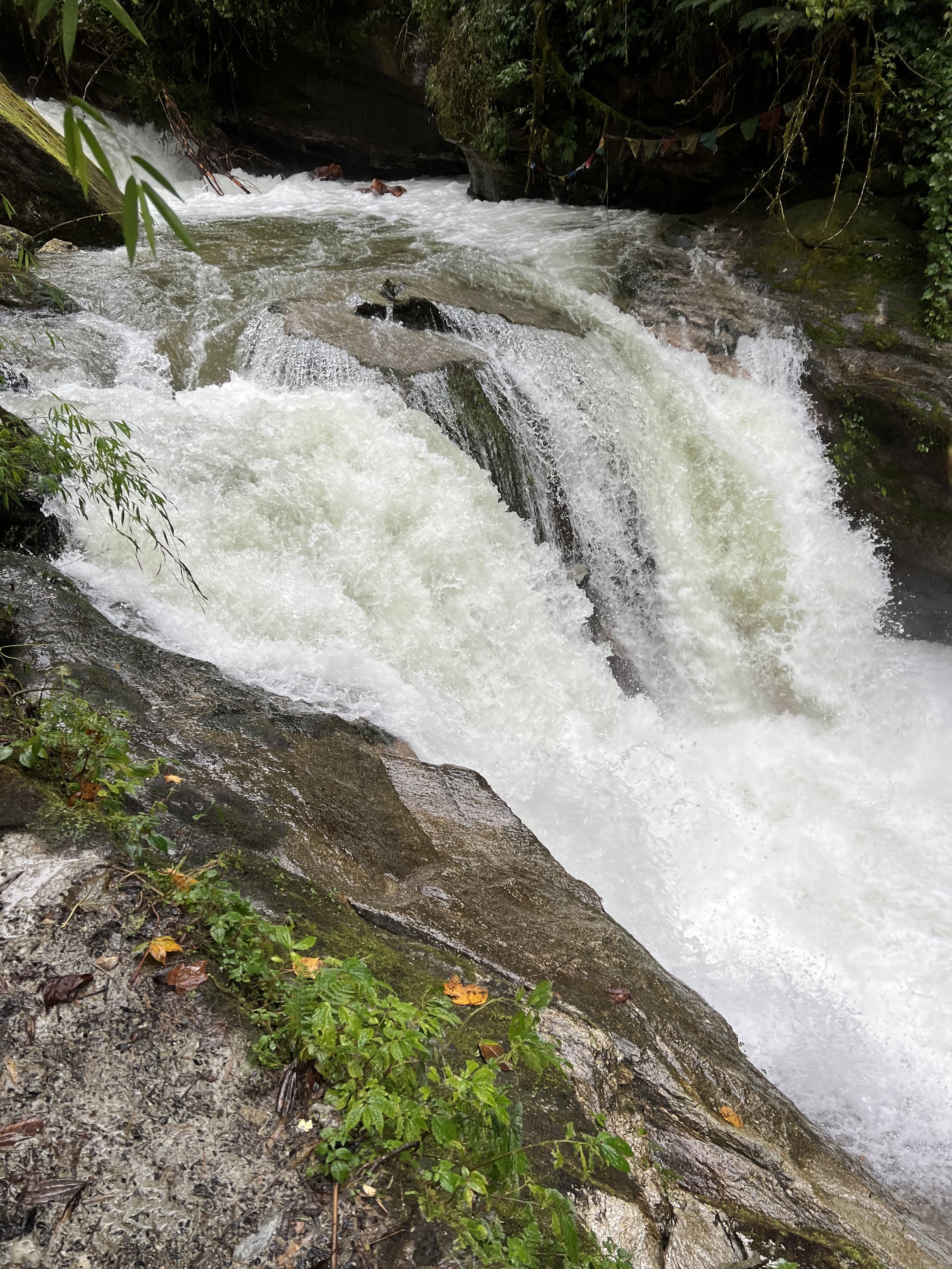
Landslides in Nepal are for the most part not a natural phenomenon. As numerous drivers told me, the development of motorable roads and the massive disruption blasting causes to the equilibrium of the natural environment have destabilized large stretches of the country. Add in climate change (you don’t get five-day snowstorms in Upper Mustang in early October, and it was pretty late for an all-Nepal rain event) and the transformation of the Nepalese economy to one reliant on imports—and hence to large numbers of huge trucks from India and China using the roads—and you have a recipe for ongoing natural disasters. I saw dozens of slides in my month there, but nothing like the chaos caused by the 5-day October storm. As I write, in fact, I’m sitting in a long line of traffic watching a bulldozer clear a slide on the road to Kathmandu in front of me. For the second time today. And it’s not yet 10 am.
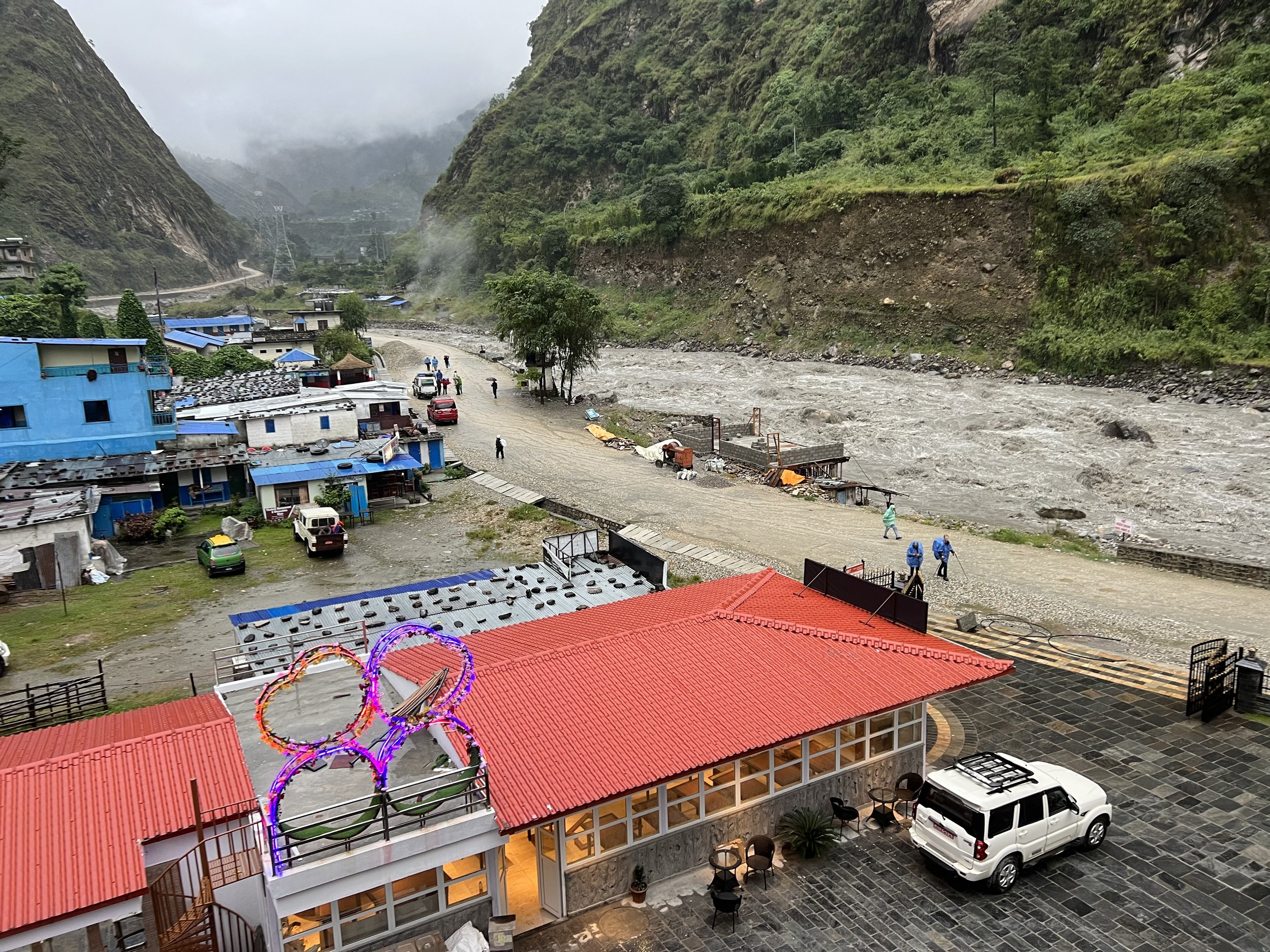
But back to our walk. We got to Tatopani around sunset. Aside from our earlier time on the slide, the short walk on the road to Tatopani was probably the most dangerous part of the walk. Large rocks were rolling off the hillside and bouncing onto the road. We walked as close as we could to the river side of the road and prayed, and we got to town in one piece. The place was full of groups of trekkers and motorcyclists standing outside in the rain clearly considering options. Not long before we arrived, a huge slide had started just South of Tatopani on the road. It was not crossable now and might well not be by morning. We watched guides and motorbikes walk South and return 10 minutes later. None of us was going anywhere tonight.
Ram was crestfallen. All his plans to secure a ride were crushed, over and over again. The jeep waiting on the far side of slide one was going back to Pokhara. If we could cross the slide near Tatopani first thing, maybe we could still get a ride to Beni and another from there to Pokhara, after walking across both slides (and assuming the road was walkable or drivable—which was looking increasingly unlikely). Otherwise, he told me—and here I have to say, my still minimal knowledge of Nepal’s geography left me flabbergasted by this news—if we could just get across the slide near Tatopani, we could walk to Pokhara on the old Poon Hill trekking route in the Annapurna region. The walk would take two long, rainy, doubtless leechy days. But if we could get to the start of that trail, just a half mile or so South of us, we could do it and we’d be largely out of danger. Because of our initial bail, I had five days to work with before I needed to fly to Japan. Suddenly, this worst case scenario looked like a pretty good, if uncomfortable, option.
Cheering up a despondent guide was about the last thing I wanted to do at this point. To be honest, I wanted to quit myself, or at least to curl up somewhere dry and consider what we’d just been through. My hand was still bleeding from the leech and we were so wet, water was pooling around us in the hotel lobby. But here’s the thing: Ram’s knowledge of the old trekking routes is what had gotten us this far. His mastery with securing drivers might yet come in handy. And only one of us was allowed to quit, or even to feel like quitting, at a time. If he could handle the jeep and trail logistics, I could handle the emotional logistics. We grabbed dry clothes, headed to a small restaurant full of guides, ordered the first food we’d had since breakfast and two small bottles of rum (they had already run out of whisky), and got fed and just the right amount of drunk.
It was a rough night, nonetheless. The thunder and lightning we’d seen in the forecast really kicked in around midnight, and I spent most of the night trying to figure out—through observation and research—whether a gorge gives you any protection from lightning strikes. It rained hard all night as well, and I could hear slides both on the road and behind us in town. I went looking for coffee at first light expecting to find the hotel lobby full of guides and trekkers, but apparently no one else thought getting up and out as early as possible was a priority.
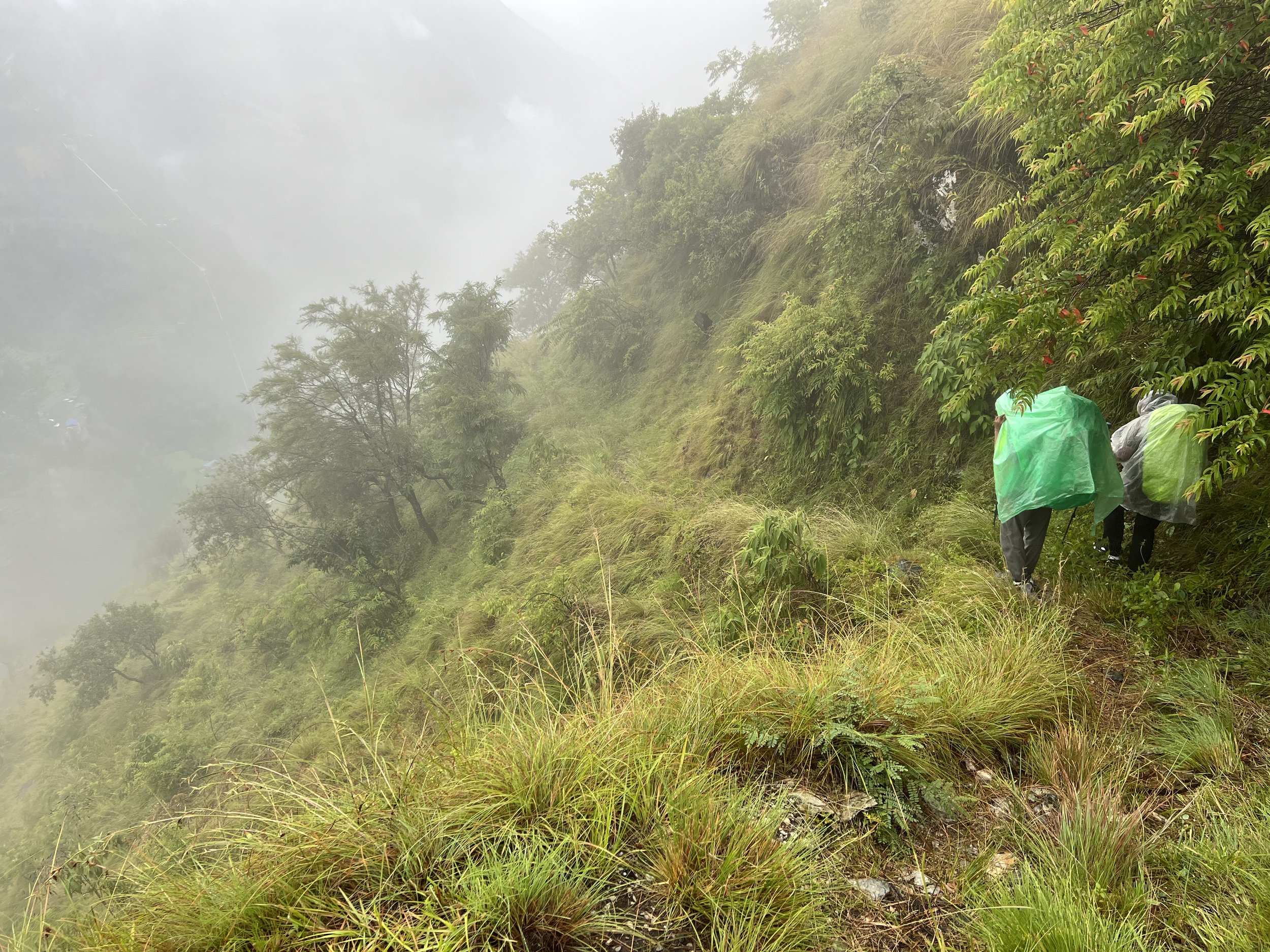
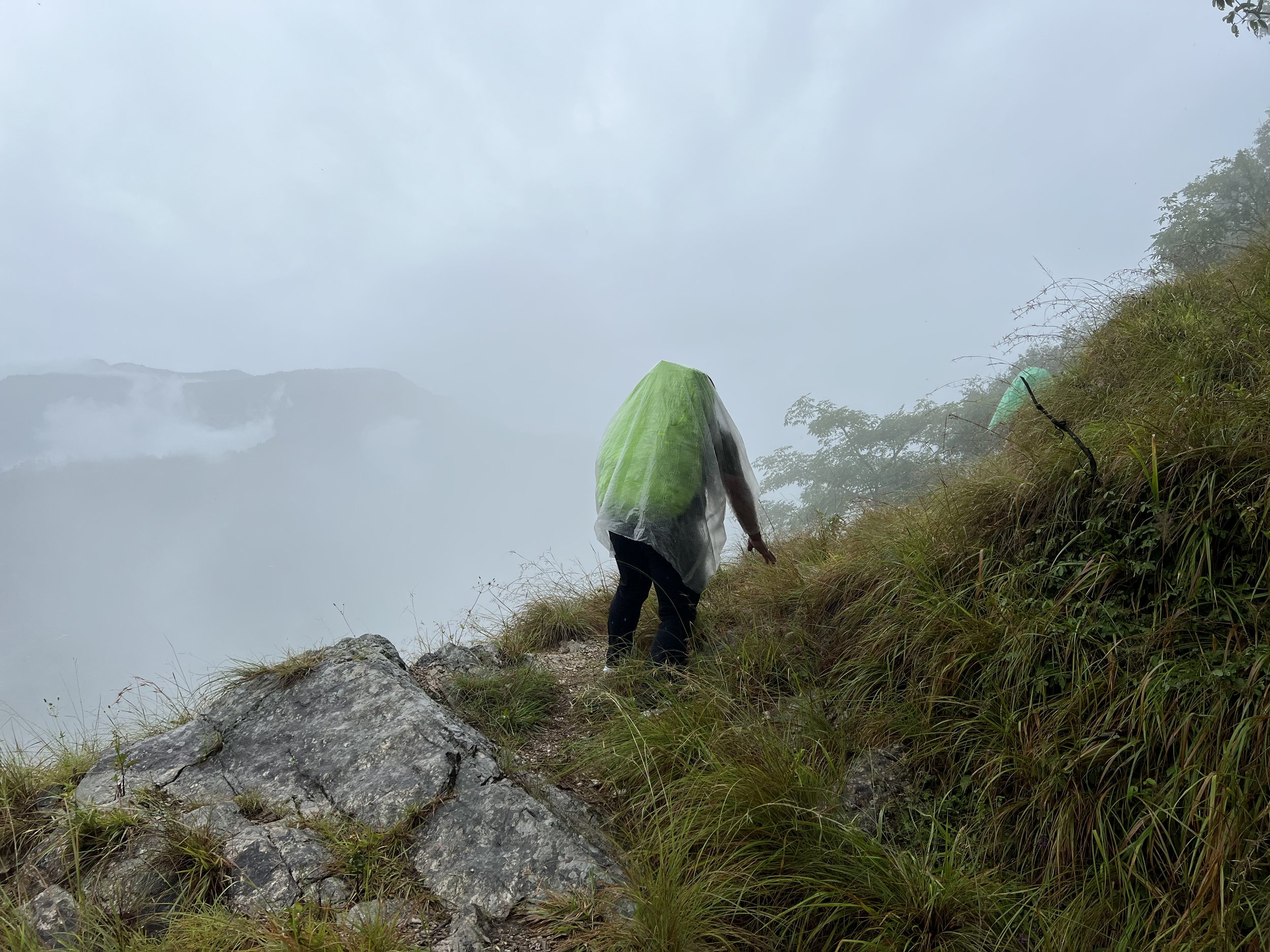
Still, over the next few hours, as the lightning slowed and mercifully petered out, groups began walking south. Nearly all of them returned within a matter of minutes. The guides—the credible ones at least—deemed the slide unpassable. It was “still running,” as they say here, meaning debris was still coming down in unpredictable waves onto the road. Stories began to circulate that there might be an old route straight up the side of the gorge wall behind town, up to and across the top of the ridge, and down the other side of where the slide was. In total it would cover a quarter mile of road, but it would take a few hours and a lot of sweat. Some locals told the guides it would be impossible for any of us to cross and that there was an exposed section where falling would mean a quick trip all the way to the river. Others shook their heads and said the route was “no problem,” though the walk up was steep and more than an hour long. In the end, I saw a large Nepalese family headed up, including a young woman in flip flops with a baby strapped to her back, and I told Ram we were going. The situation in Tatopani, while relatively stable, was bleak, and anyway, conditions were only supposed to get worse over the coming four days.
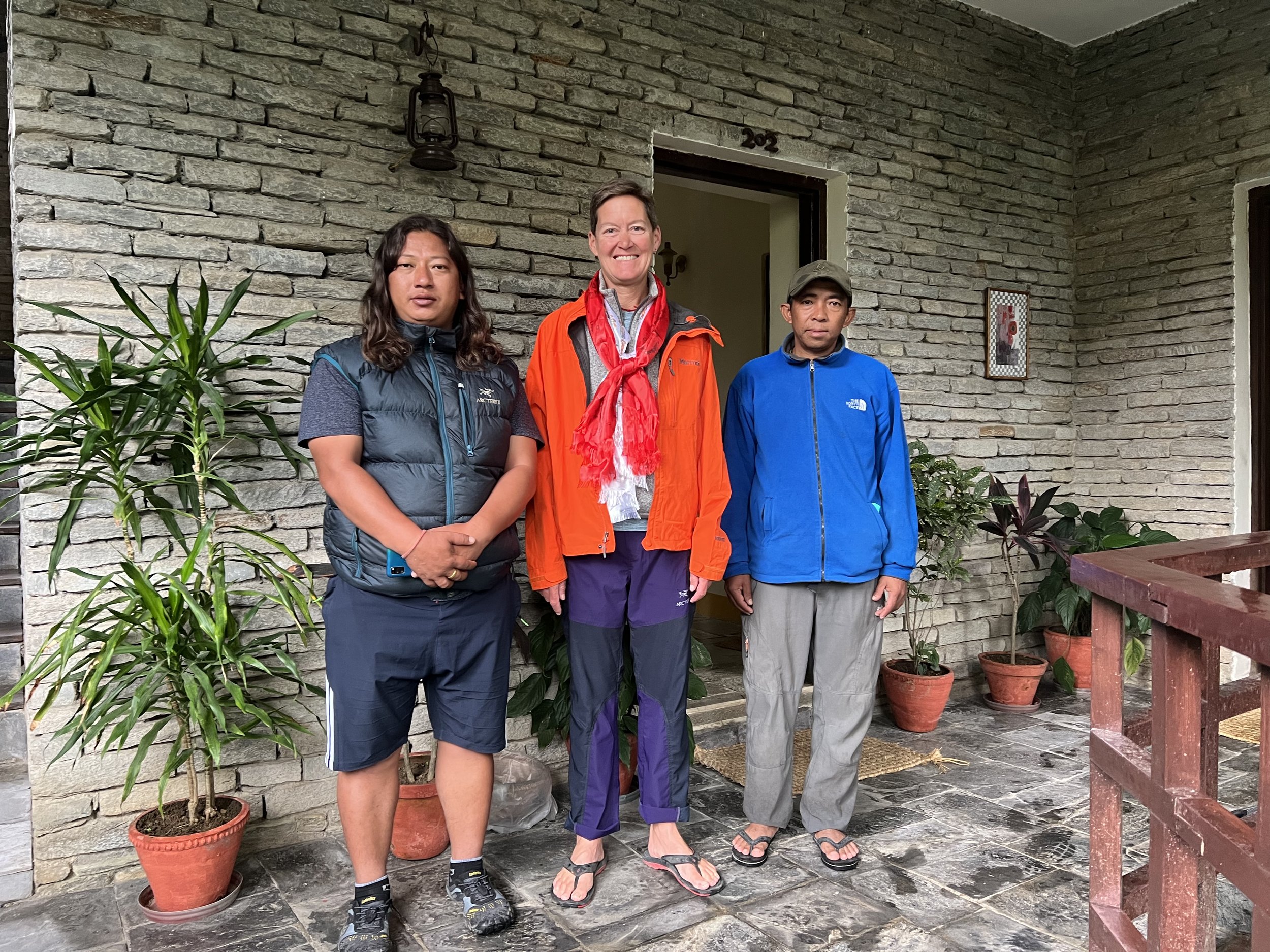
The climb up and over the gorge was strenuous and wet, but there was a feeling of camaraderie in the long line of Nepalese families and trekkers, guides, and porters. I didn’t fully understand the significance of what we were doing until we reached the other side. We walked up an old stone road until we came to a small house where two Nepalese grandmothers were standing outside the house in the road, directing traffic. They pointed to a tiny trail through the grass and trees, which they said would cut at least an hour off our time. How they knew what we were all up to, I don’t know, but it was clear that the word had spread. We kind of bushwhacked our way up through the trees. There was indeed one very exposed section, and Ram was terrified (he’s afraid of heights), but Man the porter led the way and we got across without much difficulty. He asked me if I was scared of falling, and I told him I thought the trail was “very good.” After crossing the exposed section, we walked 1000 feet down a slippery narrow trail on the other side. When we got to the road, Ram looked at me and said, “we are completely safe now.” It surprised me–I had not realized either how worried he was or that this was the end of our real hazards. He told me he had cried on the way over the mountain thinking of his two daughters. I myself had crossed the first of the cable bridges the day before chanting the names of my most dear ones. At the end of the day, you just get through it any way you can, because if you remember the people you love, you know you don’t have the option of quitting, for them, if not for yourself.
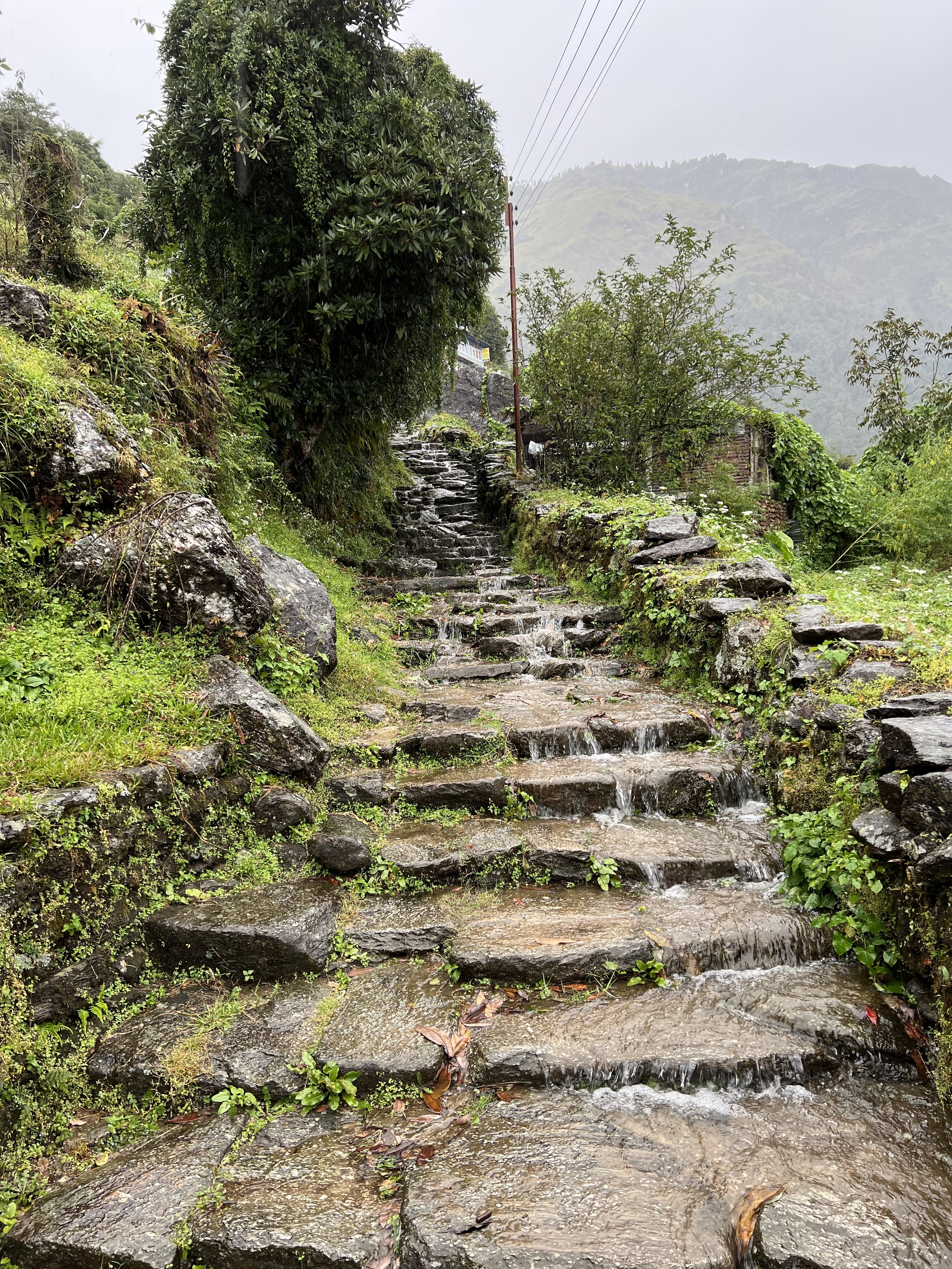
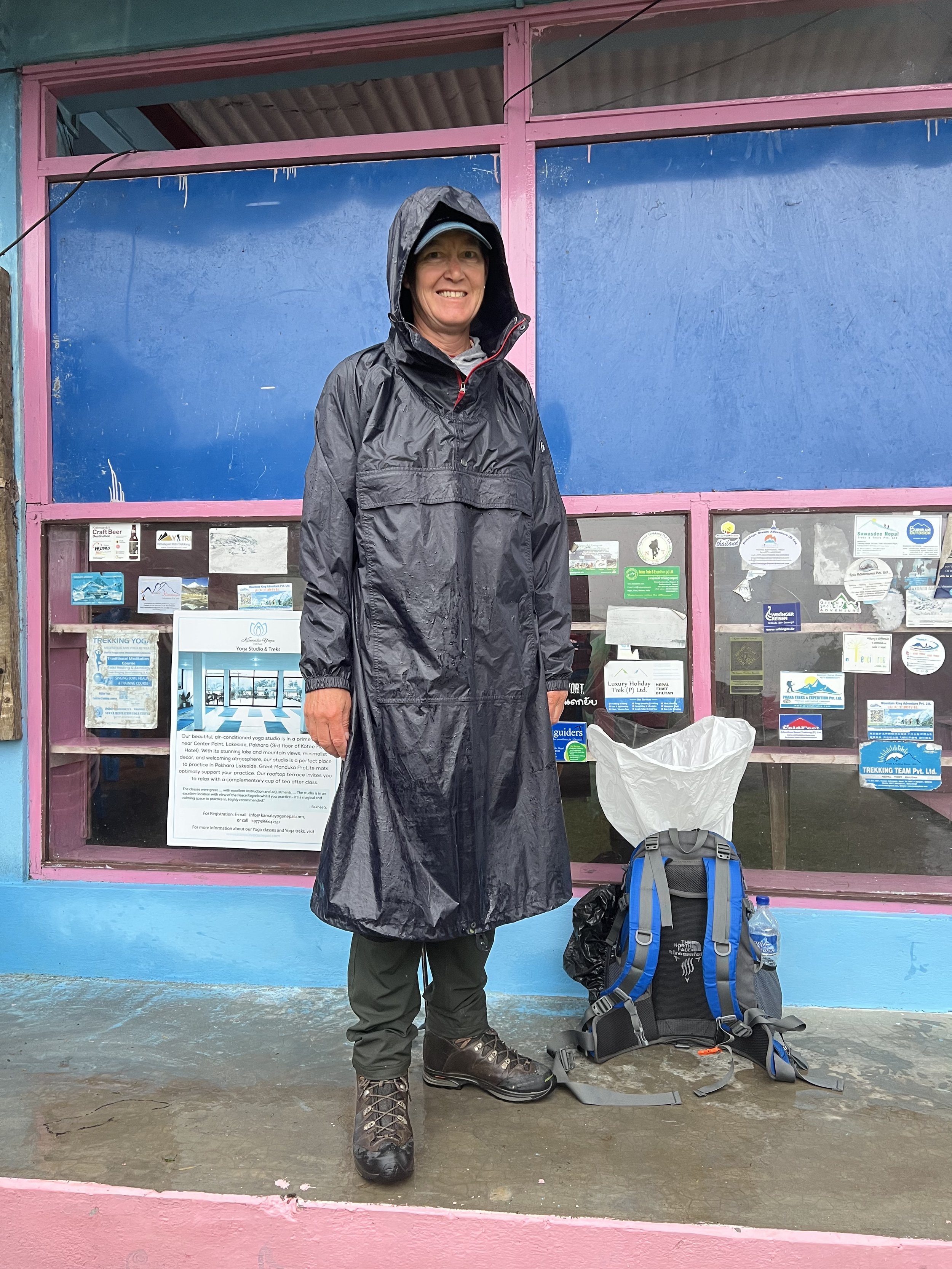
The rest of our trip was uncomfortable but non-life threatening. And at least for me, mercifully leech-free. Ram worked his magic and cut nine hours straight uphill of walking by securing a jeep near the place where we reached the road. The jeep took us up for 45 minutes toward Ghorepani, the high point of the Poon Hill route toward Pokhara. We reached a slide on that small jeep road, and the confederacy of drivers came through–another truck soon met us on the other side. This was pure grace, and allowed us to imagine we could reach Pokhara–or close to Pokhara–that very day. We ate lunch and dried out a bit on the top of the ridge at Ghorepani, and then started a four-hour unbroken descent on stone steps. Walking on stone steps that have turned into rivers is, at least for me, incredibly challenging, and I was genuinely afraid that I would fall and put us into yet another set of difficulties. You have to concentrate with every step, and the pounding on the body is intense. We were moving fast to try and reach one, final jeep that Ram had secured for us to go to Pokhara. We needed to get to the jeep by nightfall. I was soaking wet and definitely feeling exhaustion. If worse came to worst, we’d find a teahouse on the stairway to the road and rest for the night, but that would mean another 10 or more hours of rainfall to potentially cut off the road.
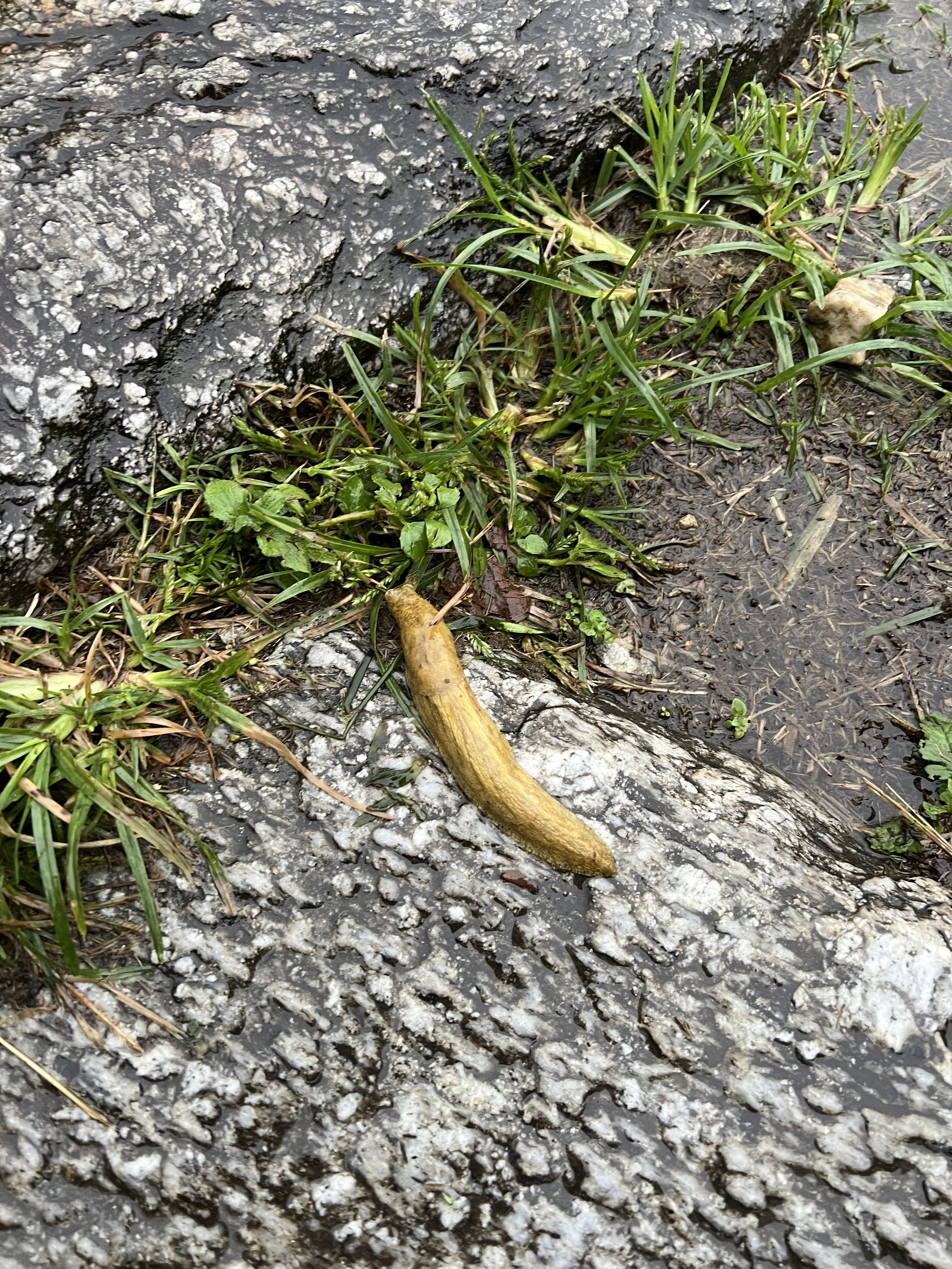
Three and a half hours in, I was done. I felt like I couldn’t descend safely, and was just about to tell Ram, that’s it, we have to stop. I came around the corner in the staircase and stopped to wait for Ram and Man to catch up so I could tell them it was time to quit. It didn’t matter that we were half an hour from the car. I just felt like I couldn’t go on. Waiting for them, I looked down at the ground and was amazed to see, sitting quietly on the stone steps: a banana slug. A banana slug? Like, the iconic mascot of UC Santa Cruz? I burst out laughing and Ram and Man probably thought I was hypothermic. They couldn’t quite get the significance–apparently banana slugs are common in Nepal–but for me, it was all I needed to finish the route. Sometimes grace arrives in grandiose ways, and sometimes in small and discreet ones. I’m not sure who sent that little yellow friend, but I’m forever grateful.
We crossed a couple of final cable bridges over small torrents–thankfully, they were short ones–and found our jeep. We headed to Pokhara in the densest fog I have ever experienced, bouncing over rutted roads and repeatedly getting stuck in the mud. We were still in our wet clothes and the driver couldn’t go more than a few miles per hour. By the time we arrived around 9 pm, I was only barely awake, and there was neither hot water nor food at the hotel in Pokhara. None of that mattered. There was one more major obstacle ahead–what turned out to be an 11-hour jeep ride to Kathmandu through slides and traffic jams–but there was also a palpable feeling of the obstacles being workable, with patience. I won’t say those drives weren’t hazardous, but they were out of my hands. I had to trust the drivers, and thankfully, through their expertise, I ultimately made it to Kathmandu with a couple of days to rest and reset.
I know it will be a while before I’m able to fully metabolize the experience of walking out from Mustang. It’s the closest I’ve come in more than 30 years of mountain travel to not making it out. We did things I would never have done in other circumstances–crossing slides and walking on a road that’s shedding boulders chief among them. There were numerous moments at which the edge between the wisdom of quitting and the wisdom of not quitting was almost imperceptible. It helped that among us we had a lot of experience in mountain environments, but experience alone was not enough. At one point early on the first day, Ram asked me if I was frightened, and I said, “no.” He asked me why, and what came out of my mouth was, “I have great faith.” By that I think I meant, not that I had faith that we would make it out, necessarily. There was no way to be sure of that. But I had faith that, whether we made it or not, everything would be ok.
Everything other than my trusty boots is dry now. I think it will take them a few days to recover. The same, I’m sure, is true for all of us who walked out. I’m grateful to have a couple of days to rest, and a good week before we start our walk in Japan. Basic needs like sleep, food, and connecting with loved ones are proving restorative, and writing is more helpful than I would have imagined. Sometimes writing, too, is a form of integration. I’ll go to Boudinath stupa at sunrise tomorrow to walk the khora with the devoted here in Kathmandu before leaving for Japan. Walking and praying, still, and always.


 Walking and Praying
Leave a reply to Carla F Cancel reply