We’ve just finished day 20 of our 45 day pilgrimage, and we’re deep into what I recently heard someone refer to as “the heart of the walk.” The designation makes a kind of sense. We’re tracking toward the southwest corner of the island, having started in the Northeast. We’re close to halfway done, both day- and mileage-wise. And we’re a few days away from entering our third of four prefectures—and ending the period called spiritual or ascetic training.
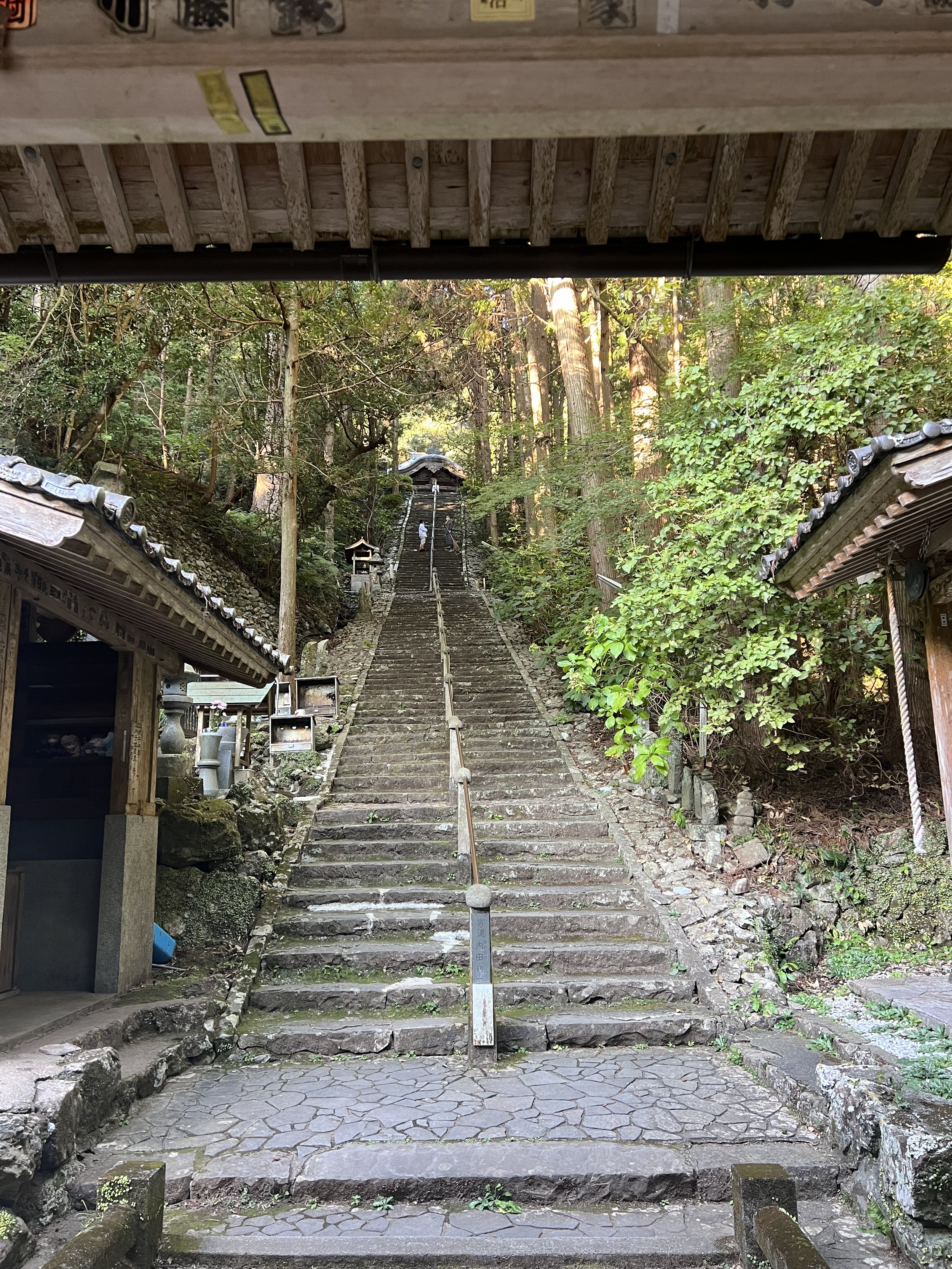
On this 28 km day, I had plenty of time to think about this “heart of the walk” designation. In particular, I thought about something a young Belgian guy who lives here, François, said to me, on a gorgeous walk a few days ago, after we left Shōryuji, temple 36–a temple with an impressively long set of stairs to climb, in the spirit of ascetic training—and began the long, long section that follows.
I’d spotted him at the vending machine outside the temple the evening before. I think he’s the first non-Japanese Henro I’ve seen since day five or six, and I fully admit I went bounding up to him as though he were a long lost friend. He responded in kind. We chatted a bit and I learned that he lives in Fukuoka with his Japanese wife and walks sections of the Henro when his banking job permits. We parted ways at the top of the stairs a little wistfully, at least on my side, and it seemed maybe also on his, and headed off to our respective lodging.
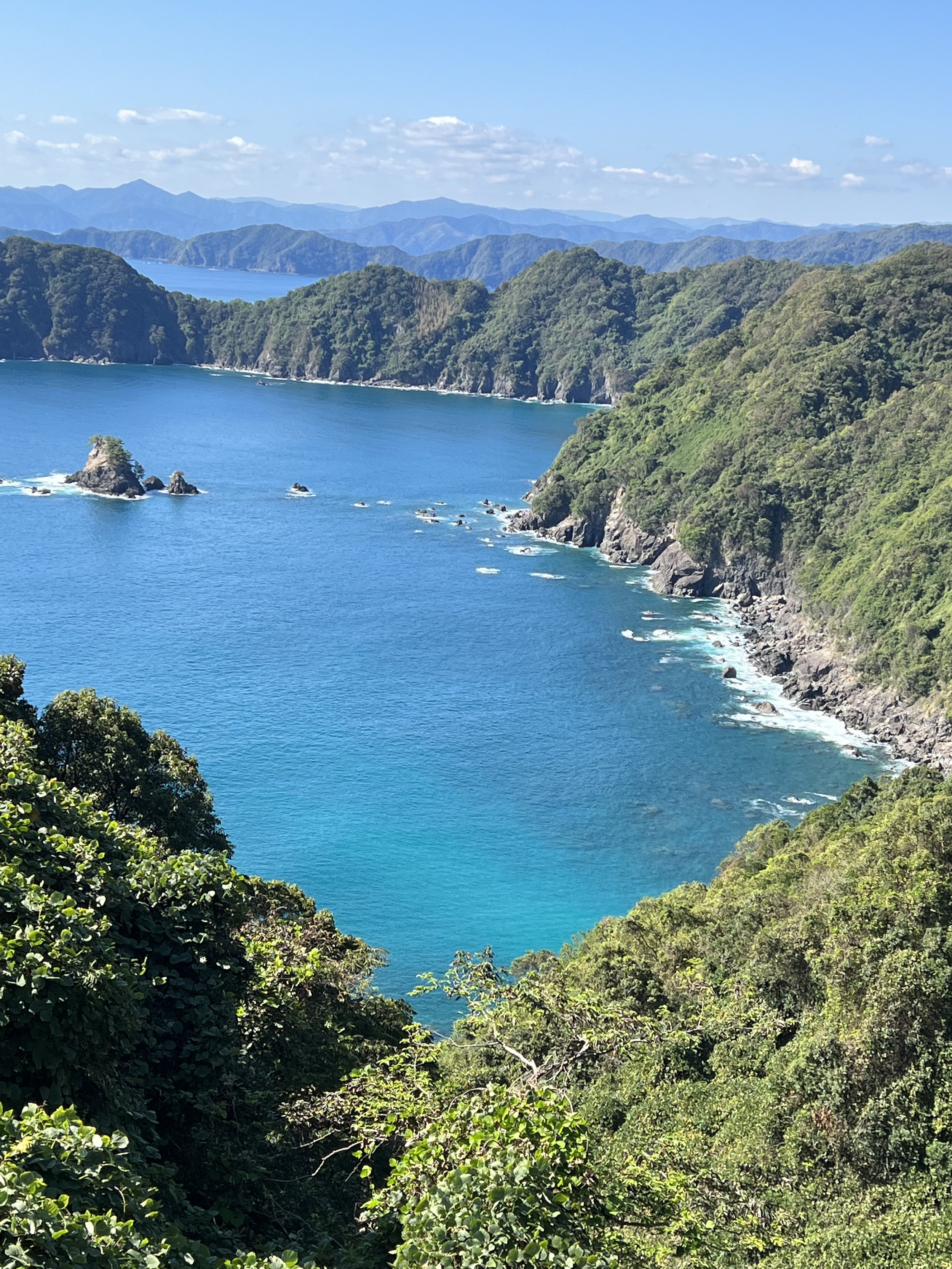
I can’t exactly remember how we found each other the next morning. We were all scheduled to walk a gorgeous section of the route called the Yokonami Skyline—impressively hilly and with breathtaking views. We connected in the flatlands early in the morning and ended up walking the hills together for the whole day through a section of highway that looks like nothing so much as a portion of the northern California coastline. Even more amazing for me, it is full of motorcycles on a Sunday morning, just like the Skyline Boulevard that runs south from San Francisco. For once, I was feeling at home.
At some point, François mentioned the idea that this is “the heart of the walk.” He suggested that this prefecture is devoted to spiritual discipline precisely to prepare us for the section from temple 36 to temple 40. Whereas at the beginning of this thing, and again next week, we might visit six temples in one day, between temple 36 and temple 40, you travel for something like 10 days to visit six temples. At one point there are 82 km or 50 miles—three full days of travel—between two temples, 37 and 38. In addition, there is a remarkable out-and-back trip to be made to finally reach temple 38, which sits at the bottom of a spit of land called Cape Ashizuri.
There are all kinds of legends associated with this part of Shikoku. there is even something called the seven wonders of Ashizuri. One part of the lore involves a belief that you can set out by boat from the Cape, or even wait on the shore, and meet with loved ones who have died. We traveled for many days with a wonderful pilgrim who lost his wife three years ago very suddenly. She was only 54. He walked the Henro right after she died because, as he told me, he “couldn’t think of anything else to do.” He is walking it again right now to arrive on Ashizuri on the third anniversary of her death. The place is powerful not only for people walking the Henro, but for many Japanese of all walks of life, and I’m very excited to be on the Cape and en route at last to temple 38 in just a couple of days.
The trip from temple 37 to temple 38 takes three days. We walked to 37 in the pouring rain all day, and found a weirdly modern temple with hippy slogans inscribed on the stairs. Knowing we’d be on the road for many days before seeing another temple, I rang the bell extra hard, as rain poured over my hands onto the bell rope.
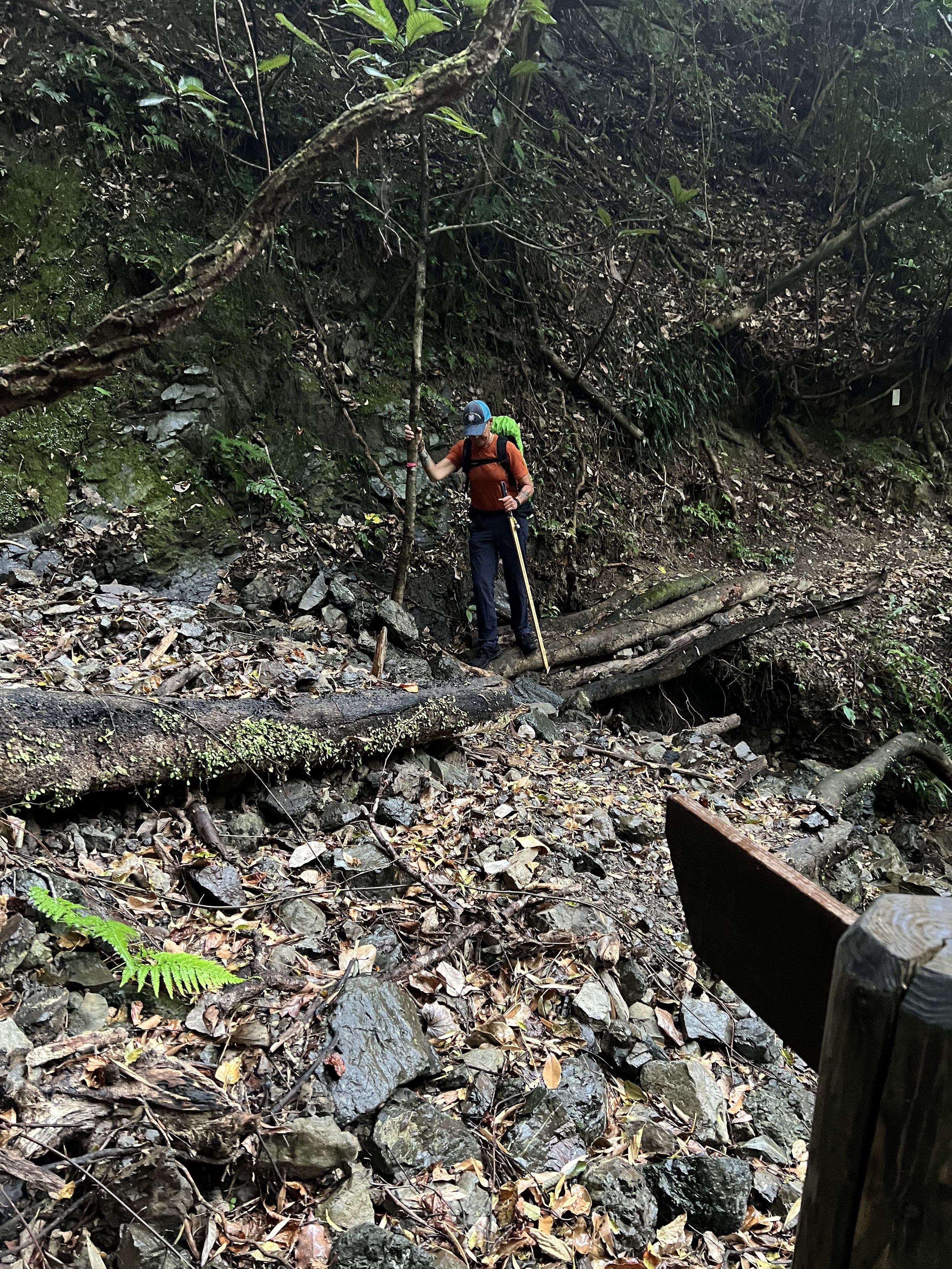
In the version of the route we are doing, you walk for two days after temple 37, then stay at a guest house at the top of Cape Ashizuri. You offload as much of your stuff as possible, leave it at the guesthouse, and then walk the 23 km down to temple 38. You spend the night at a guesthouse there, and then you retrace your steps the next day to pick up your stuff before setting off at the beginning of your northward journey. Temple 39 comes a day later, and then, on the following day, you cross from Kochi to Ehime prefecture, and your spiritual training is no longer your exclusive focus, or maybe it’s better to say, the spiritual training wheels come off. Also between 39 and 40, the walk, in terms of distance, is more than halfway done.
It just so happens that we will walk to temple 38 and back at exactly the midpoint, timewise, of this pilgrimage. How the spiritual training is going, I cannot really say, but I will say that today was the first day I walked without pain in my legs or feet. As I mentioned, it was a long one, and humid, so I was grateful not to be battling with aching shins and arches.
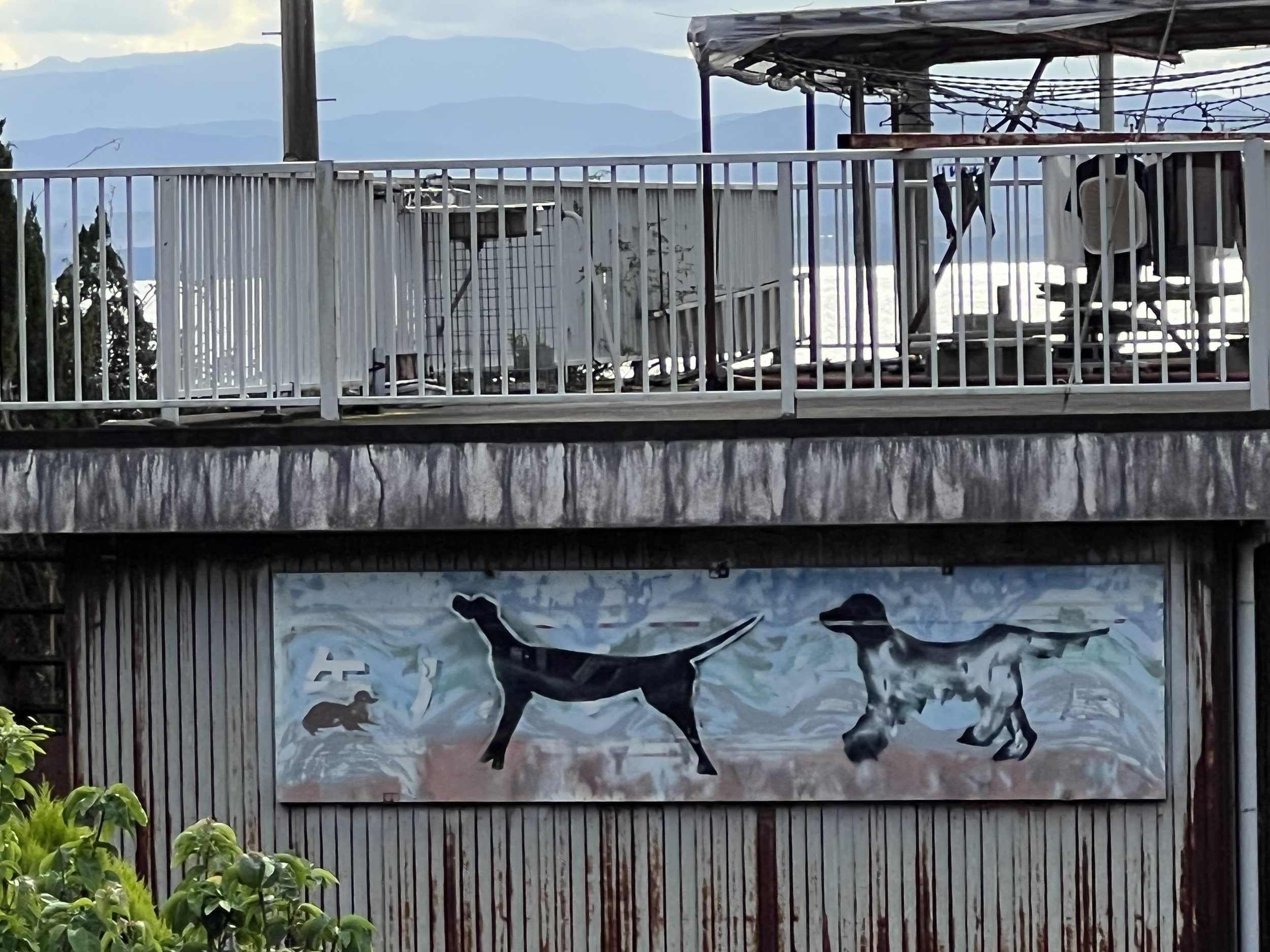
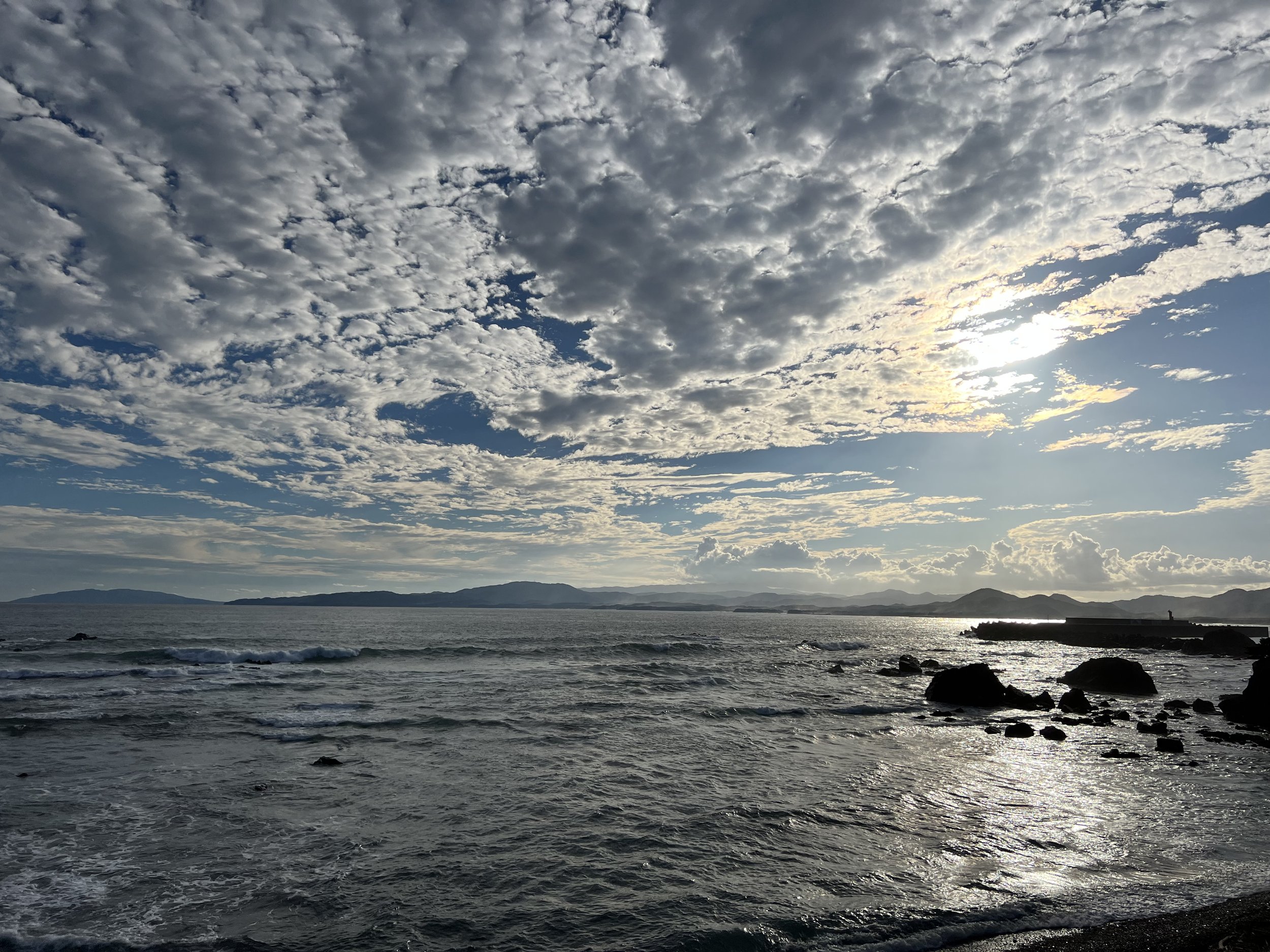
I also felt truly encouraged today by the fact that we popped back out on the water. We had lunch, as we often do, OK nearly always do, at a convenience store, and I laughed as I walked out the door to see a giant basket of the surf wax known as Mr. Zog’s Sex Wax that is ubiquitous in Santa Cruz and stashed all over my house. I’m kicking myself that I did not have the courage to stop and take a picture. We ended the day, for the second time on this trip, and once again after a long hot walk with no temples, in a little surf town. There was a Kōbō Daishi statue to meet us at the entrance to town and a rather wonderful mural of some happy dogs. And then there was another guesthouse, right on the water. Once again, I can hear the waves from my bedroom. Once again, I am encouraged by the great roar of mother ocean and reminders of home. I can see Cape Ashizuri through the mist, waiting. The name of this guesthouse is Umibōzu, ocean monk (although it’s also the name of a mischievous sea spirit-we’ll leave that aside for now). I’m feeling quite welcome and in the embrace of the familiar here.
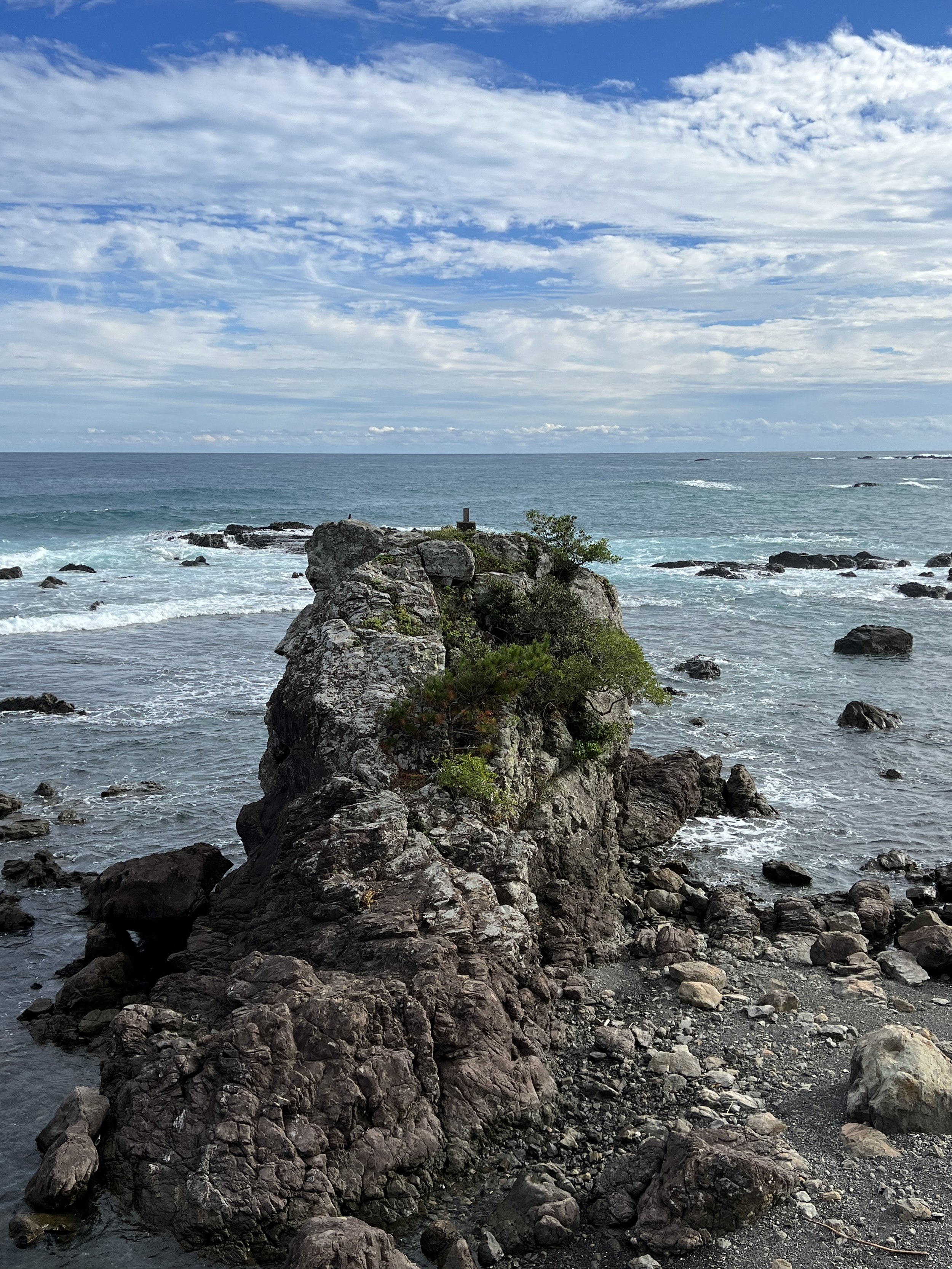
I was flagging a bit this afternoon, when we passed a car parked by the side of the road with its blinkers flashing. no one was in the car, but I happened to look back out to the ocean to see a tall rock standing by itself with a small funeral monument on top. As we came closer, I saw a well-dressed man with a phone in his hand leaving the bottom of the monument and clearly returning to his car after having paid a visit. I don’t know what relation the person memorialized there was to him, but I could feel in the moment that this, too, was a kind of Temple. There are temples between the temples, it seems, at the heart of this pilgrimage.
It’s a long haul from temple 36 to temple 40, but it’s not without its great teachings. I am grateful to feel stronger and to know that apparently this period of training has not been for nothing. I am grateful to see the ocean and to listen to her steady pulse. I am grateful to be moving forward, and also to be nearly halfway done. And most of all, I am grateful to be at the center of this walk, just a day away from walking Cape Ashizuri, with fewer burdens than I’m used to carrying, here and perhaps in general. I’ll be keeping an eye out for my loved ones who have died as I walk. And I’ll be listening and feeling for the heartbeat at the center of this pilgrimage, and for the temples between the temples.







 Walking and Praying
Leave a reply to Kirsten Cancel reply