
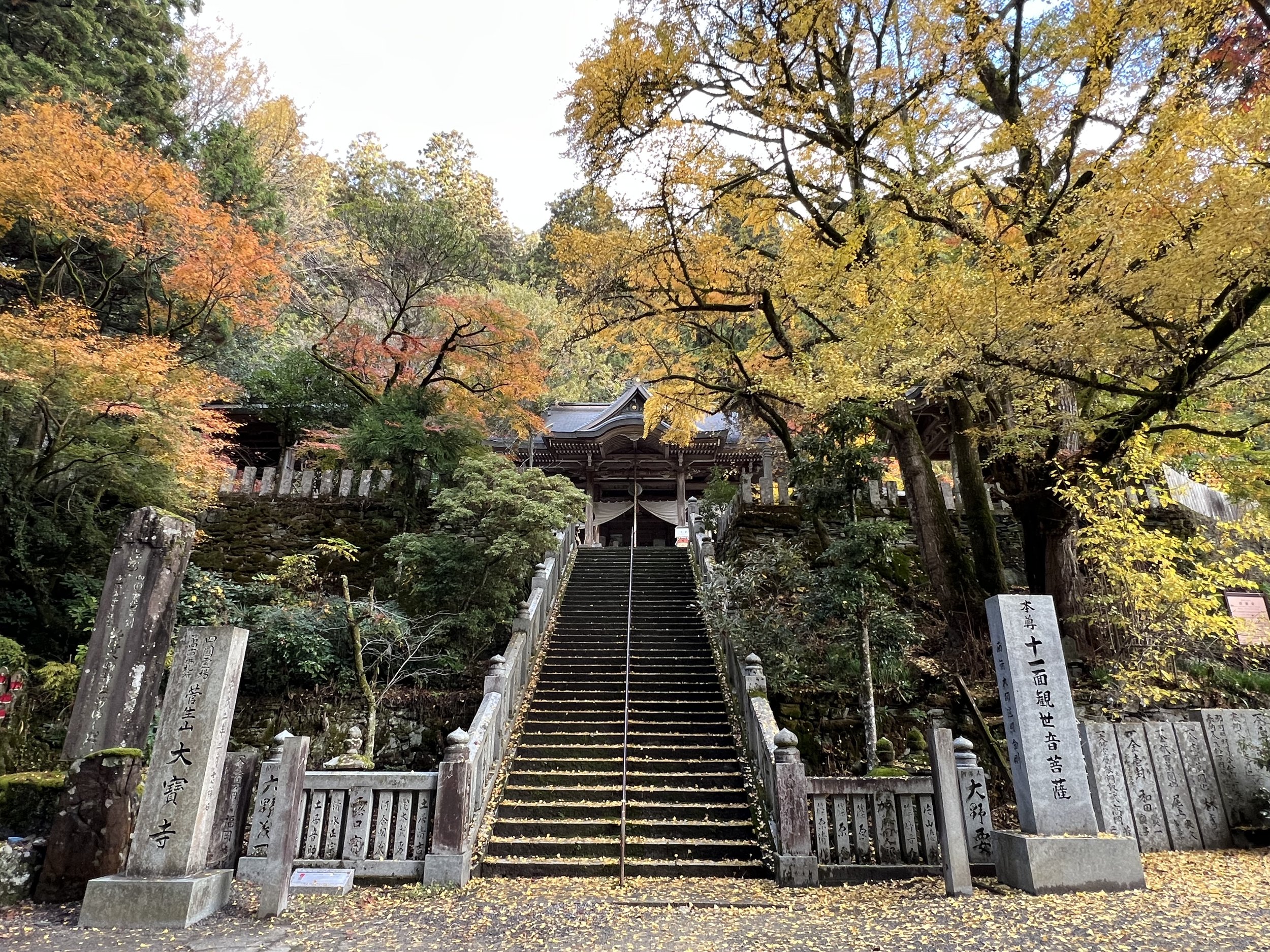
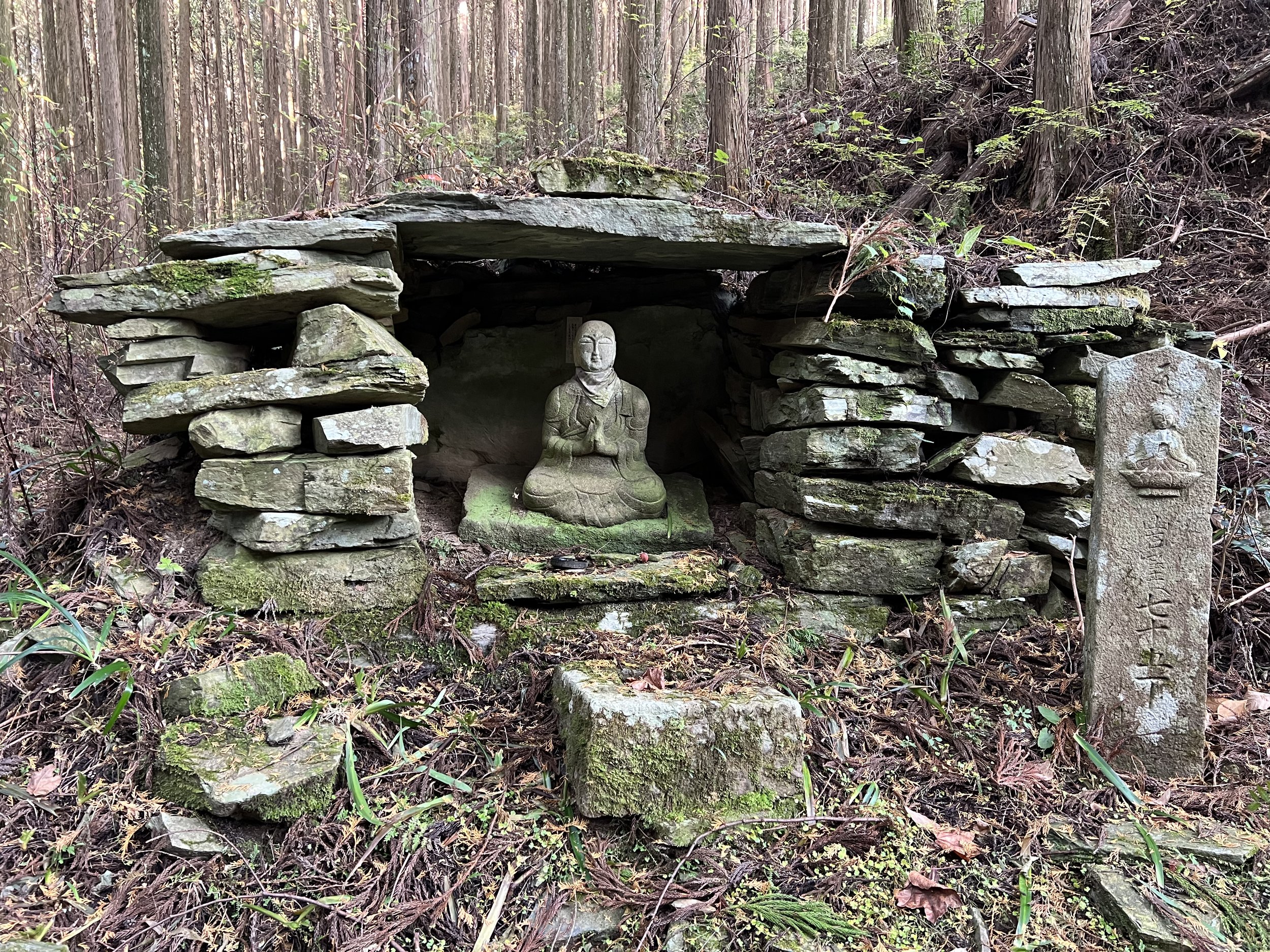
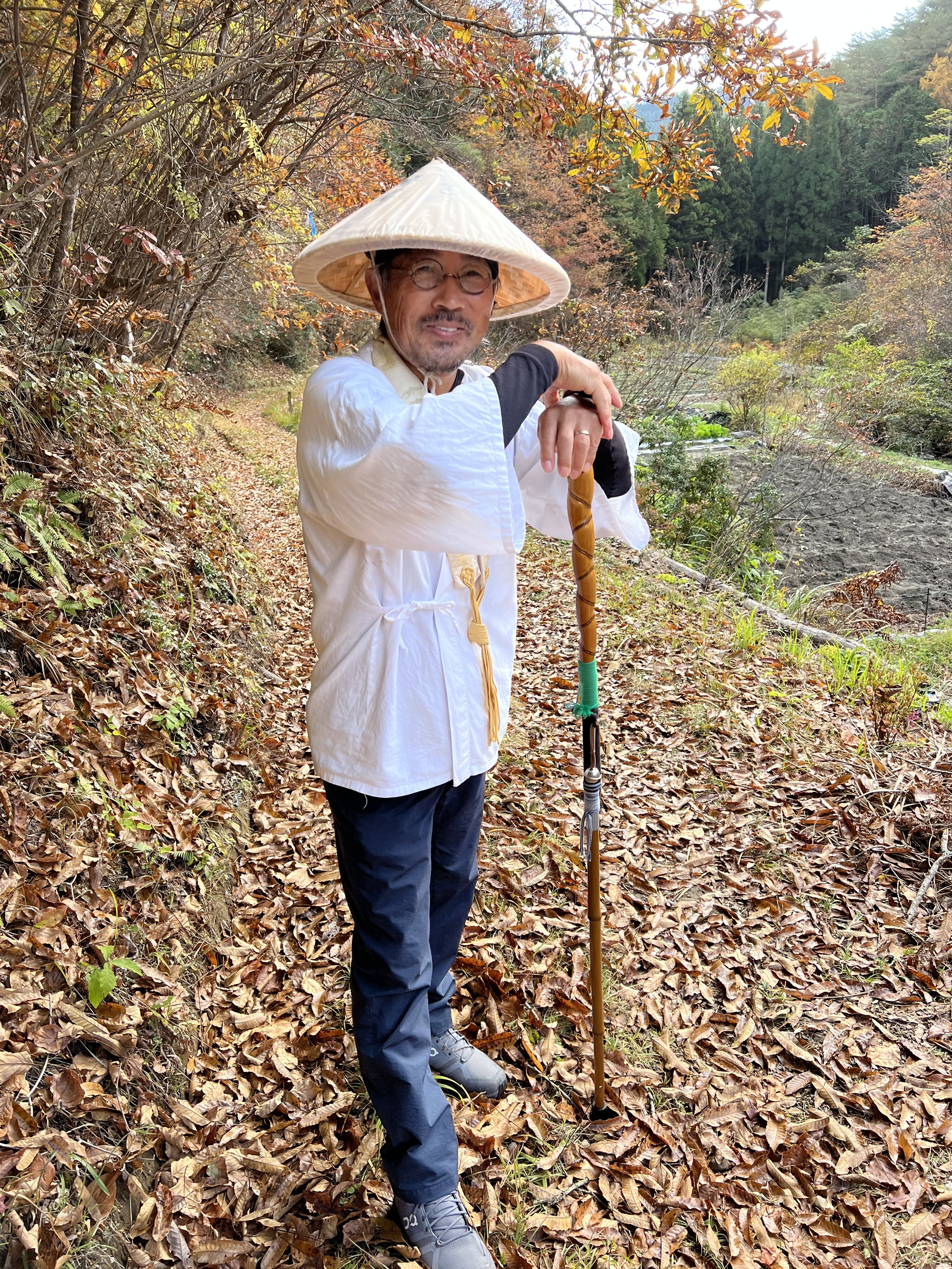
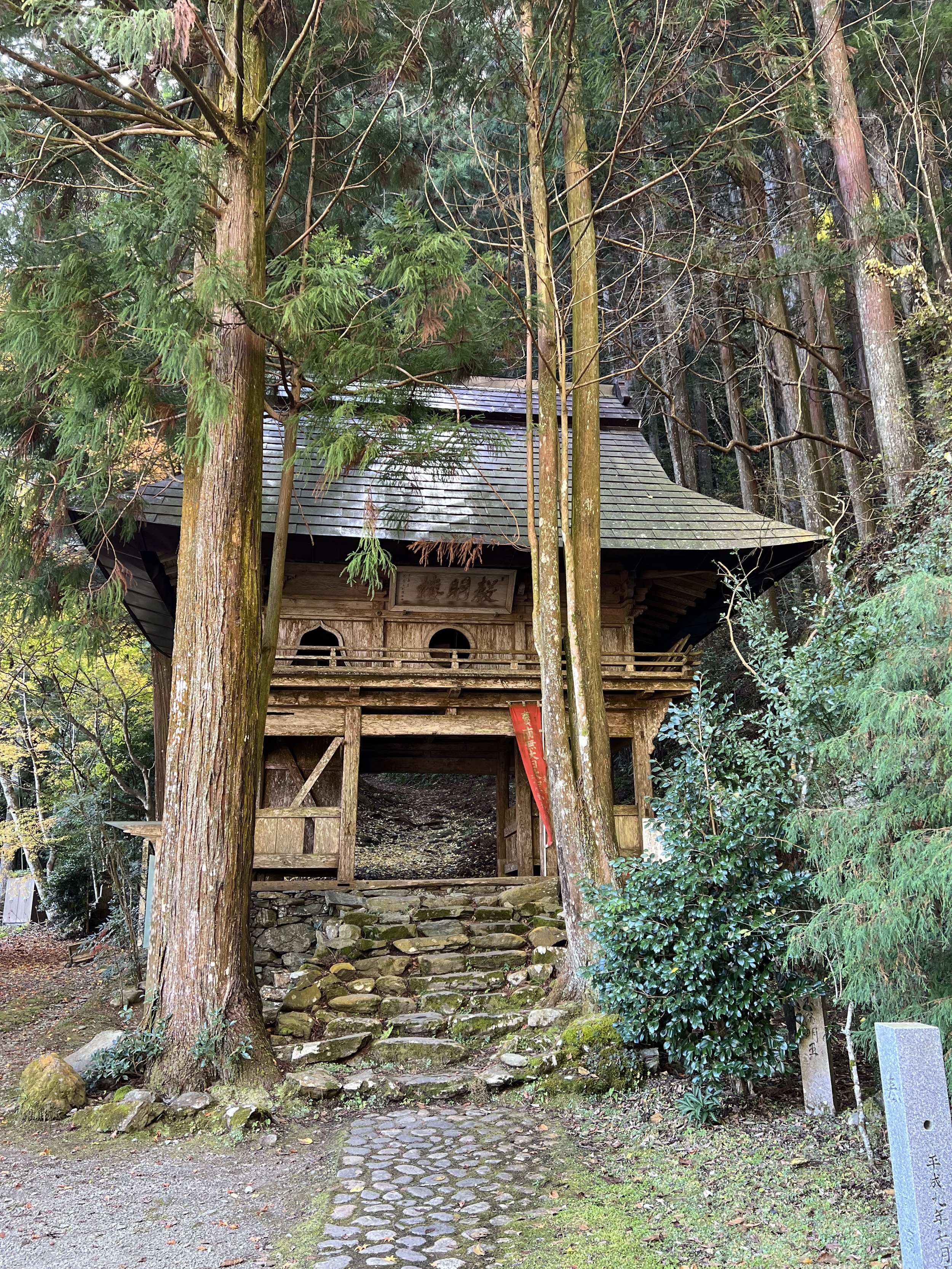
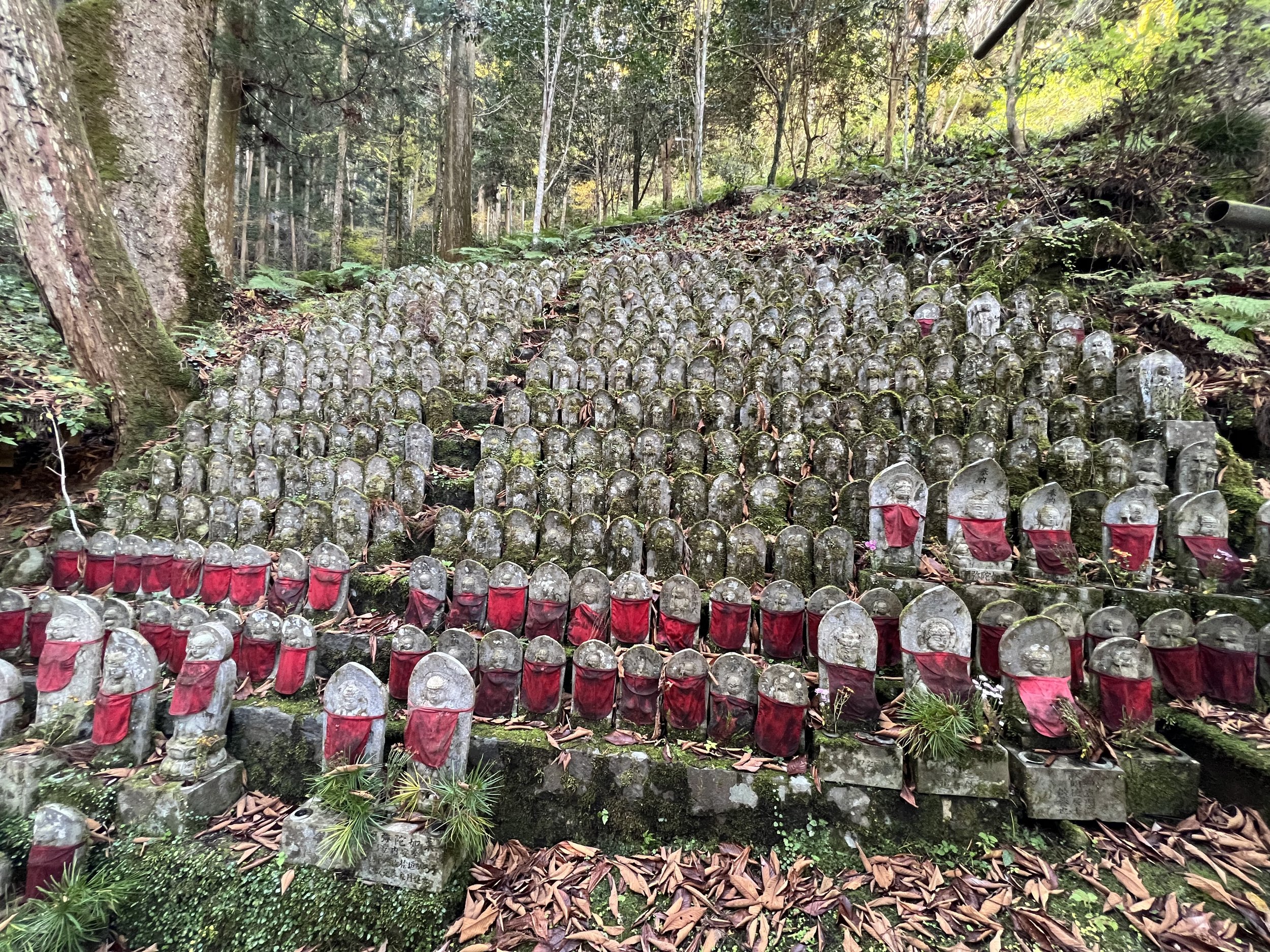
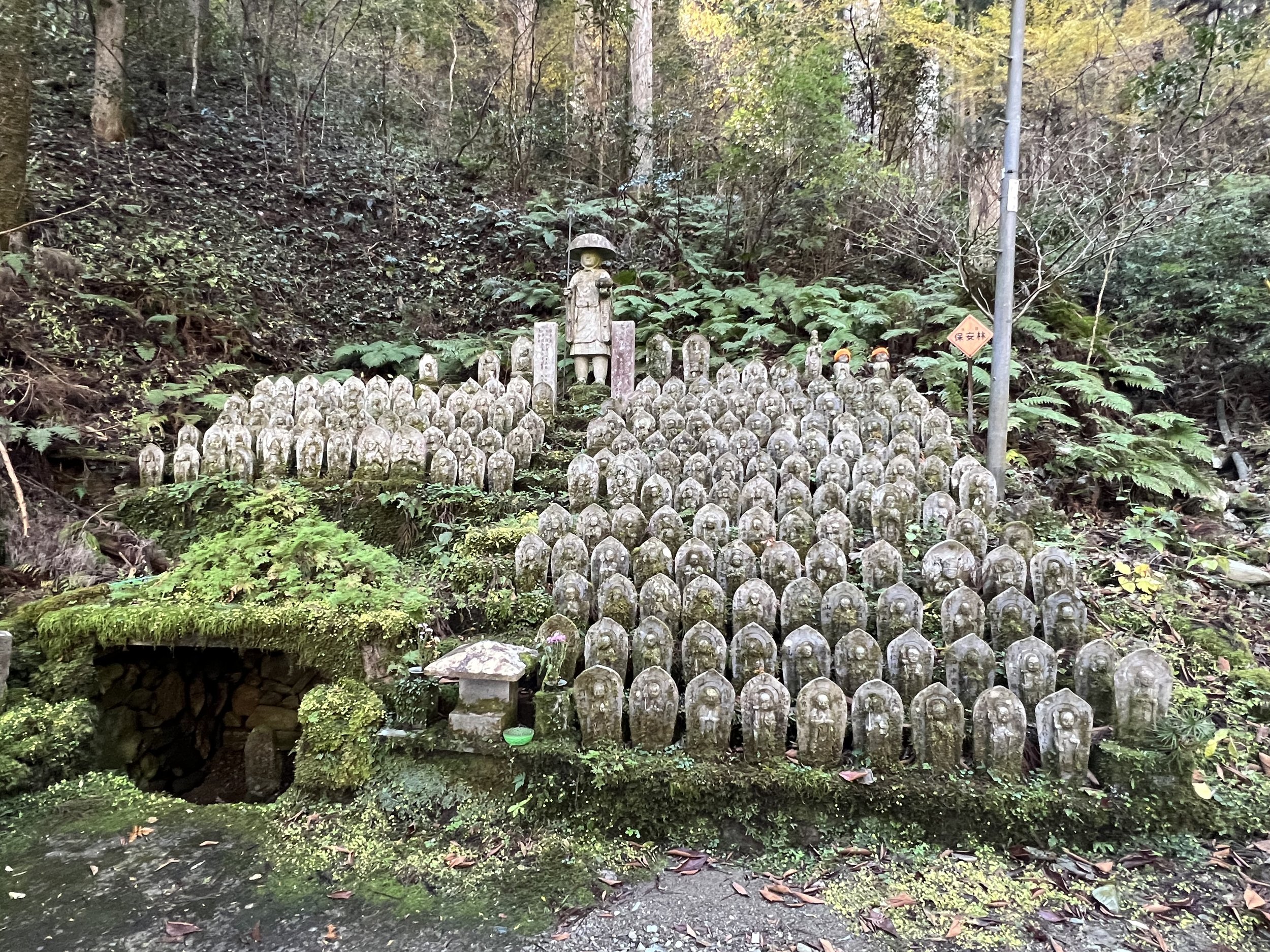
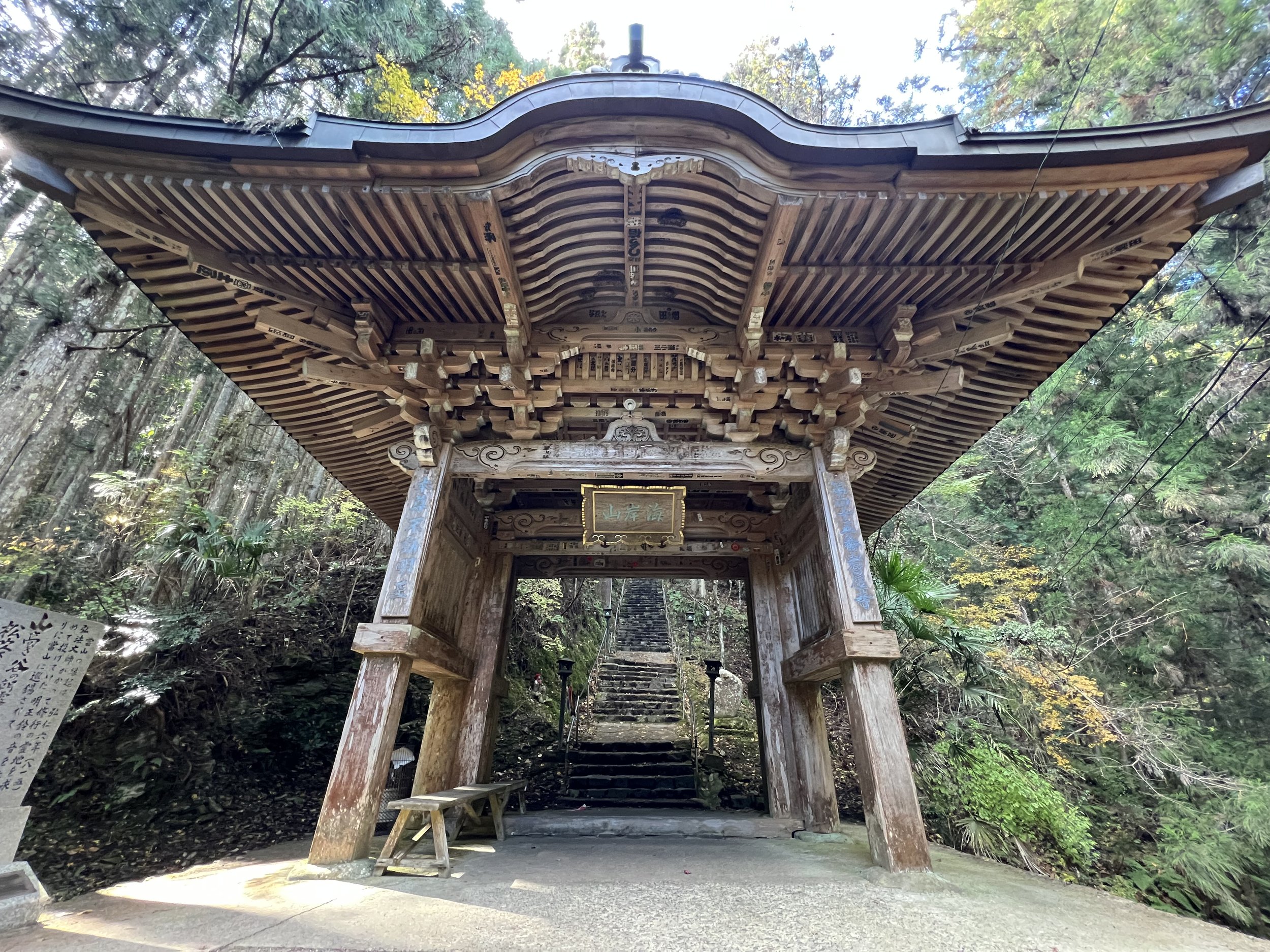
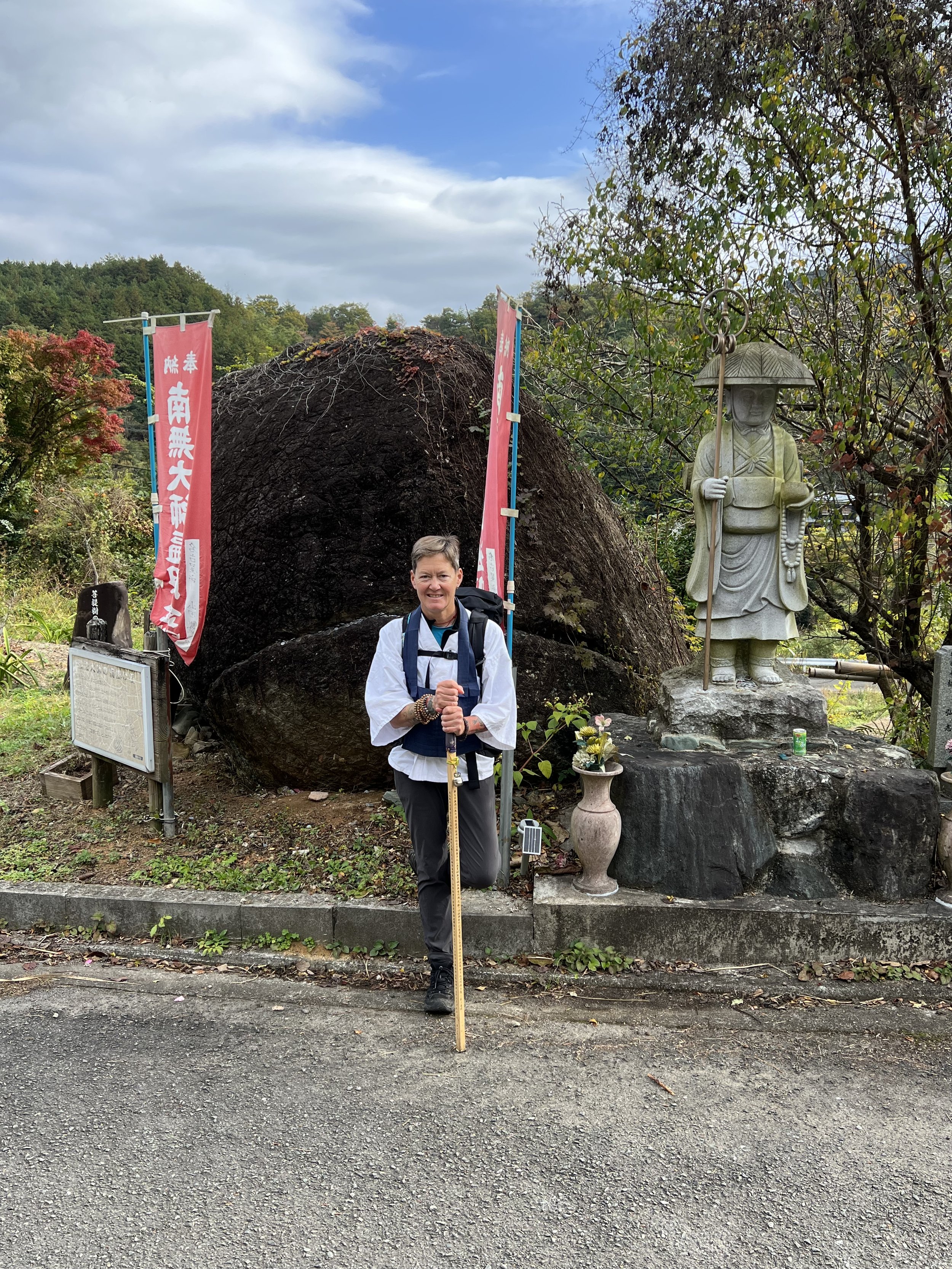
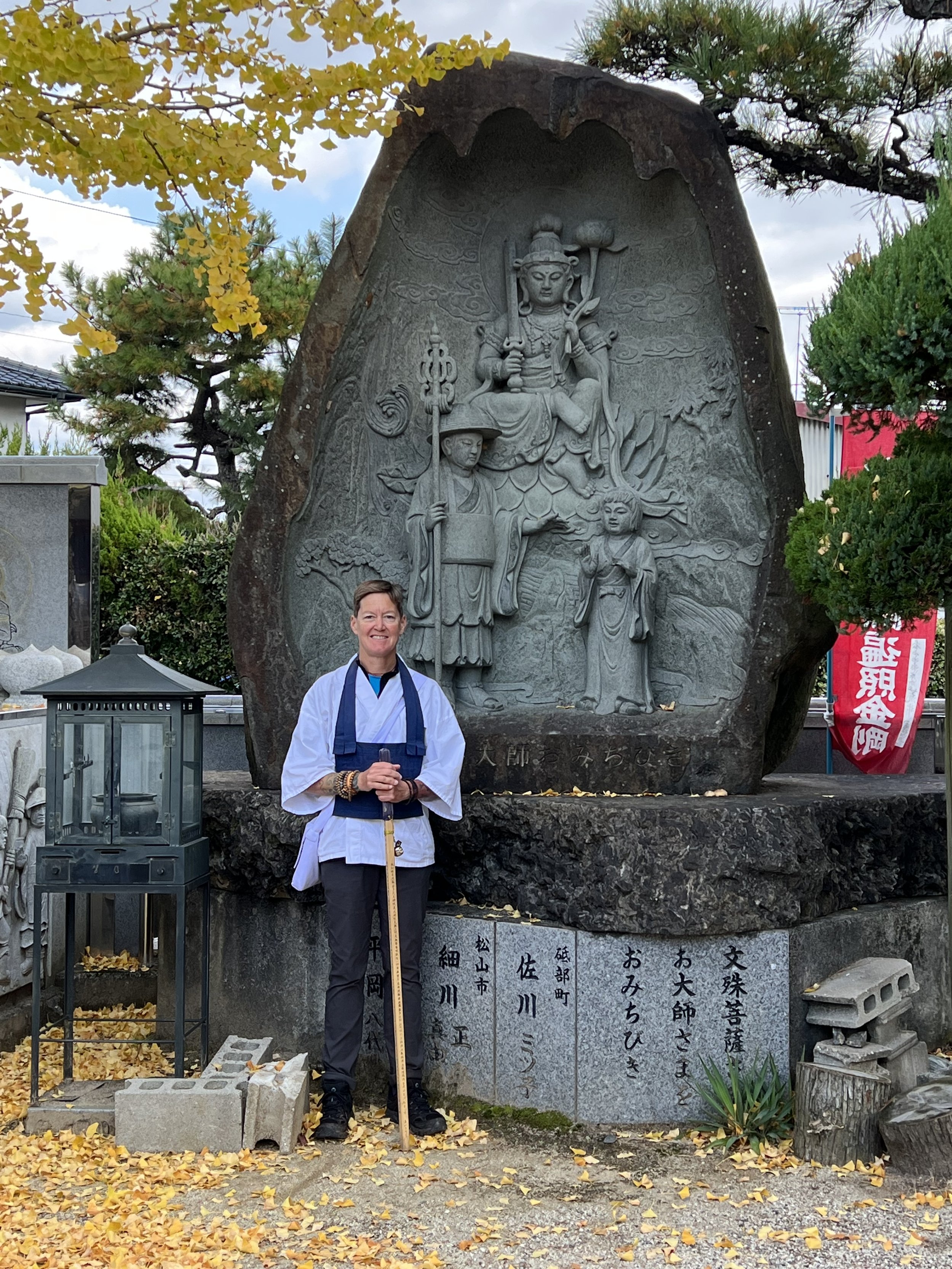
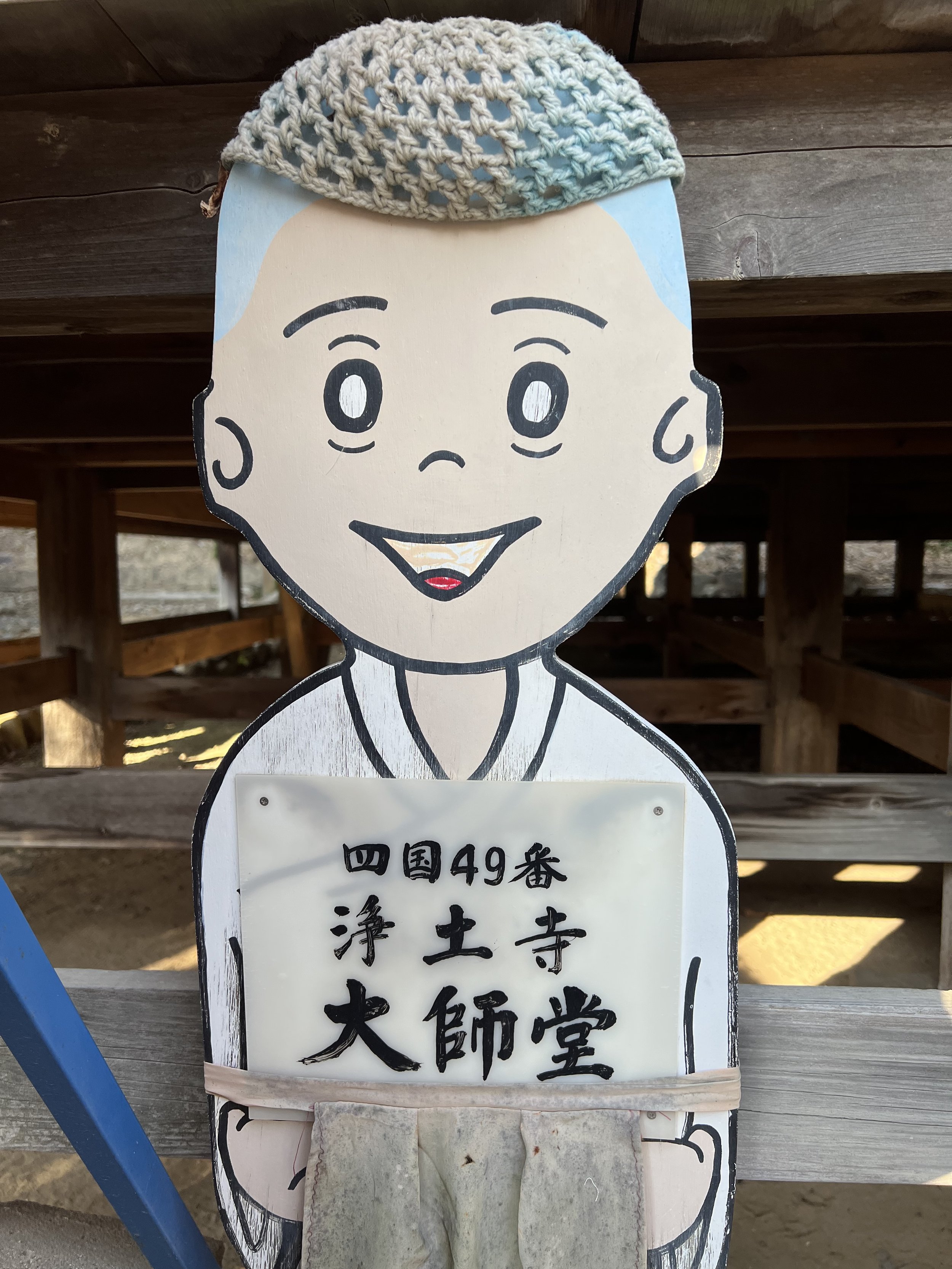
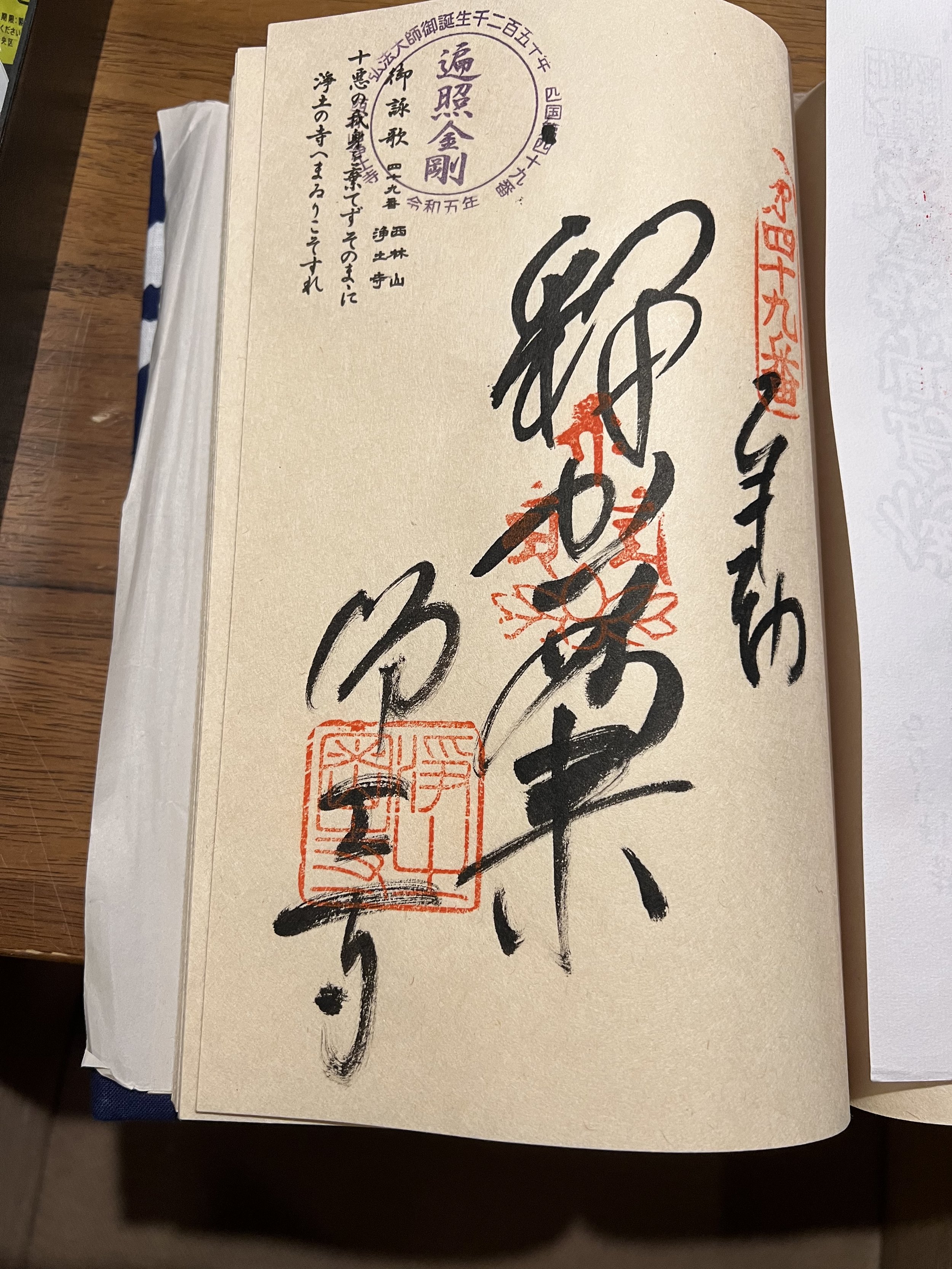
Today was the last day of my pilgrimage on Shikoku—at least for now. The contrast between the last two days was marked. Yesterday was nearly all off trail, climbing over mountain passes and back, without packs, from temple 44 to 45 and back to the same inn. It was a bright November day and the foliage in the mountains was going off. For one day, anyway, this really kind of was a “nature walk.” Today was a long but lovely highway walk, covering temples 46-49. It was cold—we started our walk in the 30s—and largely overcast. In the middle was one of the Bangai or “extra 20” temples, devoted to Manjushri. We walked up and over a mountain range on the highway and descended into the big city of Matsuyama, visiting all five temples on the way. At temple 49, Jōdōji, I followed the forms for retiring from the pilgrimage and bowed out from this 33-day excursion. I’ll still be walking and praying in the days to come, with nearly a week to explore Kyoto and visit who knows how many historic temples and monasteries. Still, it’s true to say that in a way, the formal portion of this now 15-week pilgrimage is over.
While we never announced to anyone that these would be our last days on Shikoku, I’d swear someone was blowing our cover. One very strong theme was a string of gifts—described in English to us by person after person as “presents”—from a varied group of people with whom we crossed paths. We spent two nights at a strange and nearly deserted minshuku near 44 with no food, no wifi, and not even any beer. Yet when we arrived back after seven hours from 45, muddy and kind of beat, the solitary tee-totaler inn owner presented me with a piece of paper that said “BEER {indecipherable kanji} PRESENT.” He also just kept saying, in Japanese, the number six—even I got that part—and we thought he meant, come at six for beer. But he eventually ushered us into the COVID-bereft dining room, dusted off a table, and handed us a six-pack of Asahi and a bag of something crunchy and salty. Then he walked away. Presents.
Today, more of the same. At the Manjushri temple, I went in to get a special calligraphy stamp from the young priest, who clearly didn’t get a lot of stamp business. He had a little chihuahua in a pen in the back, and I was talking with the dog, when he came running up and handed me two printed pieces of fabric he’d grabbed from the shelves of his little gift shop. “Presents,” he said, bowing and laughing. Just before this, I had crossed paths with a woman praying outside the temple, and as we walked to temple 48, not 15 minutes later, a car came barreling down the street and she jumped out with a shopping bag. Somehow in that time, she had procured four cans of coffee, a bag of salty snacks (love when these come with the drinks) and a bunch of chocolate, which Dave appreciated. “Presents,” she said, as she bowed, hopped back in the car, and drove off.
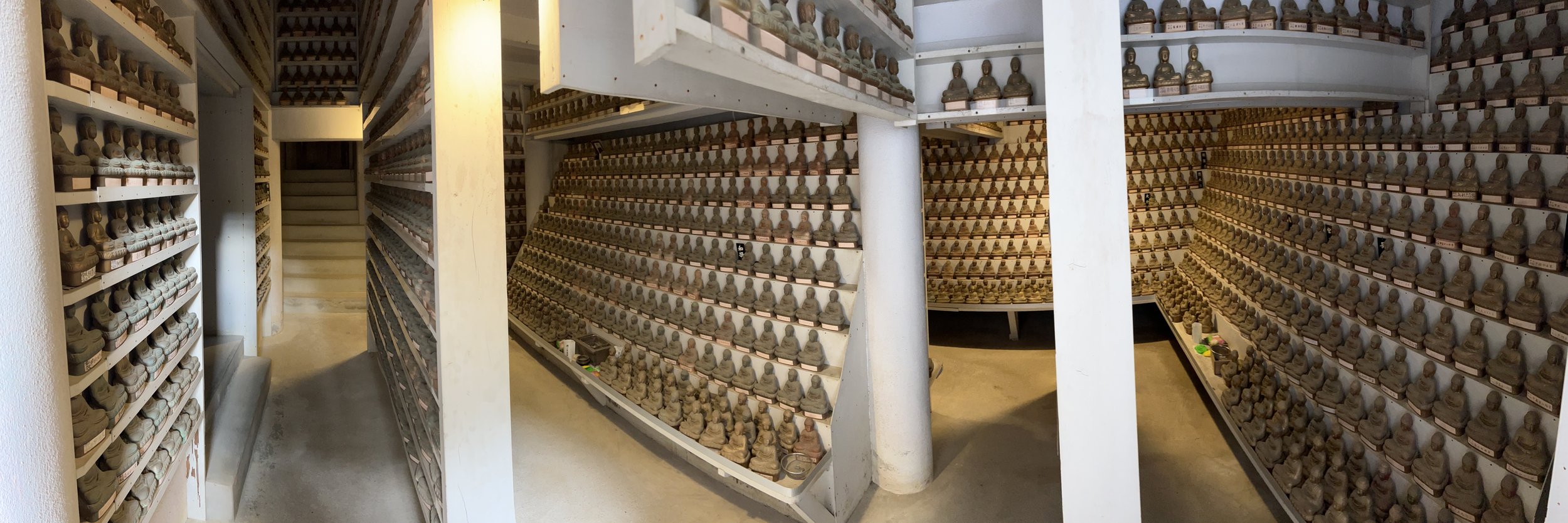
The last instance was just as good, if not better. At the convenience store where we got breakfast in the freezing sunrise, we saw another Henro, an old guy with a green bandana on his head, who had clearly spent the night sleeping out. We didn’t interact much there, but we kept crossing paths all day at the temples. Eventually we learned that he is 87 years old and has completed the Henro 26 times, once a year. He takes 35 days. That means he walks 35 km a day. He told Dave that he must do it again next year when he’s 88–88 temples at 88 years old. 1140 km. Unbelievable. At temple 48, I returned from my devotions to find him chatting with Dave. He handed me a tiny china statue of Kōbō Daishi. I eventually understood that he had made it—and 6,999 others, which he had distributed all across the temples and given to other Henros. I suppose at this point I don’t need to tell you what he said as he handed it to me, bowed, shouldered his pack, and walked off: “Presents! Have a good day!”
Staying present on the last day of a 33-day pilgrimage is not easy. Staying present on the last day of a 15-week odyssey, and also when you’re retiring early? Also not easy. Still, it felt as if all of Shikoku was conspiring to help me find ways to stay right here, in presence, and to feel showered with the gifts of this place on my way out the door.
There were plenty of other significant and unexpected wonders in the past two days. The foliage was heaven-sent on the mountain, restoring my spirit and sense of awe. We ran into Ito-san one last time on the way up, and he reiterated his offer to escort me “when” I come to complete the circuit. Happening on a Manjushri temple on our last day was another unexpected gift. He’s central to my own lineage and practice, and anyway, he’s the one who helped me get my phone back. It was important to take time to thank him and receive his blessing. And, finally but not finally, Temple 49, the last on our foreshortened pilgrimage, is devoted to Shakyamuni—just like temple 1. There are only four Shakyamuni temples on all of the Shikoku Henro route. I seem to have completed a circuit, after all. The Buddhas and ancestors are clearly in charge of the itinerary. And attentive readers will not have missed the significance of the number 49: as I wrote earlier, 49 is the number of days it’s said a consciousness takes to travel through the Bardo state. I was supposed to spend 49 days in Japan—now it will be more like 42. But I finished my circuit—and my time in the Henro state—at number 49 after all.
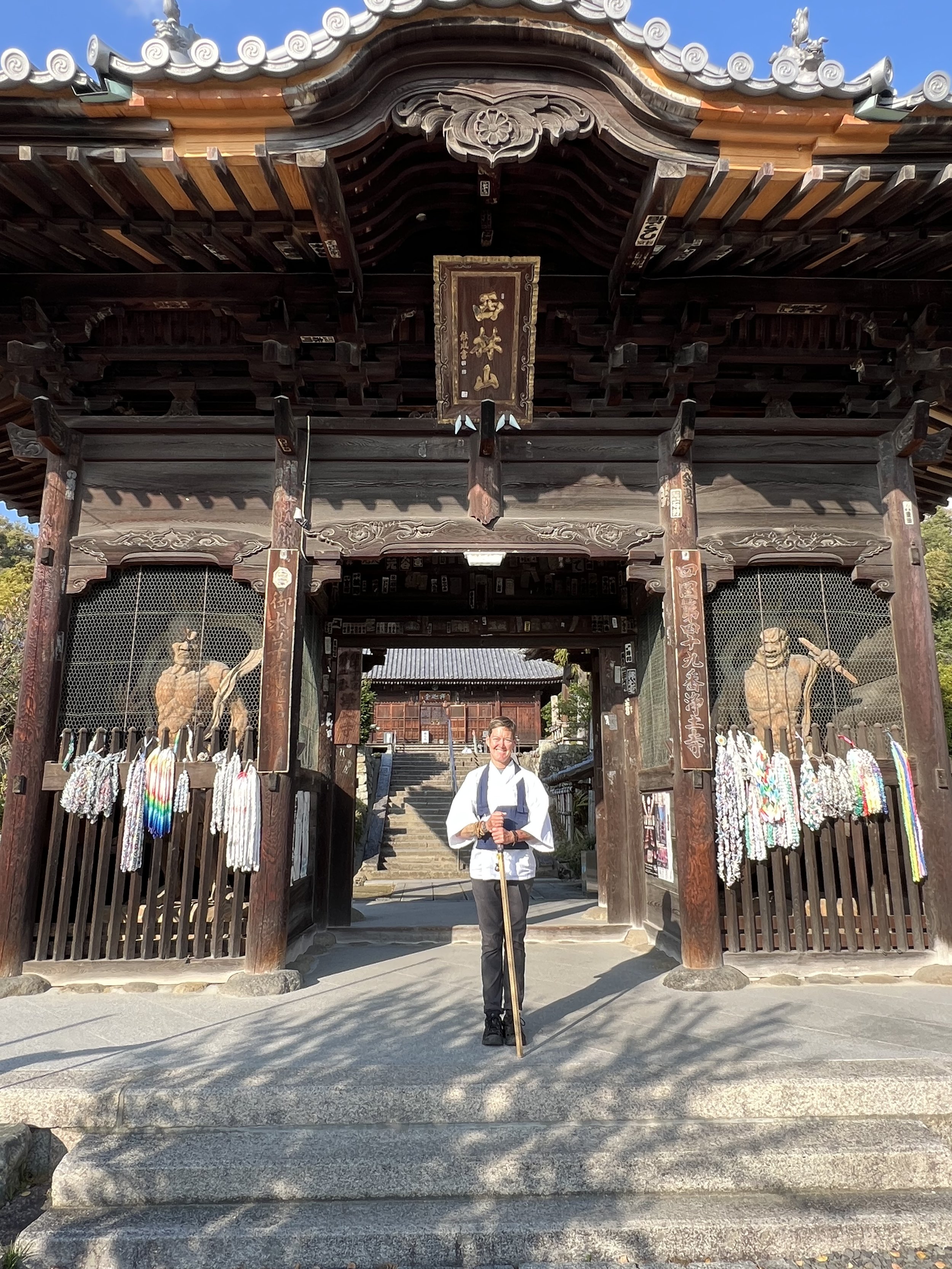
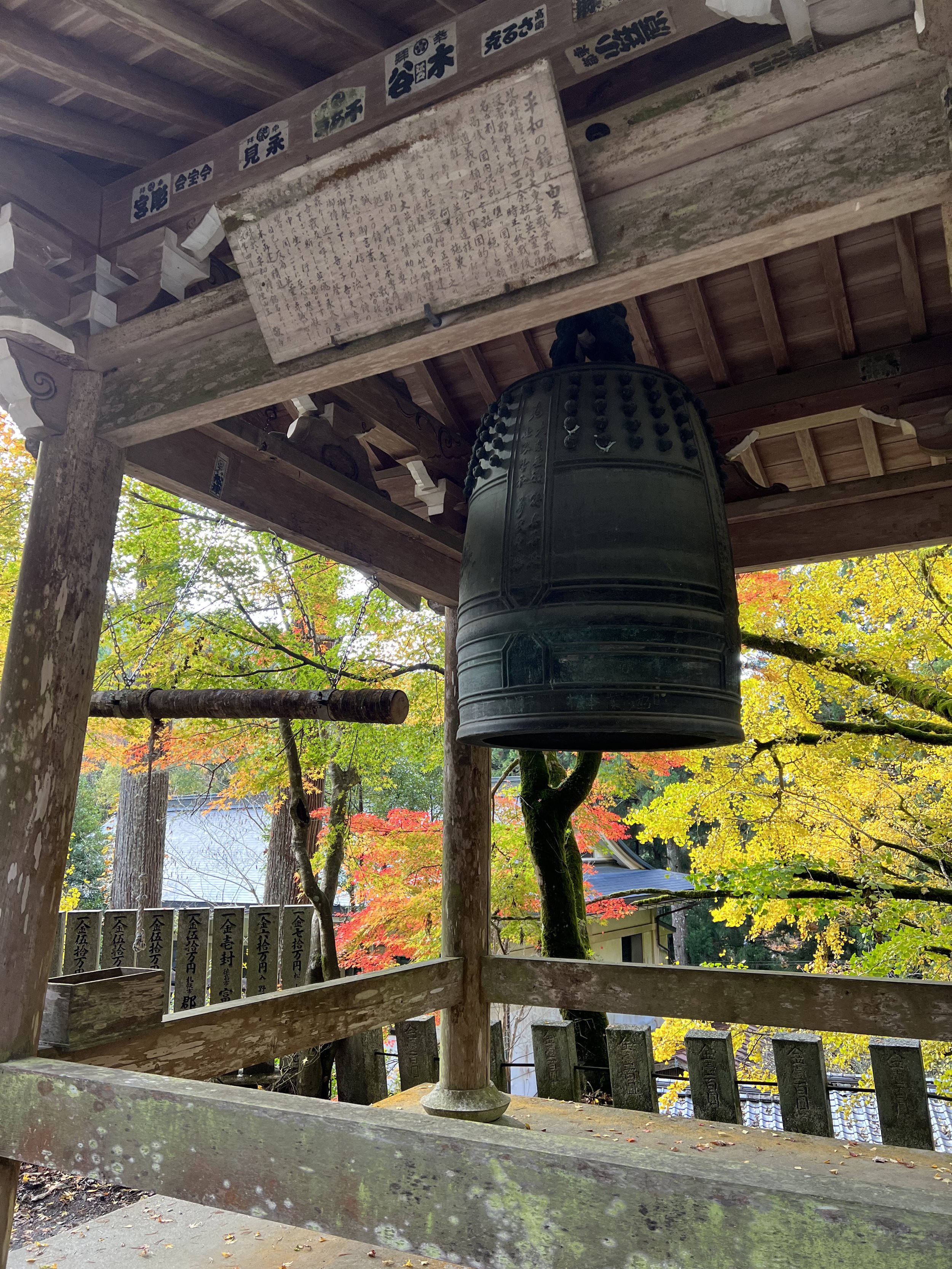
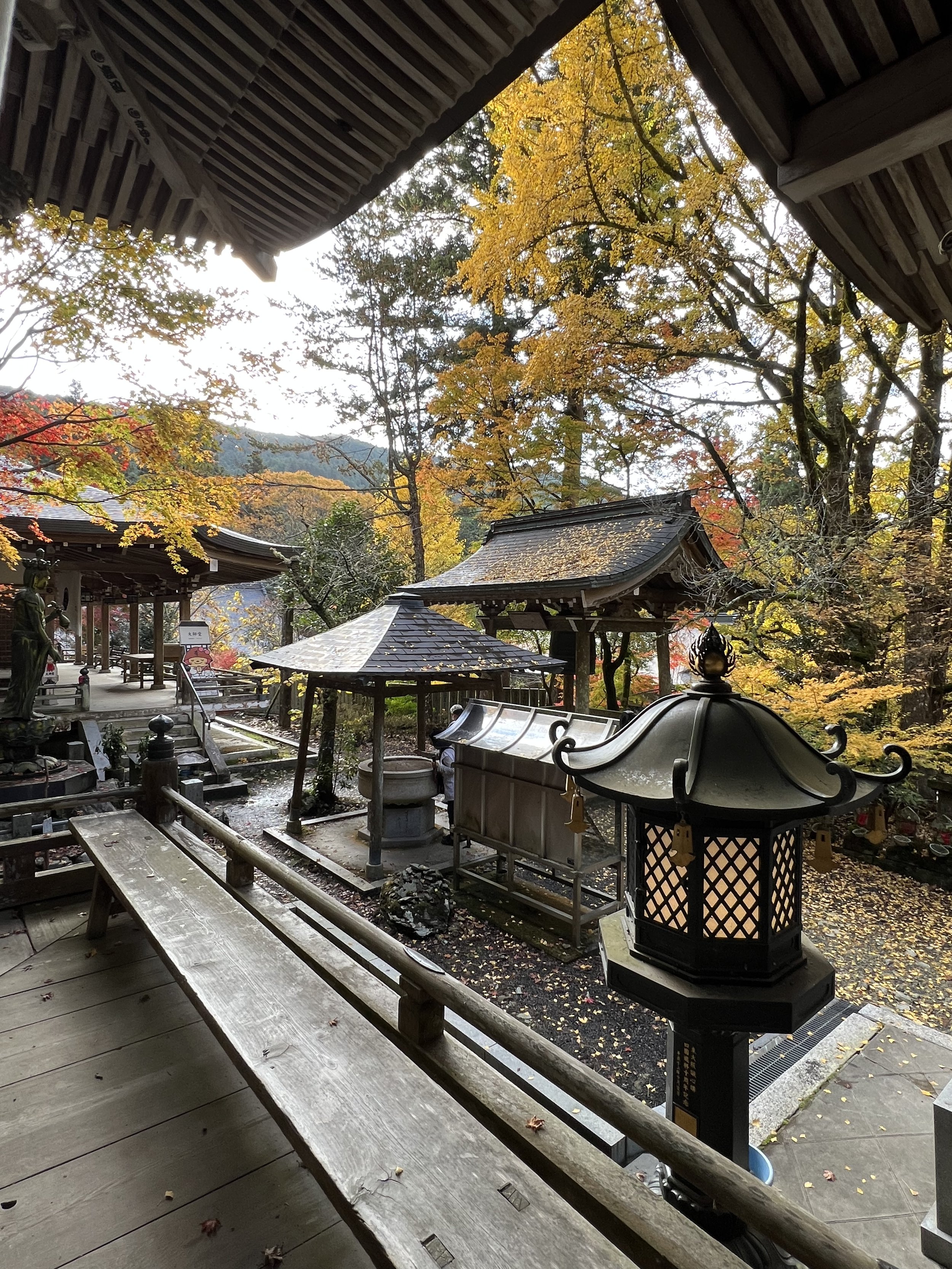
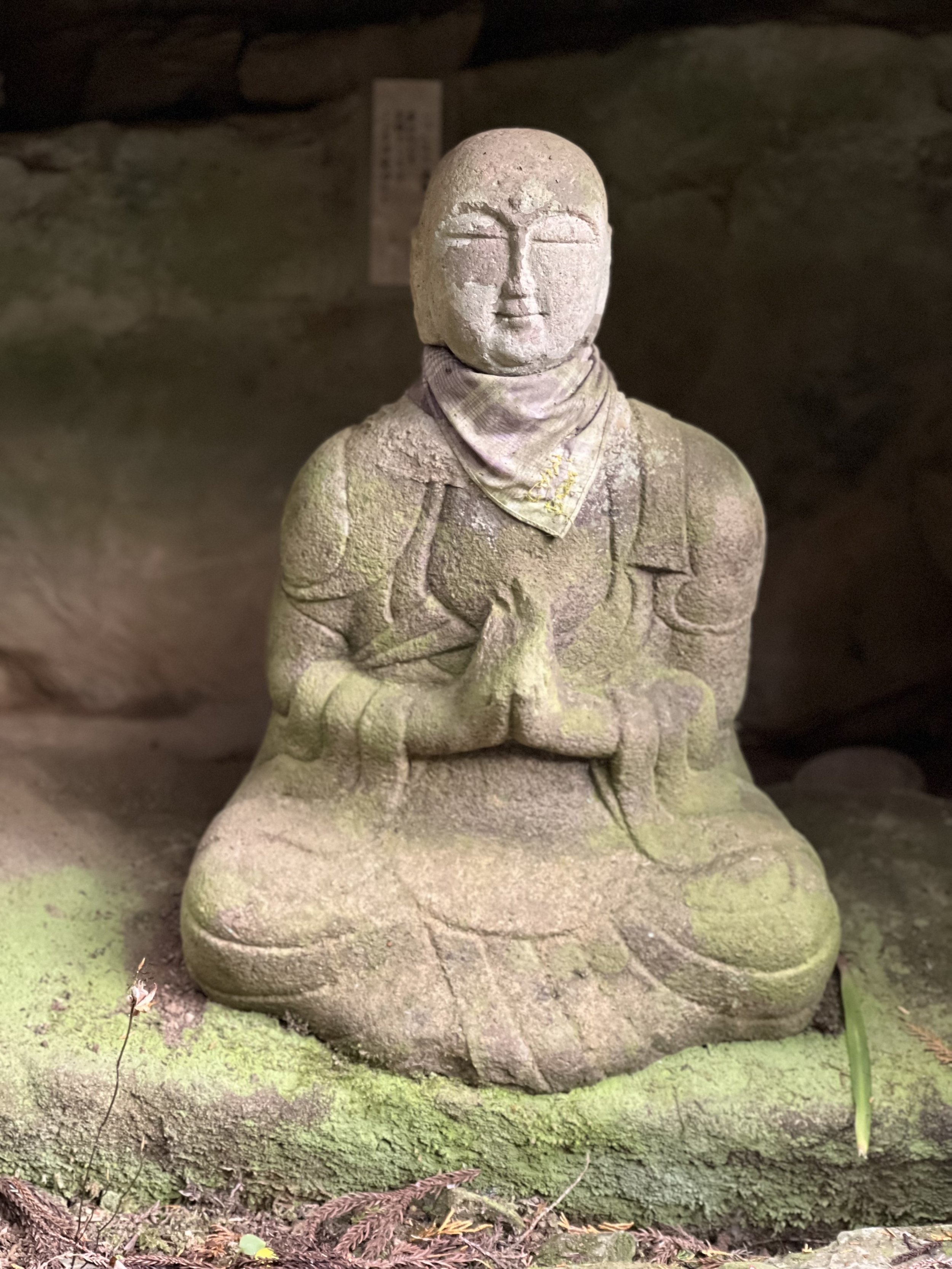
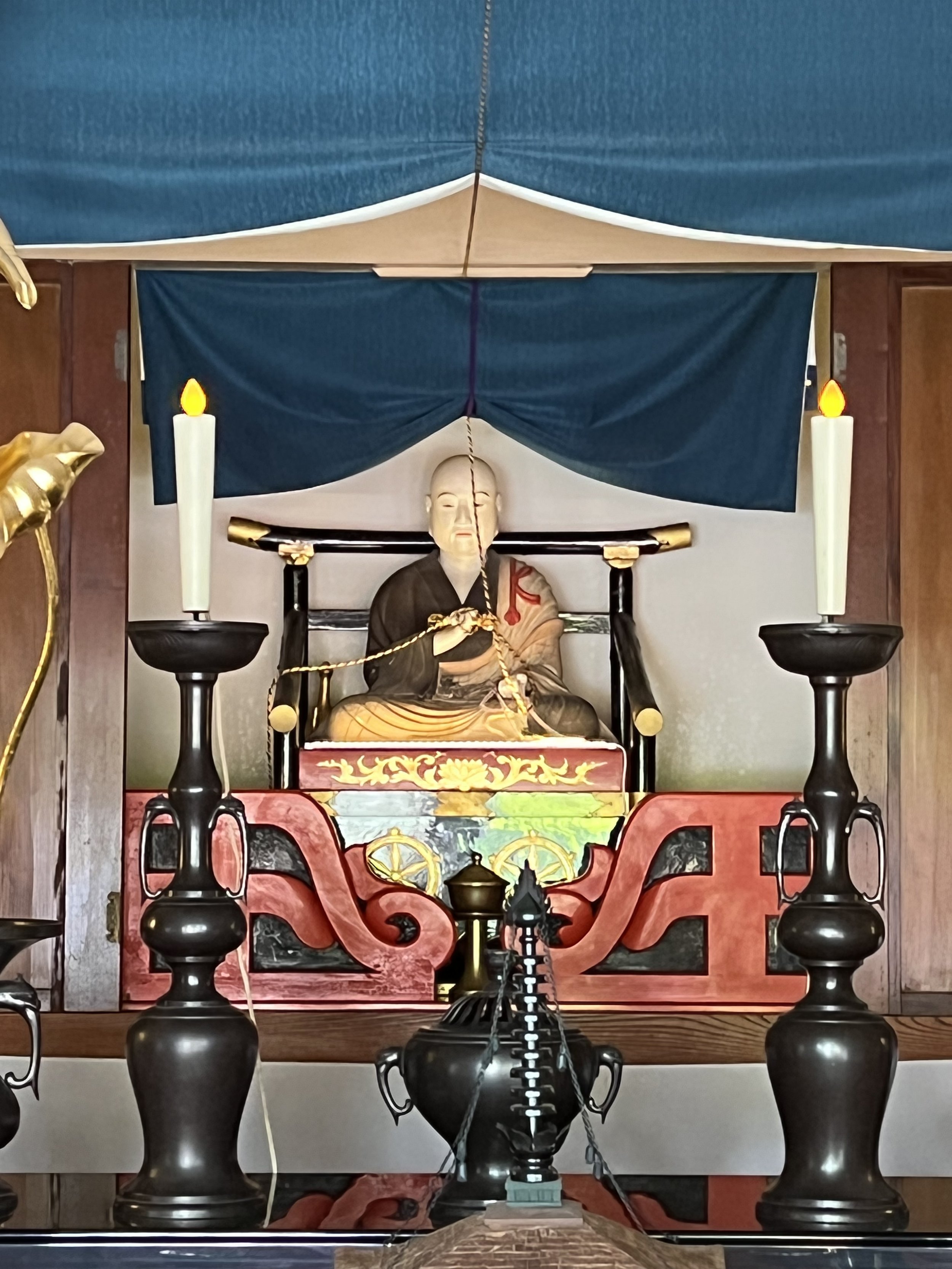
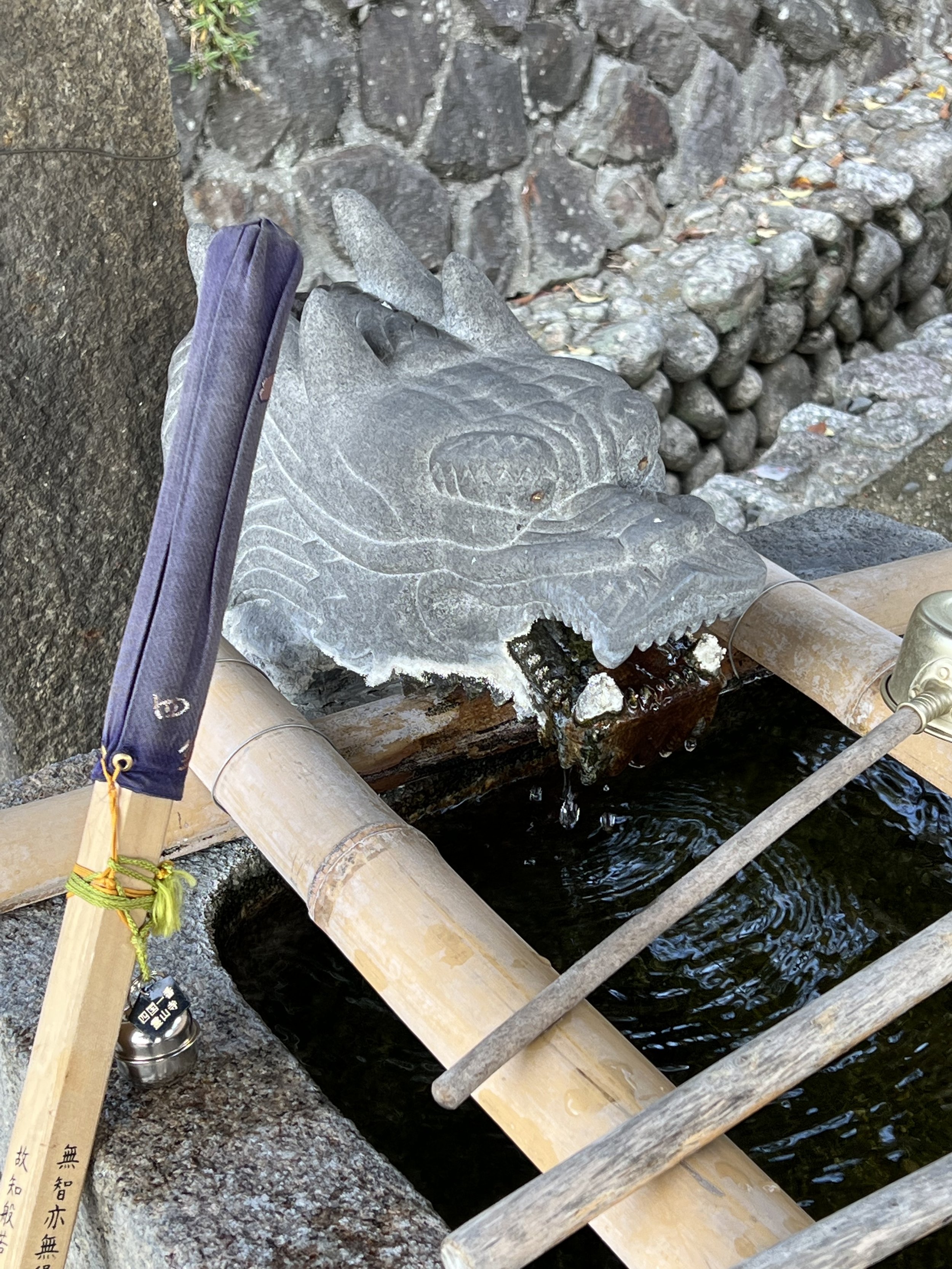
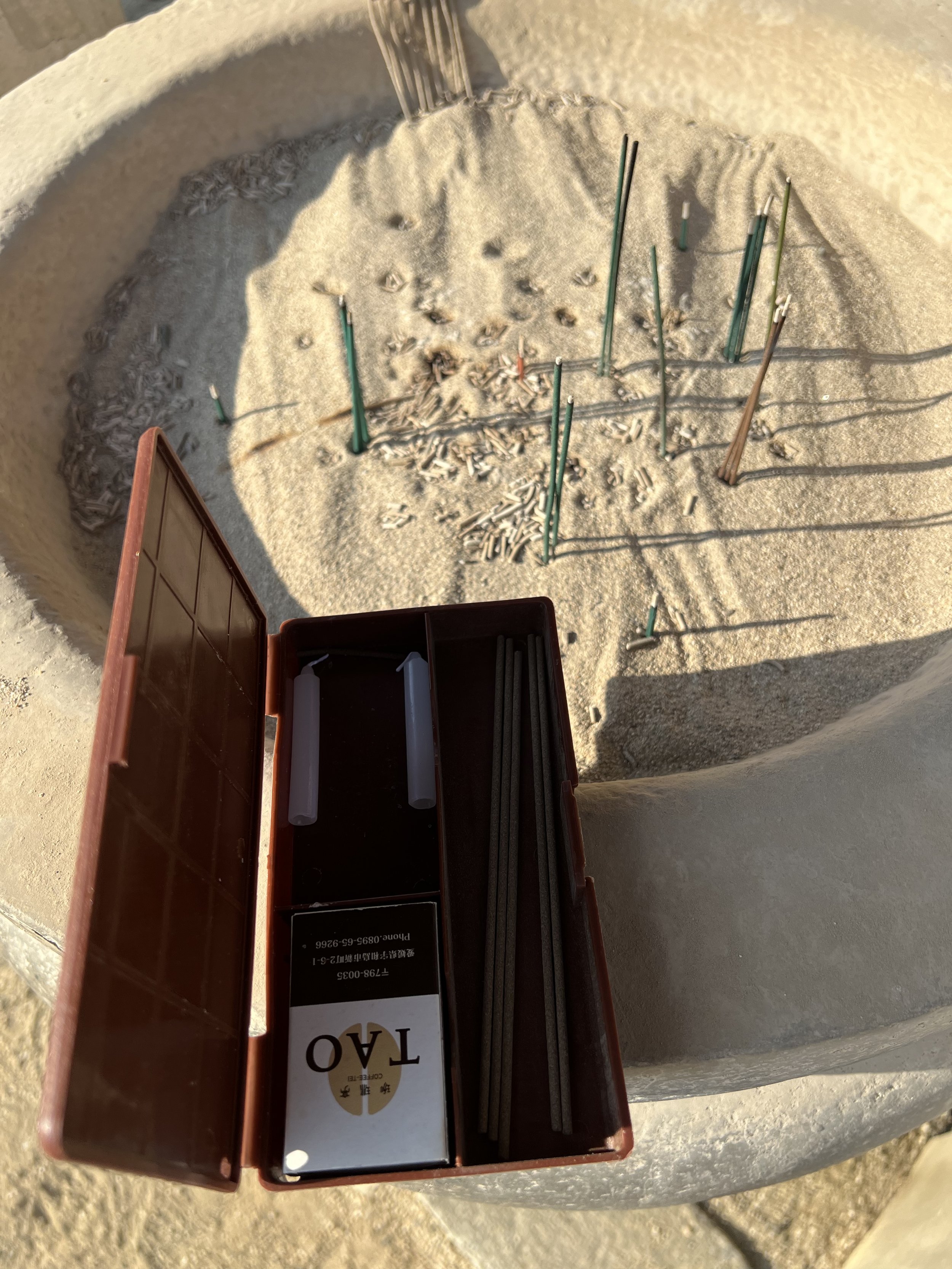
There were some extra ceremonies to attend to at the last temple, and I’m grateful to Banana Slug Don, who had prepped me, unprompted, on the forms. I did the usual rituals, washing, ringing the bell, leaving name slips, and chanting the Heart Sutra at the main Shakyamuni temple and the temple to Kōbō Daishi. I was just one stick of incense short at the very end, and I asked the Daishi to forgive me for only offering two. I was still offering all I had. I then stayed on for a bit to thank the Daishi for my journey and to let him know that I needed to retire. I stated my intention that I’d be back, and that when that happens, I’ll return to temple 49 to let him know I’ve returned to restart the journey. After that, I removed the cloth covering and bell and left my walking stick outside the Daishido. Hard as it was to part with it, I love knowing it will be burned at New Years with all the other ritual objects accumulated during the year. This business done, I got my final stamp, bowed at the great gate, and left.
We ended the day and our journey at a “spa” hotel near 49, on the outskirts of Matsuyama. We had not been able to find any accommodations nearby, and, for the only time in our trip, I jumped on the web and booked the hotel myself a couple of weeks ago, having no idea this would be our last night on the pilgrimage. Our check-in was bumpy. They told me—for the first time in my five weeks in Japan—that I couldn’t use the baths because of my tattoos. I could only laugh. Japan will keep you humble—that’s for sure. Still, Dave had secured my good humor earlier, when we walked by the hotel, saying, “I think you’ll like this place.” “Why,” I asked, thinking he meant something about the spa. “The name: Takanokono. Taka is hawk; noko is youth or offspring. Takanoko means, child of a hawk, or young hawk. Both and either.”
So there it is. You can’t make this stuff up. The hawk people have guided and lifted me every day in Japan, as they have for all the years of COVID. They are the wise ones who appeared in the Winter of 2020 to warn of something new on the horizon, and I don’t think a day has passed in close to three years without a visitation from these ancestral winged kin. Tonight I’m enjoying the thought that I’ve landed back with my people, fledged but not yet fully grown in the Dharma. I’ll keep looking for their companionship and receiving their teachings. And when I return to Shikoku, I know the Buddhas and ancestors, the kites and ospreys, and Kōbō Daishi himself will be here to receive me.















 Walking and Praying
Leave a reply to Fayal Cancel reply